












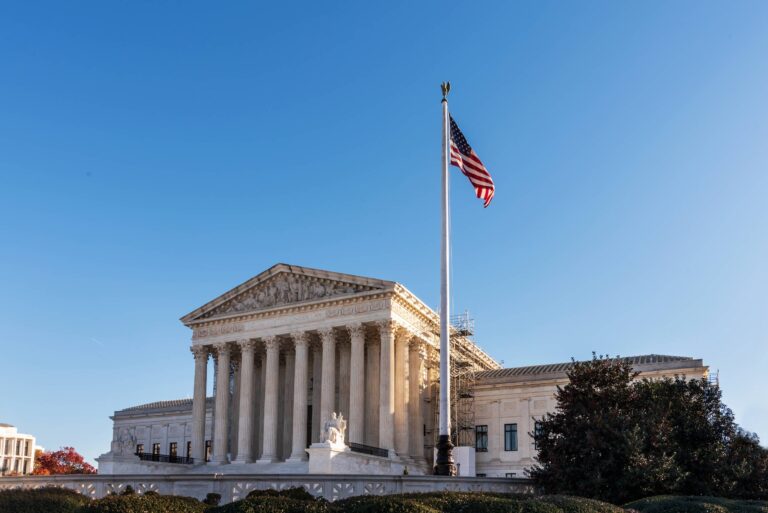
The U.S. Supreme Court on Wednesday struck down Louisiana’s second majority-Black congressional district in Louisiana v. Callais, issuing a major voting rights decision that could reshape the state’s congressional map, place U.S. Rep. Cleo Fields’ seat in jeopardy, and make it far harder for voters to challenge maps that dilute Black political power.
In a 6-3 opinion written by Justice Samuel Alito, the Court held that Louisiana’s current congressional map, known as SB 8, is an unconstitutional racial gerrymander. The map created a second majority-Black district after years of litigation over whether Louisiana’s previous congressional map violated Section 2 of the Voting Rights Act by packing Black voters into one district while splitting others across five majority-white districts.
The Court concluded that the Voting Rights Act did not require Louisiana to create an additional majority-minority district. Because of that, the conservative majority found that the state had no compelling legal justification for using race in drawing the new map.
“Because the Voting Rights Act did not require Louisiana to create an additional majority-minority district,” the Court held, “no compelling interest justified the State’s use of race in creating SB8.”
The ruling does not formally strike down Section 2 of the Voting Rights Act, the provision that allows voters to challenge election laws and maps that dilute minority voting power. But it dramatically narrows how Section 2 can be used in redistricting cases.
Under the Court’s new framework, plaintiffs challenging a map must do more than show that Black voters are politically cohesive, that white voters usually vote as a bloc against their preferred candidates, and that a reasonably configured majority-Black district can be drawn. The Court said plaintiffs must also produce alternative maps that do not use race as a districting criterion and that satisfy the state’s other “legitimate districting objectives,” including partisan goals and incumbent protection.
The Court also said plaintiffs must control for party affiliation when proving racially polarized voting, a requirement that could be especially difficult in states like Louisiana, where race and party preference are deeply intertwined.
In plain terms, the Court made it much easier for states to defend maps that weaken Black voting power by arguing they were pursuing partisan advantage rather than racial discrimination.
Congressman Troy A. Carter Sr., D-New Orleans, called the decision “a devastating blow to the promise of equal representation in our democracy.”
“This ruling is about far more than lines on a map,” Carter said in a statement. “It’s about whether Black Louisianians will have a meaningful opportunity to make their voices heard.”
The decision lands with immediate consequences in Louisiana. The state’s current map was created after a federal court found that Louisiana’s previous congressional map likely violated Section 2 because it included only one majority-Black district despite Black residents making up roughly one-third of the state’s population.
Louisiana lawmakers responded by passing SB 8, which preserved the existing New Orleans-based majority-Black 2nd Congressional District while creating a new majority-Black 6th District stretching from Baton Rouge through Lafayette and up to Shreveport.
That district helped send Cleo Fields back to Congress in 2024. Fields, a Baton Rouge Democrat, currently represents Louisiana’s 6th Congressional District. The Supreme Court’s ruling now throws the future of that district into doubt.
The majority opinion emphasized that Louisiana drew District 6 specifically to raise its Black voting-age population above 50 percent because state officials believed the Voting Rights Act required a second majority-Black district. The Court said that choice triggered strict scrutiny under the Equal Protection Clause. Because the Court found that Section 2 did not actually require the district, the map could not survive.
The opinion also highlighted the political bargain behind the map. Louisiana did not adopt the illustrative maps advanced by voting rights plaintiffs in the earlier Robinson case. Instead, lawmakers drew a different second majority-Black district that protected the Republican incumbents they considered most important: House Speaker Mike Johnson, House Majority Leader Steve Scalise and Rep. Julia Letlow.
That is one of the central tensions in the case. Louisiana’s Republican-controlled Legislature drew a map intended to comply with a voting rights ruling while preserving as much Republican power as possible. The Supreme Court has now said even that compromise was unconstitutional.
Justice Elena Kagan, joined by Justices Sonia Sotomayor and Ketanji Brown Jackson, issued a sharp dissent, warning that the ruling will make it easier for states to dismantle majority-minority districts across the country. Kagan wrote that the decision “renders Section 2 all but a dead letter” and warned that, in states still marked by residential segregation and racially polarized voting, minority voters “can now be cracked out of the electoral process.”
Carter made a similar point in his response, warning that the decision could affect not only congressional representation but also state and local governments.
“This decision will embolden efforts to dismantle majority-Black districts and fracture communities that have finally begun to see themselves reflected in their government,” Carter said.
The immediate legal path remains uncertain. The Supreme Court affirmed the lower court ruling that struck down SB 8 and sent the case back for further proceedings. That means Louisiana’s congressional map is once again in legal and political limbo, with major implications for the 2026 election cycle.
If Louisiana is forced to draw a new map without the second majority-Black district, Fields’ seat could be dismantled just one election after it was created. The state could return to a map with only one district where Black voters have a realistic opportunity to elect their preferred candidate, despite Black residents making up roughly one-third of Louisiana’s population.
For voting rights advocates, Wednesday’s ruling is not just a setback in one Louisiana redistricting case. It is a warning that the Supreme Court’s conservative majority is increasingly willing to treat race-conscious remedies for discrimination as constitutionally suspect while allowing states to pursue partisan maps that can produce racially unequal outcomes.
For Louisiana, the fight over fair representation is once again headed back to the map-drawing table.
This is a developing story. The Bayou Progressive will update this article as more information and reactions become available.