

The candidates came to the Harvey H. Benoit Community Center on Thursday night to talk about rural hospitals, data centers, wages, infrastructure, agriculture and the grinding affordability pressures facing Northeast Louisiana.
But before the forum could fully settle into policy, the central question of the night was already hanging over the room: Would voters actually be allowed to cast ballots in the congressional races they had come to hear about?
The Monroe stop of the “To The People, For The People” 2026 Democratic Roadshow unfolded less than 48 hours before early voting was scheduled to begin in Louisiana’s May 16 primaries, and just as Gov. Jeff Landry and Republican officials moved to suspend the state’s U.S. House elections following the U.S. Supreme Court’s ruling in Louisiana v. Callais. Ballots had already gone out. Candidates had qualified. Campaigns had spent months organizing under the rules as they existed.
That uncertainty shaped the entire evening.
Conrad Cable, the Democratic candidate in Louisiana’s 4th Congressional District, named it directly when the congressional panel began.
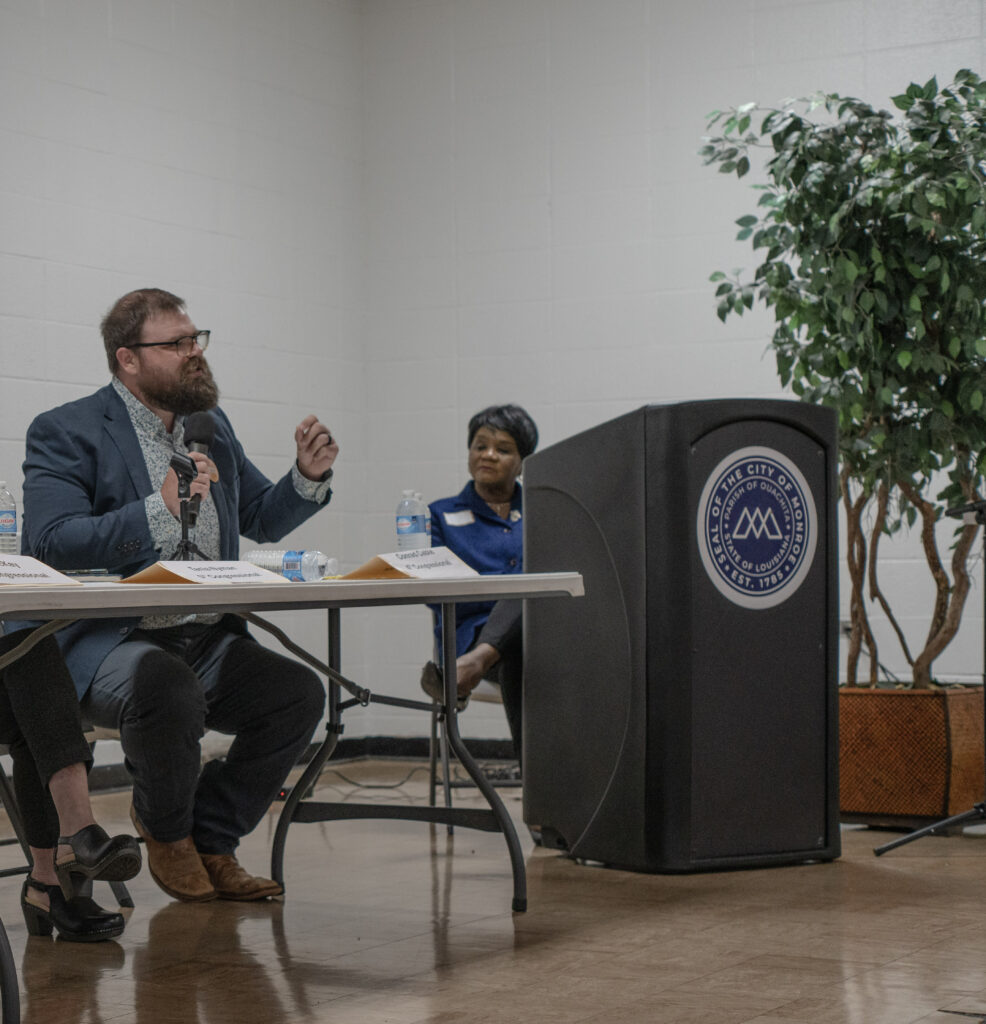
“Instead of getting into too much about who I am, I think that we need to just mention the elephant in the room that is on everyone’s minds,” Cable said. “Today was a tough day, not just for our candidates, not just for you as the voters, but for our democracy.”
Cable called the effort to halt the May election “an absolute authoritarian power grab,” saying candidates had stepped forward under the promise of a closed primary and a May 16 election date.
The forum, moderated by former Monroe School Board President Betty Ward Cooper, featured all three Democratic U.S. Senate candidates — Nick Albares, Gary Crockett and Jamie Davis — along with Cable, all five Democratic candidates in the 5th Congressional District — Tania Nyman, Dan McKay, Larry Foy, Jessee Fleenor and Lindsay “Rubia” Garcia — and Public Service Commission candidate Austin Lawson.
The event was opened by Melissa Flournoy, board chair of 10,000 Women Louisiana, who described the roadshow as an effort to elevate Democratic candidates across the state and give voters a chance to hear from them directly. But even her opening remarks were shaped by the legal and political chaos of the day.
“We believe voting is sacred,” Flournoy told the room, “and we believe that voters have a right to free and fair elections, regardless of what Jeff Landry has to say.”
Crystal Rommen, a volunteer lead organizer with Indivisible North Louisiana, sharpened the point further, telling attendees that “democracy is being dismantled before our very eyes” before performing a satirical song titled “Dumb Ways for Democracy to Die.”
The opening remarks set the tone for a forum shaped as much by voting rights anxiety as by campaign policy.
The Senate candidates were first asked to respond to the Supreme Court ruling and Landry’s move to redraw the congressional map. Albares called the decision “a moral failure” and “an anti-democratic power move” by Landry.
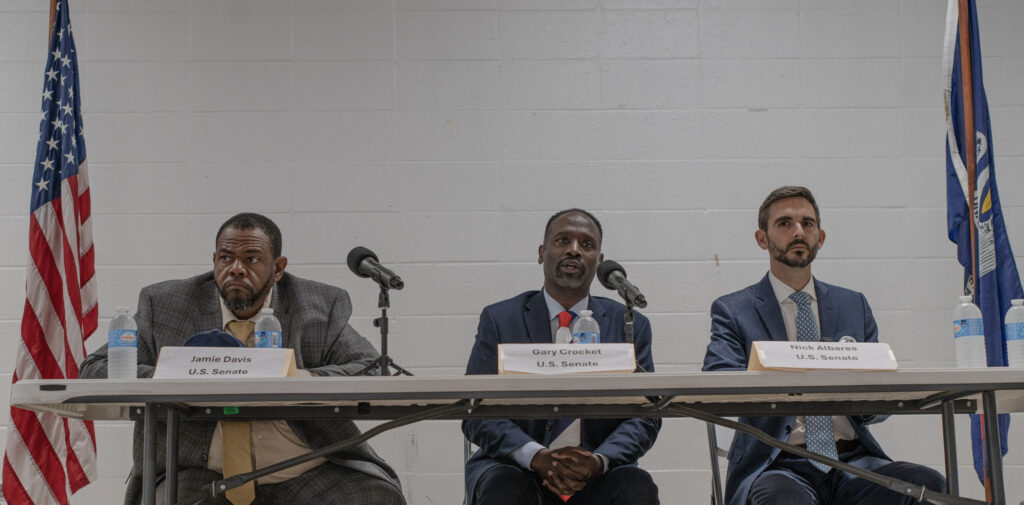
“This election that’s happening on May 16, it’s not just happening on May 16. It’s already happening,” Albares said. “People have submitted ballots. Mail-in, early voting starts May 2. This is voter suppression.”
Crockett, a retired 24-year Navy veteran and businessman from Tallulah, focused less on the court ruling itself and more on how voters should respond.
“The governor can make these decisions, but there are also decisions that we can make,” Crockett said. “One is to make sure that your neighbor, your family, go out to vote. Despite the fact that how the lines are drawn, we still have power.”
Davis, a third-generation row crop farmer from Tensas Parish and the Louisiana Democratic Party-endorsed Senate candidate, described the day as one of the hardest of his campaign.
“To see people just get smashed — it is horrible,” Davis said, arguing that the ruling could reshape representation far beyond Louisiana. “This is not just Louisiana. It can look like this over the whole United States.”
From there, the Senate portion moved into themes that have become familiar across the roadshow: health care access, rural economic development, wages, broadband, youth violence, agriculture and the cost of living. But in Monroe, those topics had a sharper regional edge.
The candidates were pressed on the proposed wave of AI and data center development in Northeast Louisiana, an issue that has quickly become one of the defining policy fights in the region. Davis said he would support suspending new data centers until the communities affected understand the full impact.
“You can’t come in and get with a few legislators and tiptoe in the corner back there and cut a deal,” Davis said. “And next thing you know, everybody’s bills are more.”
Albares called for a federal regulatory framework that would require tech companies to pay their fair share and invest in the grid rather than passing costs to ratepayers. Crockett said studies alone were not enough, calling for legislation “with teeth” to regulate, govern and monitor data centers and keep them away from population-dense areas.
On rural development, Crockett argued for more trade school pathways and “innovation centers” for young people in rural areas. Davis said economic development should match the existing strengths of local communities, citing fertilizer plants in agricultural areas and timber-related industry where lumber and forestry dominate. Albares tied rural investment back to infrastructure, broadband and the Medicaid expansion under former Gov. John Bel Edwards, arguing that Medicaid helped keep rural hospitals open.
The health care section was among the most direct. Davis warned that if federal health care cuts take effect, rural communities could be left dangerously exposed.
“If the one big, ugly bill succeeds and goes into the new year as a law and the hospitals around me that are fragile and they close, that means one bad car accident, and it’s 70 miles to an emergency room,” Davis said. “That’s not life for real people.”
Albares said health care should be central to the general election, criticizing Republican elected officials for backing cuts to Medicaid. Crockett connected health care access to infrastructure, arguing that rural clinics, telehealth and prescription access depend on reliable broadband.
The congressional panel returned the night to the election crisis more forcefully.
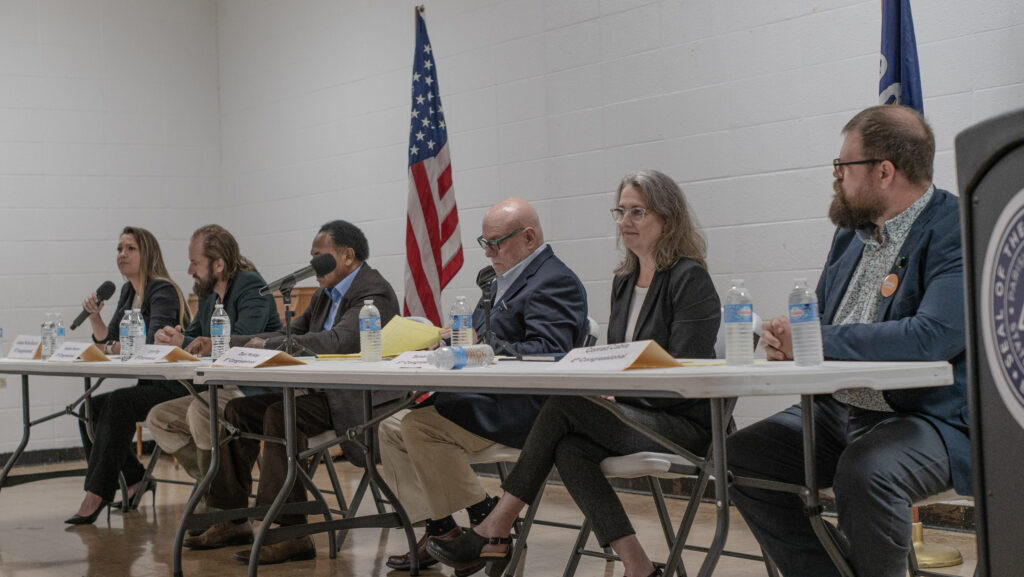
Nyman, a longtime public education advocate from Baton Rouge, said election integrity and constitutional rights had to come first before candidates could even get to the policies that improve people’s lives. McKay, a longtime attorney and Vietnam veteran from Mangham, urged voters to cast ballots and bring others with them.
“Voting is the greatest right anyone has,” McKay said. “It’s our number one right, and it needs to be exercised.”
Foy, who was born in Monroe and raised in Winnsboro, spoke about learning the value of voting from his father, saying he remembered a different “walk” and “air” about him on Election Day. “Your vote is your voice,” Foy said.
Fleenor, a Tangipahoa Parish farmer making his second run for the seat after his 2018 campaign, warned that the ruling could lead to a major drop in minority representation. “For it all right at the very end to be thrown into the air and there to be this much uncertainty is not only anathema to the democratic process, but a real kick in the face,” he said.
Rubia, a New Orleans native, Southern University Law Center graduate and former teacher, told the audience she had already taken legal action.
“I already filed a federal lawsuit on behalf of this district in order to protect your right to vote,” Rubia said, adding that she was waiting during the forum to see whether a judge had issued an injunction.
From there, the congressional candidates moved into infrastructure, roads, water, data centers and affordability. Data centers became one of the sharpest policy divides of the congressional panel.
McKay was the most openly cautious about condemning the industry outright, saying the proposed data center could bring an economic boom during construction but that the region still needed to know what would happen afterward. “We’re going to have to wait and see,” he said, while also arguing that Monroe had lost out on major interstate connectivity and should fight to restore it.
Foy called data centers a “mixed bag,” saying the region needs jobs but should be concerned about whether local workers will actually get the permanent, good-paying positions. He called for community benefit agreements before any new data center is built.
Fleenor was more blunt, calling himself an “AI skeptic” and saying he did not believe the technology was improving people’s lives. Rubia said she opposed data centers without guaranteed local hiring, water protections, federal grid safeguards and infrastructure upgrades paid for by the companies rather than ratepayers.
Cable also opposed the projects, arguing that Louisiana’s resources and labor have too often been exploited. “I do not support data centers because I’m tired of Louisiana’s resources and labor being exploited,” he said, adding that clean water and internet access should be core infrastructure priorities.
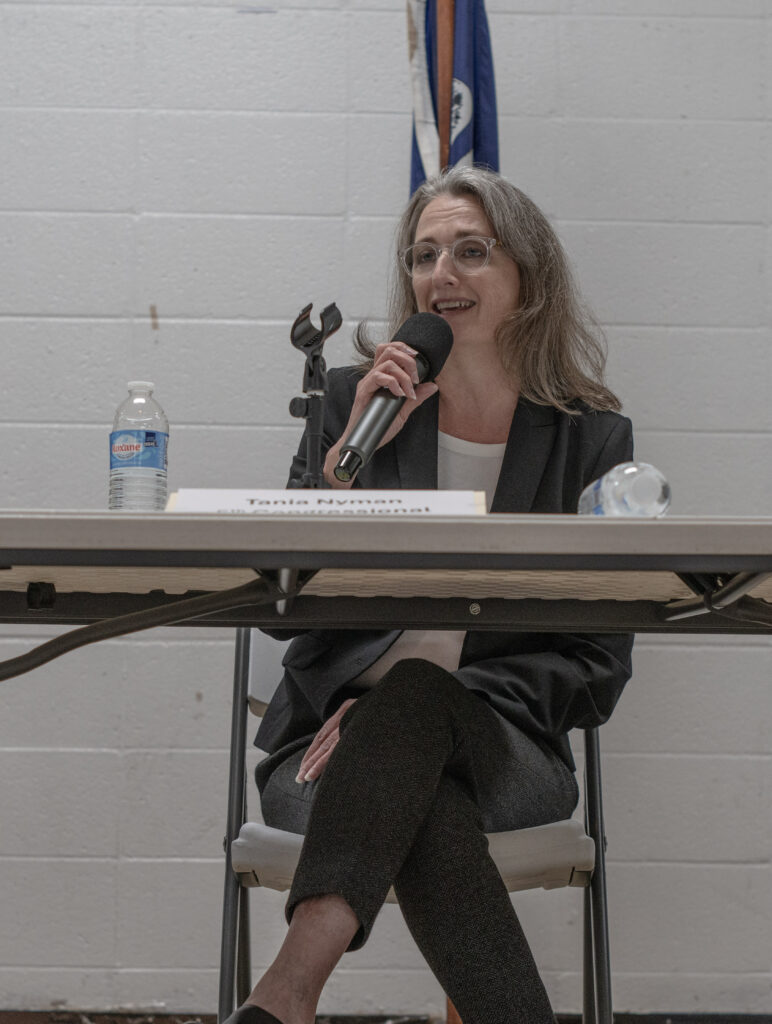
Nyman joined calls for a moratorium on new data centers and warned against handing too much power to tech billionaires.
The repeated concerns over utility costs and data centers carried directly into Lawson’s remarks on the Public Service Commission. Running for the Public Service Commission, Lawson used his time to explain the job itself and frame the PSC as a frontline office in the fight over electricity rates, water, telecommunications and data centers.
Lawson said his campaign wants to tie electricity rates to income, create a public advocate at the PSC to represent ratepayers and regulate data centers more aggressively. He described watching PSC meetings where utility and tech company lawyers outnumber advocates for ordinary residents.
“What the hell?” Lawson said. “Our government is supposed to represent us.”
Lawson, a 24-year-old Bossier City activist and bartender, leaned into his age and working-class background.
“I know what working people need, because I am one of them,” Lawson said. “A Public Service Commissioner should provide public service.”
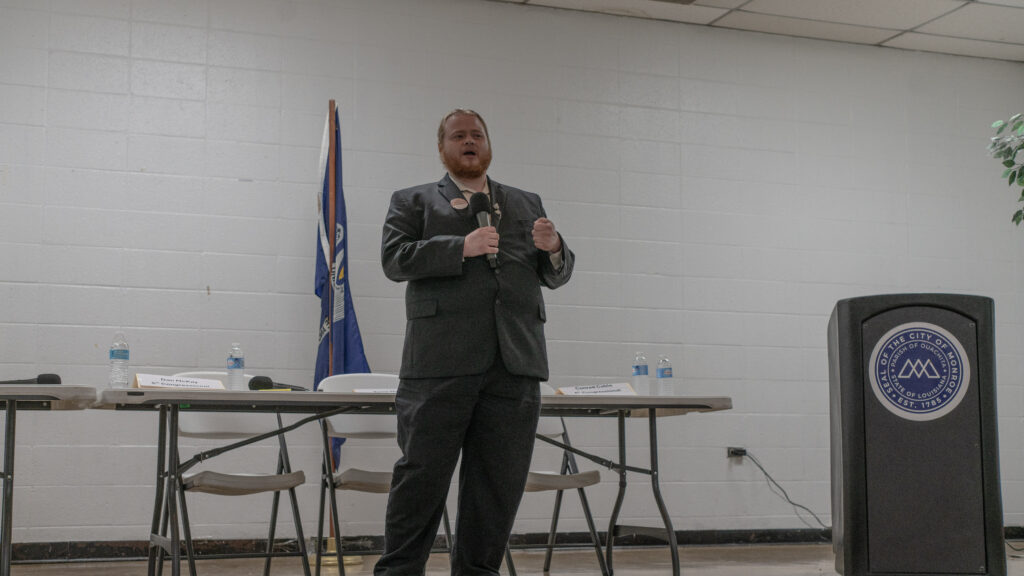
Across more than two hours, candidates returned repeatedly to a narrower set of pressures facing Northeast Louisiana: unstable health care access, rising utility costs, rural disinvestment, broadband gaps, low wages and the question of whether major new economic projects will actually benefit the people who live near them.
But the throughline was simpler: a room full of Democratic candidates trying to make their case to voters while the state’s Republican leadership was actively trying to change the conditions of the election around them.
That is what made the Monroe stop different from a normal candidate forum. It was not just a preview of the May 16 ballot. It became a live example of why the ballot itself now matters more.