
Jamie Davis finished as the top vote-getter in Louisiana’s Democratic primary for U.S. Senate Saturday night, but he fell short of the majority needed to win the nomination outright, setting up a second party primary runoff.
With all 64 parishes and all 3,722 precincts reporting, unofficial results from the Louisiana Secretary of State showed Davis with 163,507 votes, or 47%. Gary Crockett finished second with 90,764 votes, narrowly ahead of Nicholas “Nick” Albares, who received 90,480 votes.
The margin between Crockett and Albares was just 284 votes.
Under Louisiana’s closed party primary system, a candidate for U.S. Senate must receive a majority of votes in the party primary to become the party’s nominee. If no candidate receives a majority, the top two candidates advance to a second party primary.
That means Davis, despite leading the field by a substantial margin, will have to continue campaigning. Crockett, assuming the unofficial results hold, will join him in the runoff.
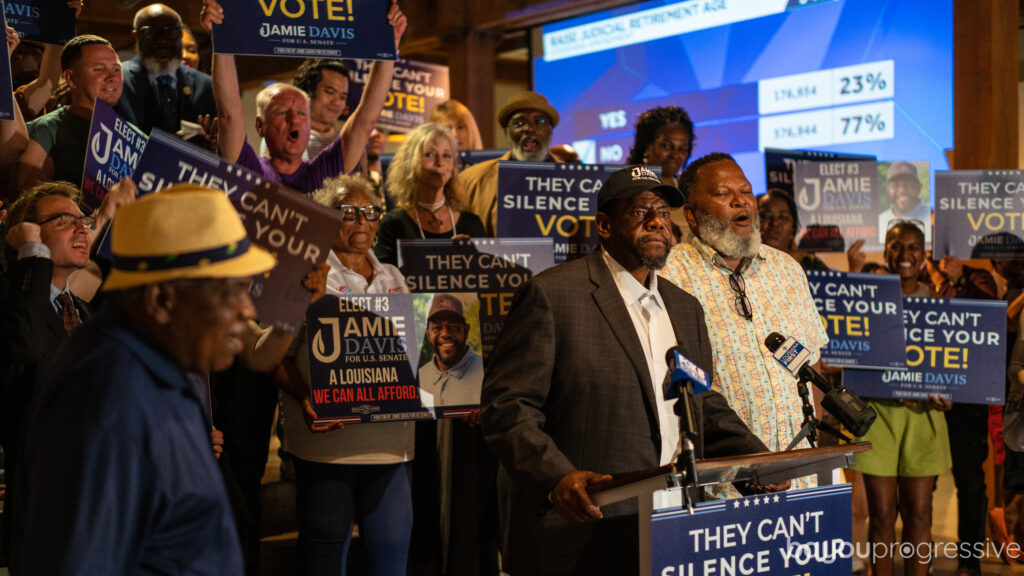
But as of Saturday night, the race for second place was not fully settled politically. Neither Crockett nor Albares had publicly conceded, and it remained unclear whether Albares would request a recount.
Louisiana law does not provide for an automatic recount simply because a race is close. Instead, a candidate may request a recount of absentee-by-mail and early voting ballots if the number of those ballots could make a difference in the outcome. The request must be filed in writing with the clerk of court by 4:30 p.m. on the third calendar day after the election.
In a race separated by fewer than 300 votes, that option could matter.
The result is a striking finish to a Democratic primary that appeared, at least in its final stretch, to be moving in Albares’ direction. Albares had the perceived momentum late in the campaign, including the endorsement of former Gov. John Bel Edwards and support from the New Orleans AFL-CIO. He also maintained a visible presence at candidate forums and Democratic events across the state.
Crockett, however, quietly outperformed expectations. His second-place finish, if it stands, would represent one of the more surprising developments of the night and suggest that his support was deeper than many political observers recognized.
The numbers also complicate the easy read of the race. Davis clearly led the Democratic field, but nearly 53% of Democratic primary voters chose someone else. In a runoff, Davis would enter as the frontrunner, but Crockett would have a fresh opportunity to consolidate voters who backed Albares or who were simply looking for an alternative to the first-place finisher.
On the Republican side, Julia Letlow also finished as the top vote-getter but failed to clear the majority threshold. Letlow received 179,876 votes, or 45%, followed by John Fleming with 113,428 votes, or 28%. Bill Cassidy finished third with 99,479 votes, or 25%, while Mark Spencer received 8,335 votes, or 2%.
The Republican primary drew 401,118 votes, compared with 344,751 votes in the Democratic primary. That turnout gap underscores the continued challenge Democrats face in a statewide federal race in Louisiana, even as Republicans now face their own runoff fight.
For Democrats, the immediate question is whether the Davis-Crockett matchup is locked in or whether Albares will pursue a recount before the results are finalized. For Republicans, Letlow now has to defend her first-place finish against Fleming in a runoff that could expose deeper divisions inside the state’s conservative electorate.
The broader result is clear enough: both major parties appear headed to runoffs in Louisiana’s first major closed party primary election for U.S. Senate.
But on the Democratic side, the final shape of that runoff may depend on whether 284 votes is close enough for Albares to keep fighting.