


















It turns out reparations are not unrealistic. They are not too complicated. They are not inherently divisive. They are not some fringe fantasy that no serious government could ever administer.
Apparently, reparations are perfectly manageable when the beneficiaries are Donald Trump’s political allies.
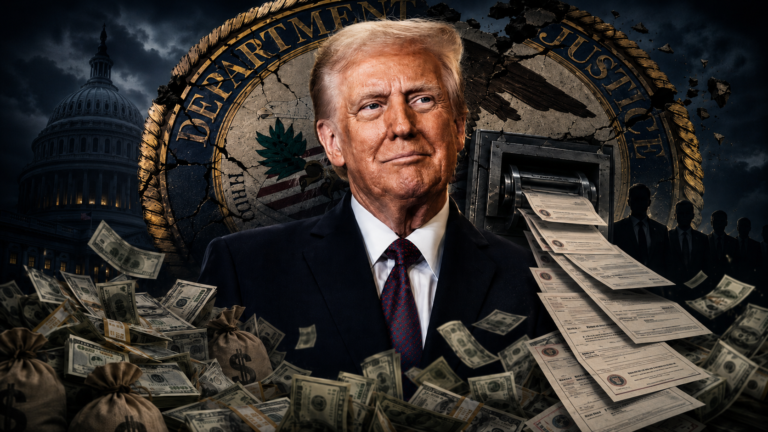
On Monday, the Trump administration announced the creation of a $1.776 billion “Anti-Weaponization Fund” as part of a settlement resolving Trump’s lawsuit against the Internal Revenue Service over the leak of his tax returns. The fund, according to the Justice Department, will allow people who claim they were targeted by the Biden-era Justice Department for political reasons to seek monetary relief and even formal apologies. It will be overseen by five members appointed by the attorney general, with the president able to remove members. The money will come from the federal judgment fund, a standing appropriation used to pay settlements and court judgments.
That is the polite bureaucratic description.
The plain English version is this: Trump sued agencies he now controls, dropped the lawsuit, and his administration created a taxpayer-funded compensation system for people who share his preferred narrative of persecution.
Democrats and watchdog groups have been blunt about what they believe this is. Nearly 100 House Democrats filed a legal brief urging a judge to block the arrangement, arguing it could unjustly enrich people close to Trump and invite meritless claims of political persecution. Donald Sherman, president of Citizens for Responsibility and Ethics in Washington, called it “one of the single most corrupt acts in American history.” Rep. Jamie Raskin called it a “racket” and a “huge slush fund” for Trump’s allies, including people tied to January 6.
The Justice Department says there are “no partisan requirements” to file a claim. That is supposed to make this sound neutral. But government programs are not judged only by what they claim to be on paper. They are judged by who created them, why they were created, who controls them, and who is most likely to benefit.
And here, the answer is not subtle.
This fund was born from Trump’s personal lawsuit. It was announced by Trump’s Justice Department. It is premised on Trump’s long-running claim that the criminal investigations into him and his allies were illegitimate political persecution. It comes after Trump pardoned or commuted the sentences of January 6 defendants and after his administration began pursuing its own investigations of perceived enemies.
This is not justice. This is grievance politics with a routing number.
The moral insult is not merely that Trump is using the government to reward his camp. It is that he is doing so in a country where any serious discussion of reparations for Black Americans is still treated by much of the political class as unserious, dangerous, radical, or impossible.
For generations, Black Americans have pointed to slavery, convict leasing, Jim Crow, redlining, school segregation, employment discrimination, mass incarceration, and government-backed wealth theft as evidence of a national debt. Not a metaphorical debt. A measurable one. A debt written into land records, labor markets, school district lines, banking practices, prison systems, home values, and inherited wealth.
The answer from Washington has usually been some version of: that is too hard, too expensive, too divisive, too backward-looking, too politically unrealistic.
But now the federal government can apparently design a nearly $1.8 billion claims process for people who feel they were mistreated because they helped, enabled, defended, or stood near Donald Trump.
The contrast is obscene.
When Black families ask the government to repair centuries of state-sanctioned harm, they are told to move on. When Trump’s allies claim “lawfare,” the government creates a fund.
When descendants of enslaved people ask for a commission to study reparations, even that is framed as a radical demand. H.R. 40, the long-running federal reparations bill, would establish a commission to study and develop proposals for African American reparations. It does not itself cut checks. It studies the issue. Even that has struggled for decades to become law.
Trump’s allies, meanwhile, may not need a generational study. They may not need a national moral reckoning. They may not need to prove a centuries-long chain of public policy and private enrichment. They get an application process.
And almost as if to remove any denying the parallels to reparations, the Justice Department has tried to defend the fund by pointing to the Obama administration’s settlement in the Keepseagle v. Vilsack case, which compensated Native American farmers who alleged racial discrimination by the federal government. That comparison is revealing in precisely the way the administration probably did not intend. Keepseagle was about claims of racial discrimination over decades by the federal government against Native American farmers. Trump’s fund is being created out of a settlement tied to the president’s own lawsuit, for a category of claimants defined almost exclusively by their political allegiance to the 47th president and the activities the federal government investigated for conduct related to his movement.
That distinction matters.
There is a legitimate place for government compensation when the state harms people. The problem is not the concept of redress. The problem is selective redress. The problem is a government that can find the moral urgency to compensate the politically connected but develops a sudden allergy to justice when the injured parties are Black, poor, Indigenous, incarcerated, displaced, or otherwise inconvenient.
This country has never lacked the administrative capacity to repair harm. It has lacked the political will to repair the harm done to the people it prefers to forget.
And that is why this fund is bigger than Trump’s usual corruption. It exposes the lie underneath decades of anti-reparations politics.
America knows how to identify victims when it wants to. It knows how to create commissions. It knows how to appropriate money. It knows how to process claims. It knows how to issue apologies. It knows how to design formulas, appoint administrators, create eligibility rules, audit payments, and defend the entire thing as lawful.
The question has never been whether reparations are possible.
The question has always been who this country believes deserves to be made whole.
Trump’s answer is now sitting in black and white on the Justice Department’s website. The fund can issue apologies and monetary relief. It will receive $1.776 billion. It will report quarterly to the attorney general. It will process claims until December 1, 2028. It is real, funded, structured, and official.
So the next time a politician says reparations are unrealistic, remember this moment.
The next time someone says taxpayer money should not be used to compensate people for past government wrongdoing, remember this moment.
The next time someone says it is too divisive to acknowledge historical harm, remember that Trump’s Justice Department just created a taxpayer-backed grievance fund rooted in the most divisive political mythology in modern American life.
The issue was never complexity. It was never cost. It was never administrative difficulty.
It was power.
Trump’s allies have it. The descendants of the people this country enslaved, segregated, excluded, exploited, and policed have spent generations being told to wait their turn.
Now, with staggering shamelessness, the Trump administration has made the hierarchy plain.
There is money for political friends. There is paperwork for everyone else.