Louisiana voters on Saturday rejected the proposed constitutional amendment that would have cleared the way for the City of St. George to form its own public school system, delivering a decisive statewide rebuke to one of the most consequential school-secession efforts in modern Louisiana politics.
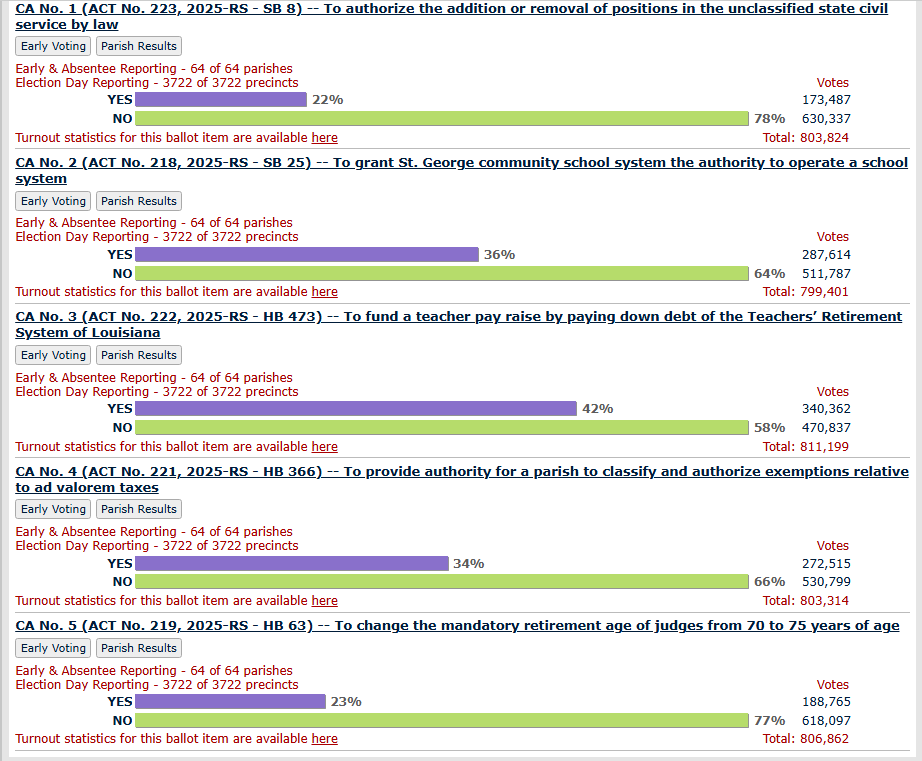
With all precincts reporting in unofficial returns from the Louisiana Secretary of State’s office, Constitutional Amendment No. 2 failed 64 percent to 36 percent statewide, with 511,787 voters opposing the measure and 287,614 supporting it. In East Baton Rouge Parish, where the proposed school system would have been located, the amendment failed by an even wider margin, with local voters rejecting it roughly 69 percent to 31 percent.
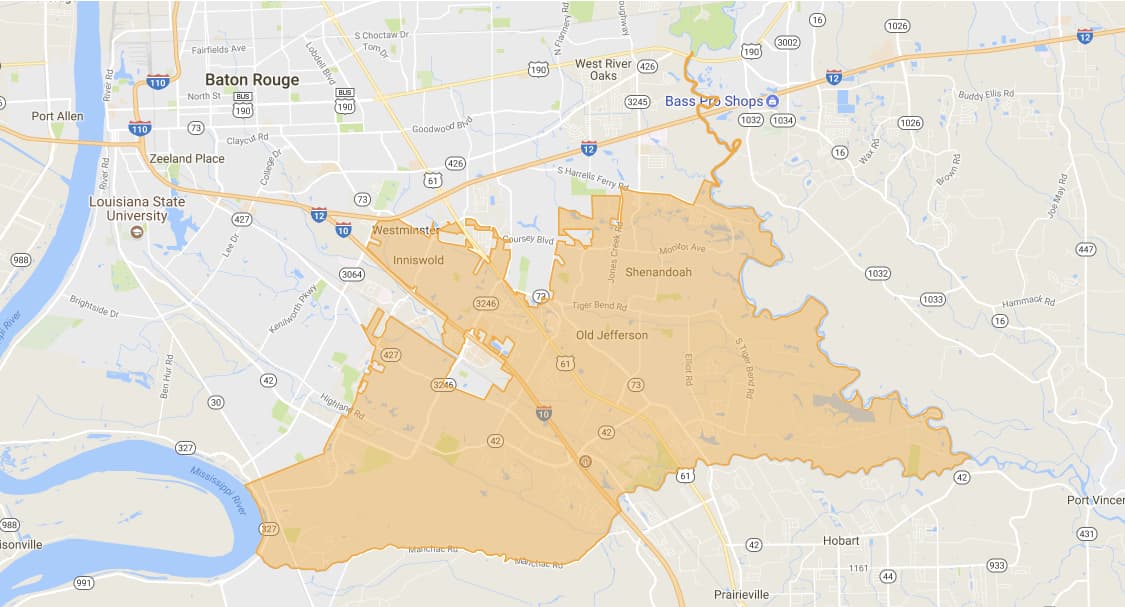
The result halts, at least for now, the effort to carve a new St. George school district out of the East Baton Rouge Parish School System. The amendment would have granted the St. George community school system the same constitutional authority given to parishes for operating schools, including access to state Minimum Foundation Program dollars, textbook funding, and the ability to raise certain local revenues for elementary and secondary education.
That technical language masked the real stakes. This was not simply a local-control ballot measure. It was a test of whether Louisiana would bless a model of municipal and educational separation that could further fracture public education along lines of race, class, and political power.
Had Amendment 2 passed, East Baton Rouge Parish Public Schools would have faced the loss of thousands of students and tens of millions of dollars in funding. EBR Schools previously estimated the split could cost the district more than 5,500 students and $100 million in state and local funding, while WRKF reported after the election that the district avoided a $60 million budget hole with the amendment’s defeat.
But the deeper threat was always broader than the balance sheet.
St. George’s push for a school district emerged from a long-running effort by residents in the southern part of East Baton Rouge Parish to separate from Baton Rouge’s public systems. The school district effort predated the city itself. After earlier legislative attempts to create a district failed, supporters pursued incorporation, won a 2019 cityhood vote, survived years of litigation, and then returned to the Legislature with the city as the legal vehicle for a separate school system.
Supporters framed the proposal as a matter of local control and better schools. Opponents saw something much more familiar: a wealthier, whiter area seeking to detach itself from a majority-Black, majority-student-of-color public school district and take public resources with it.
That concern was not invented for campaign mailers. In 2019, WWNO reported that demographic data showed a St. George district would worsen racial segregation in East Baton Rouge Parish public schools. At the time, East Baton Rouge Parish was 45 percent Black, while the proposed City of St. George was just 12 percent Black. A later WRKF report noted that if students in St. George left EBR Schools, the remaining parish system’s white enrollment would drop to 8 percent, while the share of low-income students would rise.
That is the part of the debate Louisiana cannot politely talk around. St. George was never just about administrative efficiency. It was about boundaries — who gets included, who gets excluded, and who gets to keep the public dollars attached to their children while leaving everyone else behind.
This is also why the vote matters nationally. School district secession is one of the quieter engines of modern resegregation. It does not always arrive wearing the old costume of massive resistance. More often, it arrives with polished language about neighborhood schools, accountability, parental control, fiscal responsibility, and “local needs.” But the result can be the same: whiter and wealthier enclaves draw new lines around themselves, while poorer and more heavily Black and brown districts are left with fewer resources and more concentrated need.
AERA, summarizing research on Southern school district secessions, found that after such splits, students are increasingly sorted into different districts by race, deepening segregation between school systems. EdBuild documented 128 communities that had attempted to secede from their school districts since 2000, with 73 succeeding. Louisiana’s own history sits squarely inside that national pattern, with Baker, Zachary, and Central already having split from the East Baton Rouge Parish system before St. George attempted to become the next breakaway district.
The legal history is not subtle either. In Wright v. Council of the City of Emporia, the U.S. Supreme Court held that a proposed separate school system could be blocked where it would impede the dismantling of a segregated school system. The Court recognized that new school boundaries can be more than bureaucratic rearrangements; they can become tools for preserving segregation by another name.
That is why Amendment 2 was dangerous beyond East Baton Rouge Parish. If Louisiana voters had approved the St. George model, it would have given other communities a clearer political roadmap: incorporate, isolate the tax base, seek legislative recognition, and then ask voters to bless a new school district. In a state where public schools are already deeply unequal, that precedent could have invited a wave of copycat efforts from communities looking to wall themselves off from the obligations of shared public education.
Instead, voters said no.
They said no statewide. They said no in East Baton Rouge Parish. And they said no by a margin large enough that supporters of the amendment cannot credibly dismiss the outcome as confusion, low turnout, or partisan noise.
The defeat also came on a night when Louisiana voters rejected all five proposed constitutional amendments on the ballot. Amendment 1, dealing with state civil service classifications, failed 78 percent to 22 percent. Amendment 3, which would have used certain constitutional funds tied to teacher retirement debt to fund teacher and support staff pay raises, failed 58 percent to 42 percent. Amendment 4, involving local authority over business inventory taxes and public service property, failed 66 percent to 34 percent. Amendment 5, which would have raised the mandatory retirement age for judges from 70 to 75, failed 77 percent to 23 percent.
The Senate races produced their own headlines. On the Democratic side, Jamie Davis finished first with 163,507 votes, or 47 percent, while Gary Crockett and Nick Albares were locked in an extremely close fight for second place in unofficial returns. On the Republican side, Julia Letlow led with 179,876 votes, or 45 percent, followed by John Fleming at 28 percent, while incumbent Bill Cassidy was pushed out of the runoff after finishing third.
But the clearest message of the night came from Amendment 2.
Louisiana voters did not just reject a school district. They rejected a precedent.
They rejected the idea that public education should be repeatedly carved into smaller and smaller enclaves until wealth and whiteness can protect themselves behind municipal borders. They rejected the idea that East Baton Rouge Parish should be forced to absorb the damage while St. George walked away with students, facilities, tax base, and political blessing. And they rejected a model that could have helped normalize school secession as the next frontier in America’s long retreat from the promise of integrated public education.
The fight, however, is not over. St. George leaders can ask lawmakers to put the issue back before voters in the future. Supporters have already made clear that they see this as a setback, not necessarily the end of the campaign.
That means the responsibility now shifts back to East Baton Rouge Parish leaders, school officials, organizers, and voters. Beating Amendment 2 prevents immediate damage. It does not solve the underlying distrust, inequity, school performance concerns, or political alienation that allowed the St. George movement to grow in the first place.
The mandate from Saturday is not simply to preserve the existing system. It is to prove that a shared system can serve every child in the parish, including the children in St. George, without abandoning the children everywhere else.
That is harder than drawing a new line on a map. It is also the only answer worthy of a public school system.