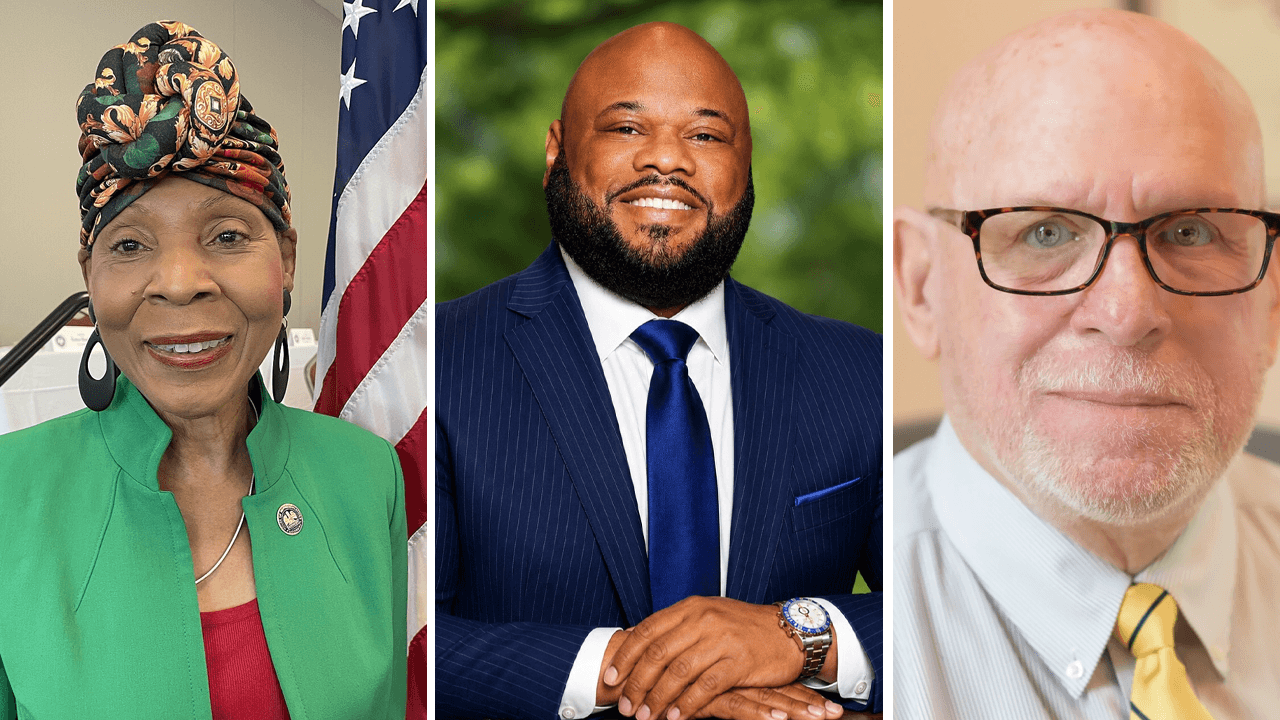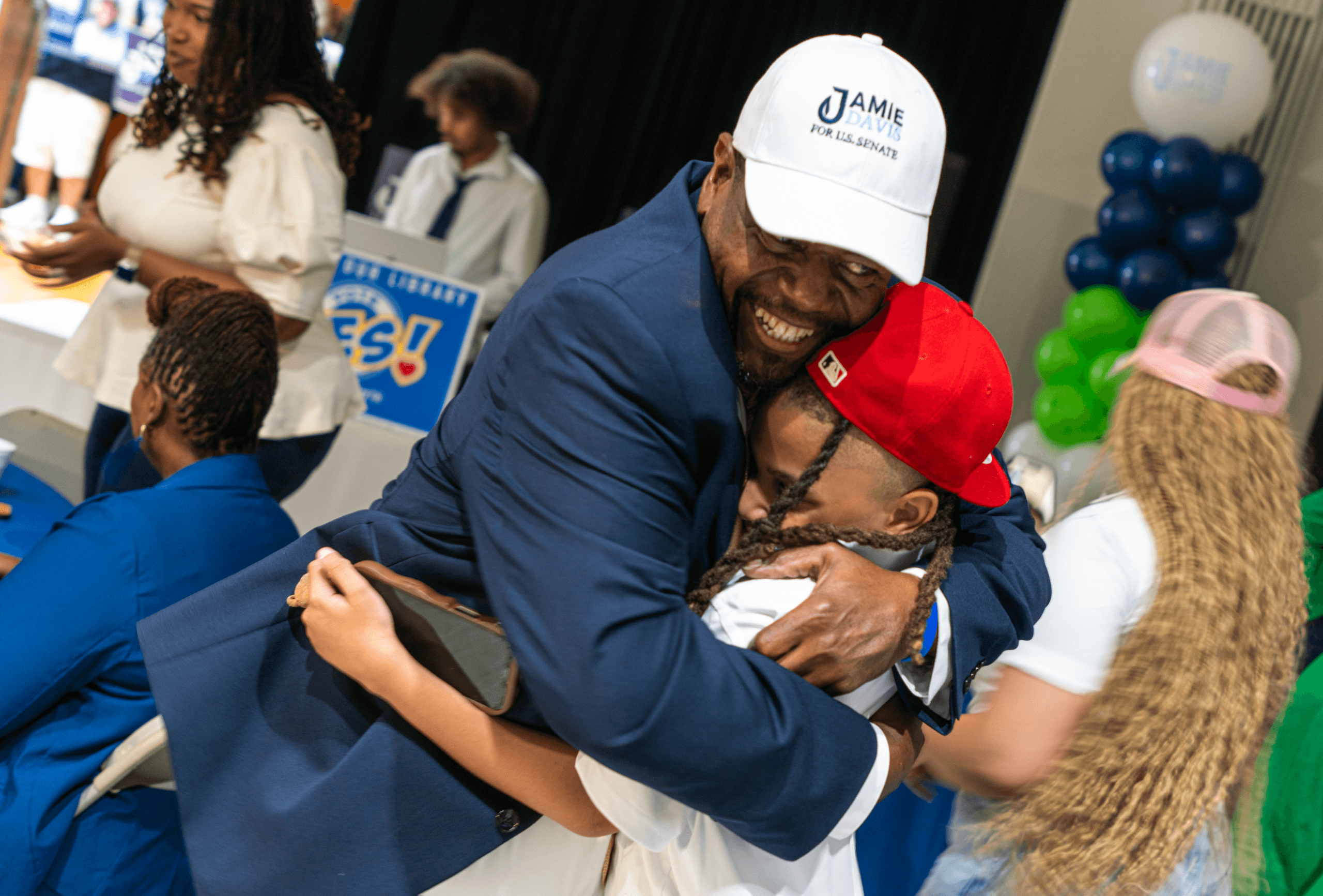
The final scheduled stop of the To The People, For The People 2026 Democratic Roadshow opened Saturday night with a smaller-than-expected U.S. Senate forum, as Nick Albares and Gary Crockett made their case to Democratic voters while Jamie Davis, the party-endorsed candidate in the race, did not attend.
The forum, held at the Unitarian Church of Baton Rouge after heavy rain across the capital region, was moderated by Robert Mann, a longtime Louisiana political historian, author and former LSU Manship School faculty member who previously served as a senior aide to U.S. Sens. Russell Long and John Breaux and Gov. Kathleen Babineaux Blanco.
Melissa Flournoy, board chair of 10,000 Women Louisiana, opened the evening by framing the Baton Rouge event as the last scheduled stop of a Roadshow that had traveled through Lafayette, Shreveport, Ruston, Monroe, Houma, Lake Charles, Covington and Hammond before returning to the capital city. Bonnie Byland of Indivisible Baton Rouge welcomed attendees on behalf of the local Indivisible chapter, saying the crowd’s willingness to show up despite the weather reflected the kind of civic engagement needed in the current political moment.
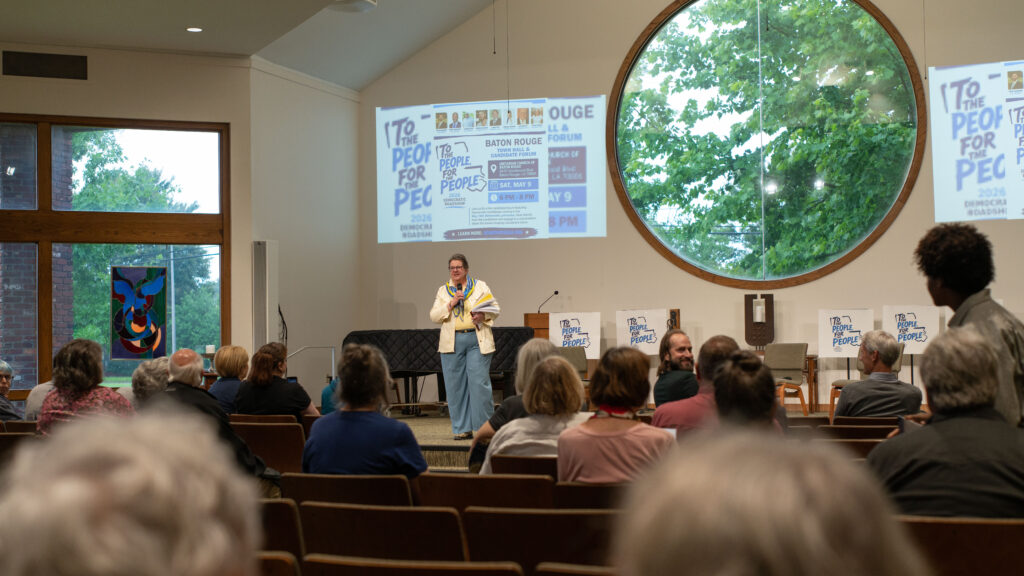
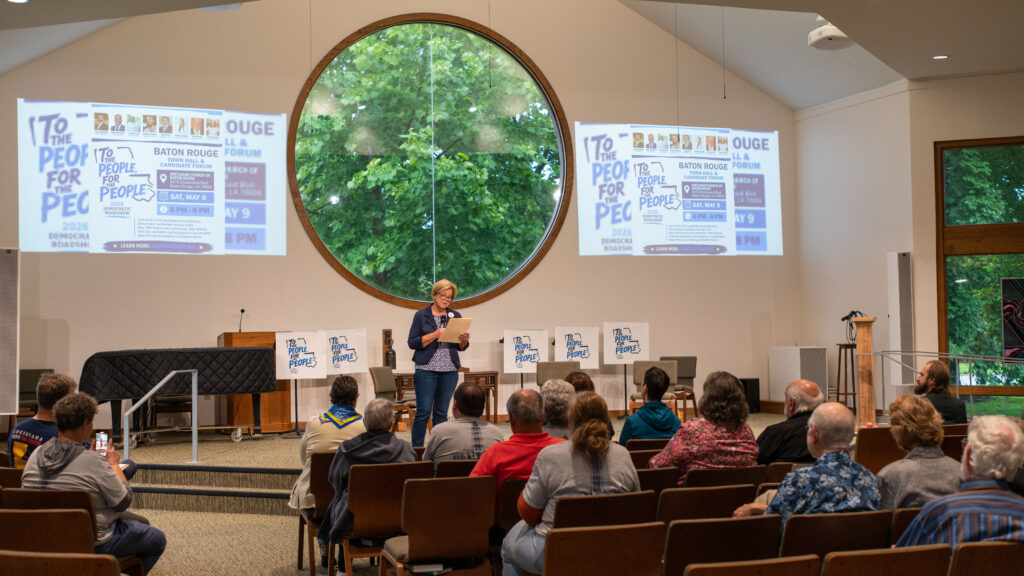
The Senate portion of the event was conversational, with Albares and Crockett seated on stage with Mann before the evening shifted to a more formal debate-style forum for 5th Congressional District candidates.
Albares used his opening remarks to cast the race as a test of whether Democrats would offer voters a candidate focused on people rather than proximity to Donald Trump.
“I looked at the Republican side, and I saw all of the Republican candidates fighting to be closest to Donald Trump,” Albares said. “And I said, we need a candidate who’s going to be fighting to be closest to the people.”
Crockett, a retired Navy veteran and business owner originally from Tallulah, said he entered the race because he did not see others “getting out on the field” to fight for Louisiana families.
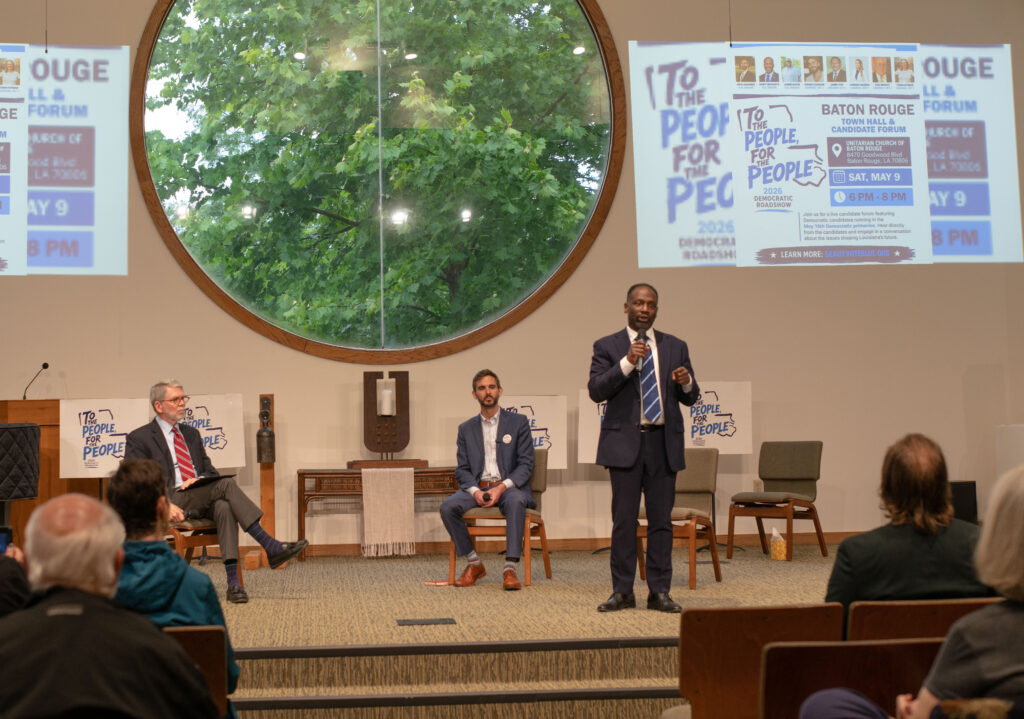
“At this time in Louisiana, we have some issues,” Crockett said. “One is affordability, the other one is better health care. And outside of that, we just need some change and some leadership that represents you.”
Asked why he was the right Democrat to take the fight statewide, Crockett leaned on his military background, business experience and self-funded campaign. He argued that Louisiana needs “practical leadership” and said Congress should ensure ordinary Americans have access to the same level of health care available to senators and representatives.
“We need plumbers, electricians and HVAC techs as well,” Crockett said, arguing that policy should focus not only on college pathways but also on trades and working-class opportunity.
Albares pointed to his public policy background, his time in the Obama administration and his work as a policy adviser to Gov. John Bel Edwards. He said he was involved in the Edwards administration’s effort to expand health coverage to roughly half a million Louisianans and protect that expansion from Republican attacks in the Legislature.
“I’ve been in these fights before, and I’ve won,” Albares said. “While they’re trying to slash health care by a trillion dollars, we need someone who’s ready to take the fight to Republicans in Washington.”
On affordability, both candidates argued that Democrats should focus more directly on wages, health care and economic security.
Albares said the first priority should be holding the executive branch accountable and forcing billionaires to “pay their fair share,” criticizing what he called a Republican bill that cut taxes for the wealthy while threatening health care coverage for vulnerable Louisianans.
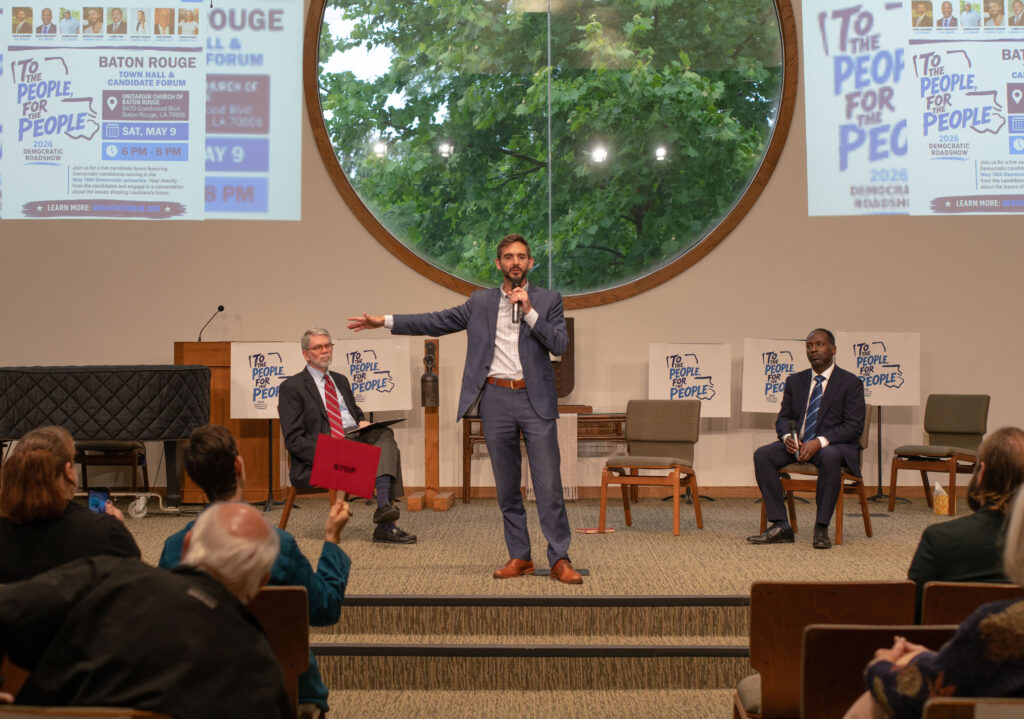
“The minimum wage hasn’t gone up in 16 years,” Albares said. “We need to more than double it and index it to inflation.”
Crockett proposed what he called a Financial Fairness Act, which he said would include a $15 national minimum wage, higher taxes for billionaires and changes to Social Security income rules so seniors are not penalized for continuing to work.
“I think it’s fair that the people who have created this great nation that we have right now, that have gone before us, that we treat them fairly,” Crockett said.
The forum also returned repeatedly to voting rights and the legal chaos surrounding Louisiana’s congressional elections. Mann framed the question around whether voters can trust election rules to remain stable once voting has begun.
Crockett called for new federal legislation requiring states to follow consistent standards, including limits on mid-decade gerrymandering and requirements that districts remain compact and contiguous. He criticized Louisiana’s current congressional map, saying it stretches across culturally distinct regions of the state.
Albares invoked the late Rep. John Lewis, who spoke at his Georgetown University graduation, and called for passage of the John Lewis Voting Rights Advancement Act.
“It’s time we start getting in some good trouble,” Albares said. “We need to pass the John Lewis Voting Rights Advancement Act to bring the Voting Rights Act into the 21st century.”
Albares directly linked that need to recent actions by Gov. Jeff Landry, including the state’s removal of Calvin Duncan from his elected position as Orleans Parish Criminal District Court clerk and the broader fight over Louisiana’s congressional elections.
“What we have just down the street is an executive in this state that is trying to strip away voting rights from people,” Albares said.
Crockett also highlighted his legal challenge related to Duncan’s removal, telling the audience that he had filed on behalf of Louisiana voters and Duncan to stop the state’s actions. He said a court had frozen both civil clerk positions and that he was continuing to oppose the state’s appeal.
“I will go there and I will fight for you the same way that Trump likes to file lawsuits,” Crockett said. “I’ll be filing a lawsuit every day to make sure that we keep things in check.”
When asked where Democrats need to fight harder and communicate better, Crockett gave a blunt assessment of the party.
“The Democratic Party is in trouble,” Crockett said. “Frankly, if I start with Louisiana, it’s really in a sad condition, and it’s important that we be honest with ourselves.”
He said Democrats need to stop being reactive and start planning long-term, comparing the need for Democratic preparation to the right-wing Project 2025 agenda.
Albares said Democrats need to focus more directly on working people and communicate around their material concerns. He pointed to his support from AFL-CIO chapters in Greater New Orleans and Northwest Louisiana and said he would fight for the PRO Act, union rights, paid family leave, child care, housing, health care and the Affordable Care Act.
“When we focus on those real issues, we will win,” Albares said.
In a lightning round, both candidates said Congress should protect reproductive health care nationwide, continue supporting Ukraine against Russian aggression and strengthen federal oversight of states that attempt to change election rules near Election Day.
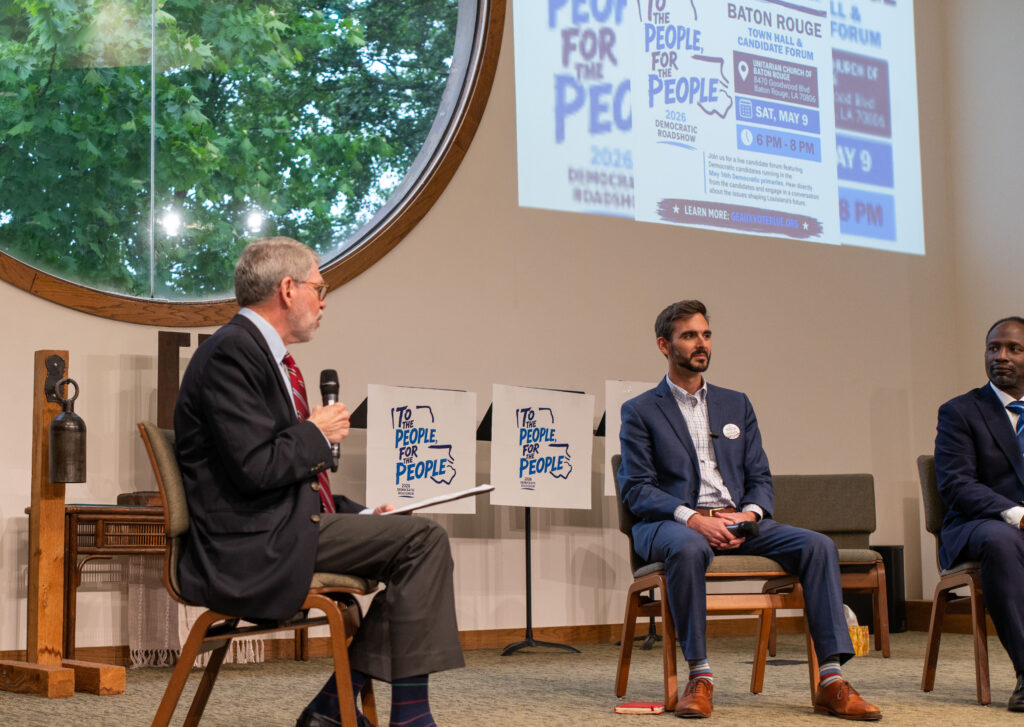
Asked for a message to Democrats who are tired of losing but not ready to give up, Albares said Democrats can still build a politics rooted in shared values rather than personality.
“Everybody wants to walk out onto a safe street,” Albares said. “Everyone wants quality health care. We all want to drink clean water and breathe clean air. We all want a solid job with good wages and solid benefits.”
Crockett closed with a direct appeal to discouraged Democrats.
“I know right now some are confused and some really feel down, but I want you to know that a better day is coming,” Crockett said. “Send me to Washington. It will be my voice, but it will be your words. Everything I do will be for the people.”
For a party still trying to rebuild its statewide voice, the Baton Rouge forum offered a familiar challenge. The Democratic message on wages, health care, voting rights and working-class economic pressure is there. Whether the party has the infrastructure to carry that message across Louisiana remains the harder question.