
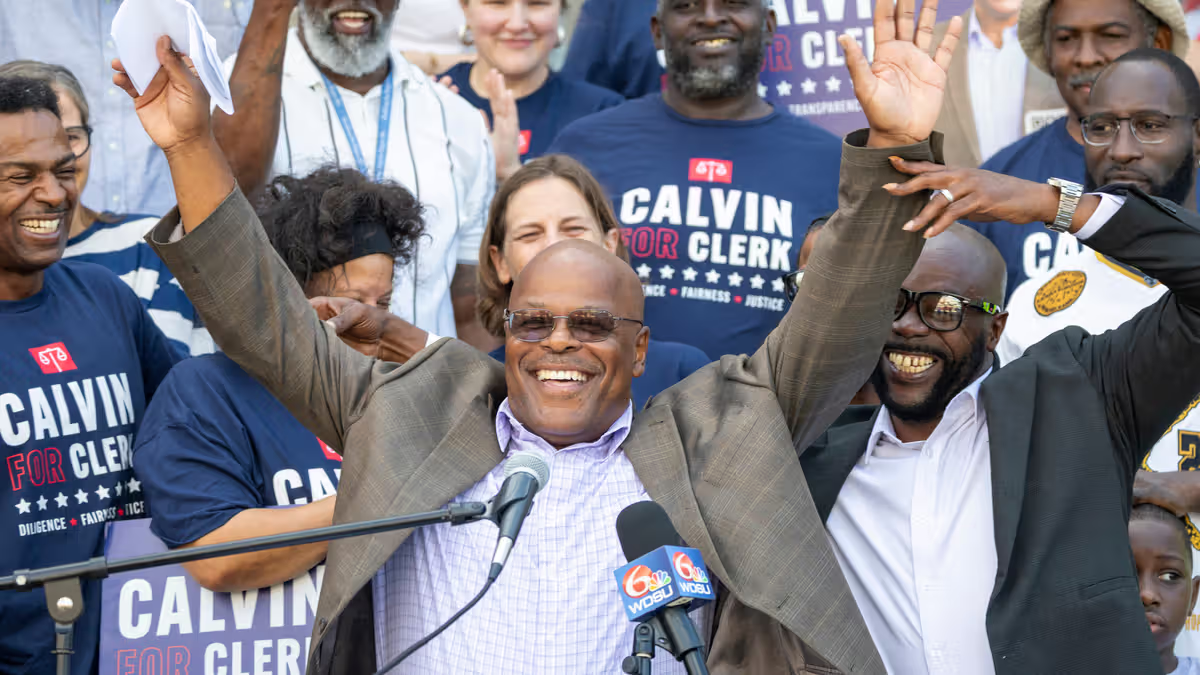
A federal judge on Sunday blocked Louisiana from enforcing a new state law that would have abolished the Orleans Parish Criminal District Court clerk’s office one day before Calvin Duncan was set to assume the post voters elected him to fill.
The ruling clears the way, at least temporarily, for Duncan to take office Monday as Orleans Parish criminal clerk of court. It also marks a sharp legal defeat for Gov. Jeff Landry, Secretary of State Nancy Landry, and Republican lawmakers who rushed through Senate Bill 256, later signed as Act 15, to eliminate Duncan’s position before his term could begin. Fox 8 reported that Duncan won the post in November with 68% of the vote.
U.S. District Judge John deGravelles granted Duncan’s request for a temporary restraining order, finding that Senate Bill 256 is unconstitutional and barring Jeff Landry and Nancy Landry from enforcing it, certifying the Orleans civil clerk as the new parishwide clerk, or issuing a commission for that newly created position. The order lasts 14 days, with a status conference set for Monday afternoon to discuss a longer-lasting preliminary injunction.
In plain English, the judge found that the state cannot wait until voters choose someone, abolish that elected office days before the winner takes power, create a replacement office, and then hand that new office to someone voters never selected for that job.
That was the heart of deGravelles’ ruling.
“The Court is not ruling that the state lacks the authority to abolish an agency or office writ large,” deGravelles wrote. But he found that Louisiana crossed the constitutional line by “abolishing this particular office, creating a new office to replace it, and then appointing someone for that office, all when the Louisiana Constitution requires an election.” In doing so, he wrote, the state violated Duncan’s federally protected rights to due process and to vote.
The ruling is temporary, but it is not a minor procedural hiccup for Landry. Temporary restraining orders are emergency orders meant to prevent immediate harm before a case can be fully litigated. To win one, Duncan had to show, among other things, that he is likely to succeed on the merits, that he faced irreparable harm, and that blocking the law would serve the public interest. DeGravelles found that Duncan met that standard.
The Landry administration and Attorney General Liz Murrill are already appealing the decision to the U.S. Fifth Circuit Court of Appeals. In a statement Monday morning, the administration accused media outlets of misreading the order and claimed the court had not actually cleared Duncan to take office.
“Late last night, media outlets breathlessly reported that a federal court ‘cleared’ Mr. Duncan to take the office of criminal district clerk in Orleans Parish,” the statement said. “If they had read the court order, they would have seen that the federal court refused to do so — not least because everyone agrees that office does not exist.”
The statement continued: “This false reporting is irresponsible, it is why the American people distrust the media, and it warrants retractions. As for the court order, it accomplishes nothing of substance, and I have immediately appealed it to the Fifth Circuit. In the meantime, a more-efficient court process under Act 15 and the Orleans Parish clerk of court begins today.”
That is now the state’s argument: that because the court did not expressly order Duncan installed into office, and because the state claims Act 15 already abolished the criminal clerk position, the ruling does not do what most news outlets said it did.
But that argument runs into the plain text of the order itself. DeGravelles found Act 15 unconstitutional and enjoined Jeff Landry and Nancy Landry from enforcing it. He also blocked them from certifying or commissioning Orleans Civil District Court Clerk Chelsey Richard Napoleon as the newly created parishwide clerk. In other words, the court may not have written the state’s desired magic words about Duncan assuming office, but it did block the legal mechanism designed to stop him and replace his office with Napoleon’s.
That distinction matters, but it does not save the state’s position from the obvious practical reality: Act 15 was designed to prevent Duncan from serving, and the federal court blocked enforcement of Act 15.
Congressman Troy Carter praised the ruling Monday, framing it as a victory for both Duncan and the voters who elected him.
“Thank you to U.S. District Judge John deGravelles for upholding the Constitution and protecting the will of the voters,” Carter said. “Clerk-elect Calvin Duncan can now move forward, and SB 256 has been rightly blocked. The people spoke. The law matters. Democracy must stand.”
Duncan’s election was historic in part because of his own experience with the criminal legal system. He spent more than 28 years in prison before his conviction was vacated, then became a lawyer and criminal justice advocate. His campaign centered on court transparency, access to records and reforms shaped by his own understanding of how broken court systems can ruin lives.
Senate Bill 256, authored by Sen. Jay Morris of West Monroe, was presented by supporters as a consolidation bill meant to streamline Orleans Parish’s unusually fragmented court clerk system. The measure merged the criminal and civil clerk functions and would have transferred the criminal clerk’s staff, records, property and duties to Napoleon, making her the parishwide clerk of court. The official legislative page describes SB 256 as a courts bill providing for “a clerk of court in Orleans Parish.”
Supporters argued the bill would make the system more efficient. Morris previously said every other parish operates with one clerk and argued that New Orleans could do the same. The governor and attorney general have also defended the move as a response to what they described as a bloated court system.
But deGravelles found that the state’s stated justifications were “likely, pretextual” and that the record showed “the state has a minimal interest in passing SB 256.” That conclusion was not based on vibes. The ruling walked through the legislative record, including Morris’ admission that the bill lacked supporting studies or data, his statement that an amendment was brought at the governor’s request to pass the bill before Duncan took office, and his acknowledgment that the amendment was designed to ensure Duncan never took office as criminal clerk.
That is the part Landry’s defenders will have the hardest time spinning away. The judge did not simply say the law had bad timing. He pointed to evidence that the timing was the point.
DeGravelles also rejected the state’s argument that this was merely a lawful restructuring of an office. The judge agreed that Louisiana may have authority to abolish or reorganize offices. But once the state created a new clerk position with a new title, duties, custody, ownership, employees and authority, the Louisiana Constitution’s election requirement mattered.
That distinction is crucial. The state’s argument was essentially: we are not nullifying an election; we are restructuring government. The judge’s answer was: restructuring government does not give the state permission to bypass voters and install its preferred officeholder.
The court also focused on the rights of Orleans Parish voters, not just Duncan personally. DeGravelles found that the law placed a severe burden on voters who had already participated in a completed election and selected Duncan by a decisive margin. The court said SB 256 was not a neutral, routine election regulation. Instead, it targeted the result of an election and prevented voters from choosing who would hold the new office.
That matters because the constitutional injury here is not just that Duncan would lose a job. It is that voters would be told, after the fact, that their ballots no longer mattered because state officials found a way to erase the office before the winner could serve.
DeGravelles made clear that the public interest favored blocking the law. When a constitutional violation is alleged, courts often treat that harm as irreparable because the injury cannot simply be fixed later with money. The judge found that the public, particularly Orleans Parish voters, has a significant interest in ensuring their votes are not nullified and that they get the opportunity to vote for a newly created clerk of court office.
The ruling does not end the case. The temporary restraining order lasts for 14 days, and the state has already taken the fight to the Fifth Circuit, a court that has often been friendly terrain for Louisiana’s Republican state government. A preliminary injunction, if granted, would block enforcement for a longer period while the lawsuit proceeds.
But for now, the immediate result is clear: a federal judge found Act 15 unconstitutional, blocked the state from enforcing it, and stopped Landry from using the law to hand the newly consolidated clerk position to someone voters did not elect to that office.
The ruling also lands in a broader political context. Landry and Republican lawmakers have spent the current legislative session pushing court restructuring measures aimed heavily at New Orleans. Supporters have framed those efforts as efficiency reforms. Critics have viewed them as another example of Baton Rouge using state power to override Orleans Parish voters, particularly in a majority-Black, heavily Democratic city.
DeGravelles’ ruling does not adopt every claim Duncan made. The court did not resolve the broader retaliation claims, including Duncan’s argument that state officials targeted him because of his public criticism of Louisiana’s criminal legal system. The judge also dismissed Duncan’s right-to-vote claim against Murrill without prejudice on sovereign immunity grounds, while allowing the immediate relief against Jeff Landry and Nancy Landry to proceed.
Still, the judge’s core finding is devastating for the state’s defense: Louisiana likely violated federal constitutional protections by nullifying an election, bypassing a required election for a new office and appointing someone else to do the job voters had chosen Duncan to perform.
For a case wrapped in legal jargon, the democratic principle is simple enough. If the people vote for someone, state officials do not get to change the rules after the election because they dislike the outcome.
On Sunday, a federal judge said as much. On Monday, Landry and Murrill appealed. And now the fight over whether Louisiana can erase an elected office to block one elected official moves to the next stage.