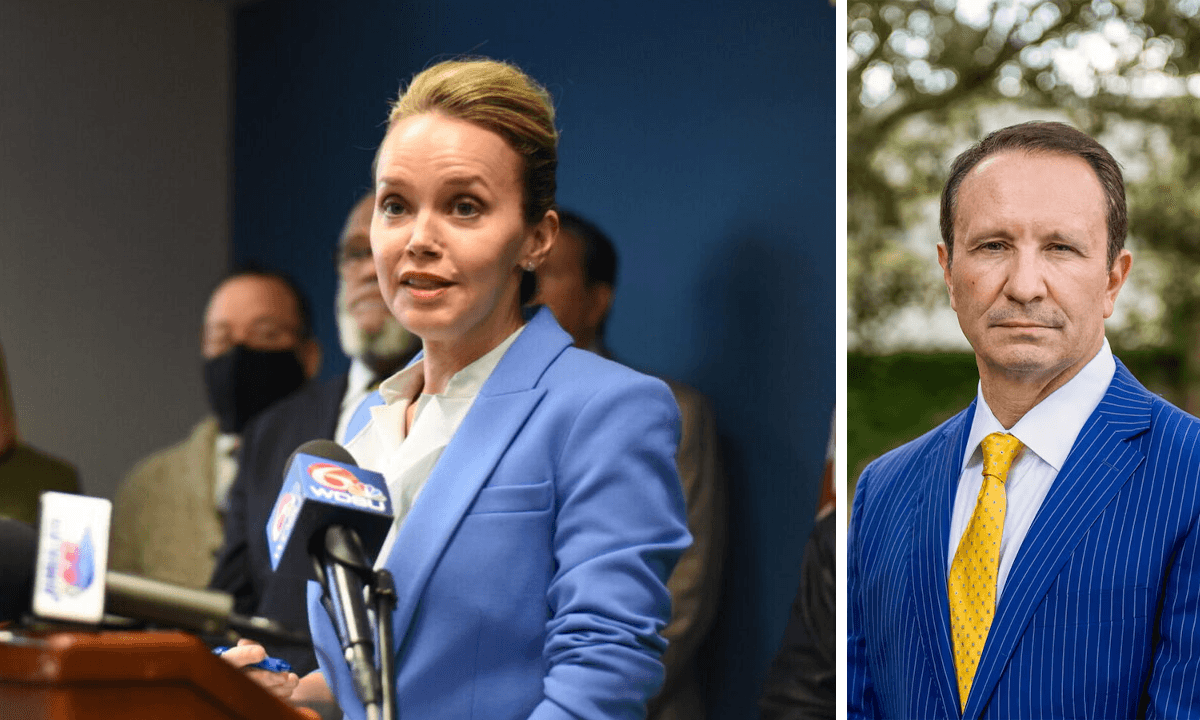
Democratic lawmakers from Louisiana, Texas, Georgia and Mississippi gathered at the Louisiana State Capitol on Wednesday to warn that Louisiana’s latest congressional redistricting fight is not an isolated state issue, but part of a broader regional effort to roll back Black voting power and Democratic representation across the South.
The press conference, led by Rep. Kyle Green Jr., chair of the Louisiana House Democratic Caucus, came as Senate Bill 121 awaited final passage in the House. The bill, sponsored by Sen. Jay Morris, would redraw Louisiana’s congressional districts following the U.S. Supreme Court’s decision in Louisiana v. Callais, which struck down the state’s previous map with two majority-Black congressional districts.
Green said the court ruling and SB 121 together represent “the most significant attempt to reduce congressional Black representation and Democratic representation in the South in a generation.”
“We’re not going to let it happen quietly,” Green said.
He was joined by Rep. Edmond Jordan, chair of the Louisiana Legislative Black Caucus; Sen. Gerald Boudreaux, chair of the Senate Democratic Caucus; Texas House Minority Leader Gene Wu; Georgia House Minority Leader Carolyn Hugley; and Mississippi Rep. Zakiya Summers.
Green said the presence of out-of-state Democratic leaders was itself part of the message.
“What’s being attempted in Louisiana is being attempted all across the South,” Green said. “This is not just a Louisiana problem. This is a regional project. It requires a regional response.”
Jordan placed the current redistricting fight in the context of Louisiana’s long history of Black political representation, pointing to the Reconstruction era, when Black Louisianians briefly held meaningful power in state government before that representation was systematically stripped away.
Jordan said he feared the state was “headed down that trajectory again,” adding that Black elected representation has always required sustained legal and political struggle.
“Our motto has always been, over the last few years, ‘If we can’t win through legislation, we’ll win through litigation,’” Jordan said. “We are prepared to do that.”
During questions from reporters, Jordan said Democrats are already looking at possible legal challenges if the map is approved.
“I’m under no delusions that this map will pass,” Jordan said. “When it does, we’ll move forward from there.”
Asked how quickly litigation could come, Jordan said it could be within the next 30 days, though he said attorneys would need time to “dot all i’s and cross all t’s.”
Boudreaux said the fight over redistricting cannot be reduced to a routine political battle over lines on a map.
“At the end of the day, redistricting is about people,” Boudreaux said. “It’s about whether communities feel like they have a voice and whether they believe the process is being handled fairly and openly.”
He said the consequences of the map would be felt well beyond Louisiana.
“What happens here will be watched closely throughout the South,” Boudreaux said.
Wu, the Texas House minority leader, delivered the sharpest political message of the press conference, arguing that gerrymandering affects not only Black voters or Democrats, but working-class people broadly.
“If you’re thinking that this is just about Democrats, or you’re thinking this is just about the Black community, you’re wrong,” Wu said. “Redistricting, gerrymandering — this is how they steal the American dream from you. This is how they steal your democracy.”
Wu urged voters to contact state legislators, help candidates and organize in their communities.
“When Republicans vote for this illegal map tomorrow, they will be stealing from all working-class Louisianians,” Wu said.
Hugley, the Georgia House Democratic leader, tied the redistricting fight to her own experience growing up in the segregated South. She said the Supreme Court’s decision felt “hauntingly familiar” because of how maps have historically been used to limit Black political power.
“Nobody is writing ‘colored’ on birth certificates anymore,” Hugley said. “But when you hear a community’s representation is being drawn off the map and politicians act as if they are doing what is right and legal and proper, what is the difference? The outcome is the same.”
Summers, a Mississippi state representative who was not included in the event’s original promotional graphic but spoke at the press conference, said Louisiana’s fight is already resonating across state lines.
“What’s happening in Louisiana is not just staying in Louisiana,” Summers said. “It’s happening all across the South.”
Summers said her own great-grandmother was only able to vote after passage of the Voting Rights Act of 1965 and would walk five miles into town to cast her ballot and encourage neighbors to do the same.
“It was because of her sacrifice that she has a great-granddaughter that’s in the state capitol, that’s a part of the policy-making table,” Summers said. “That’s what voting does.”
The press conference ended with Democrats framing the fight ahead as both legal and electoral: challenging new maps in court, pressuring lawmakers before final passage and urging voters to stay engaged despite the confusion and fatigue that often surrounds redistricting.
“They want you to believe that your vote does not matter,” Hugley said. “That is the whole plan.”