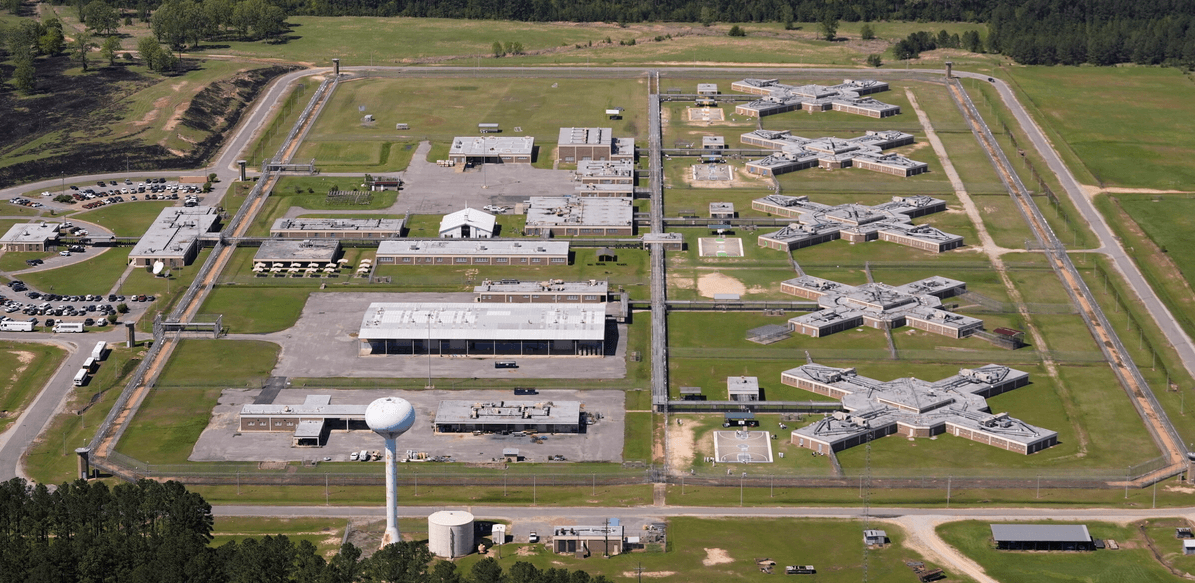
A newly released federal watchdog report found serious safety, medical, legal access and use-of-force violations at Winn Correctional Center, a Louisiana facility used to detain immigrants for U.S. Immigration and Customs Enforcement.
The Department of Homeland Security Office of Inspector General report, released June 2, details the findings of an unannounced March 2025 inspection of the Winnfield facility. At the time inspectors arrived, ICE was holding 1,576 men at Winn — the facility’s contractual maximum capacity. Winn is owned by the Winn Parish Sheriff’s Office and operated in coordination with ICE and private contractor LaSalle Corrections.
The report is damning, and not just because of one or two isolated problems. Federal inspectors found failures across nearly every area that matters inside a detention facility: use of force, food safety, medical care, legal access, classification records, detainee communications, work program records, environmental safety and recreation for people held in disciplinary segregation.
Here are the biggest takeaways.
1. Inspectors found improper use of force — including a choke hold and an officer puncturing a detainee’s thumb with a pen.
This is the most disturbing section of the report.
Winn reported 18 use-of-force incidents between September 2024 and March 2025. OIG reviewed five of them and found that facility staff violated standards in three.
In one incident, an officer used a choke hold on a detainee involved in a physical altercation. ICE detention standards specifically prohibit choke holds. In another incident, a five-person team restrained a detainee and placed him in a suicide smock, but staff failed to document the required medical review and findings on camera. In a third incident, an officer stabbed a detainee’s right thumb with a pen, puncturing the skin, after the detainee refused to remove his hand from a housing unit door.
The report also found that facility staff could not show that ICE was properly notified within the required timeframe in four of the five reviewed incidents. And when after-action reports indicated staff should receive retraining or discipline, the facility could not provide documentation showing that follow-up actually happened.
2. Facility staff did not provide complete video footage to federal inspectors.
OIG said facility staff provided incomplete footage for two of the five use-of-force incidents reviewed. In one case, the handheld recording provided to investigators ended before force was used against a detainee, even though inspectors had already viewed that footage while on site. In another case, the footage provided later did not include handheld camera footage inspectors had previously seen.
OIG said facility staff claimed they had provided all available footage. Without the complete recordings, the watchdog said it could not fully analyze whether staff complied with use-of-force standards.
That is not merely a paperwork issue. When a detention facility does not provide complete use-of-force footage to federal inspectors, the public is left with a basic accountability question: what exactly happened, and why could investigators not get the full record?
3. Inspectors found leaking ceilings, exposed insulation and water pooling inside the facility.
The report includes photographs of deteriorating conditions inside Winn.
In the intake building, where detainees enter the facility, inspectors found holes in the ceiling, insulation hanging from ceiling tiles and water dripping onto the floor. The exposed insulation was located above an area used to store detainee clothing, shoes and other property.
In the kitchen, inspectors found three leaking vents, including one that created a puddle directly beneath it. In the Special Management Unit, the ceiling was cracked and leaking, with staff attempting to catch the water using napkins and Styrofoam containers that overflowed onto the floor.
These are not cosmetic problems. In a detention setting, leaks, puddles, exposed insulation and deteriorating infrastructure raise direct safety and sanitation concerns for people who cannot simply leave.
4. Food was stored at unsafe temperatures.
Federal standards required Winn to store perishable food between 35 and 40 degrees Fahrenheit and frozen food at or below zero degrees. Inspectors found three coolers reading between 44 and 60 degrees and a freezer reading 11 degrees.
The report warned that food stored above required temperatures could spoil or rot, creating a risk of foodborne illness for detainees and staff.
This finding is especially important because food complaints have long been part of broader concerns about immigration detention conditions in Louisiana. A 2024 ACLU-led report on Louisiana ICE detention facilities cited allegations involving contaminated food, poor sanitation, medical neglect and other inhumane conditions across facilities under the New Orleans ICE Field Office.
5. Medical records were incomplete in ways that could put detainees at risk.
OIG’s medical contractors reviewed 36 detainee health records and found that Winn medical staff did not consistently update Master Problem Lists and treatment plans. Medical staff also did not always document how lab results were interpreted, what was discussed with detainees, or what action was taken in response to those results.
The report said these deficiencies posed a risk to patient health and safety because medical records are how providers communicate a detainee’s condition and treatment needs.
Again, this is not a clerical nitpick. In a closed detention environment, incomplete medical records can mean serious conditions are missed, treatment is delayed, and responsibility becomes harder to trace after something goes wrong.
6. Detainees lacked secure access to legal materials.
Inspectors found that detainees did not have a secure and private way to save legal work. Instead, detainees used shared USB drives or computer desktops. Facility staff also did not consistently post the required list of local free legal service providers or the rules and hours for legal visitation.
For detained immigrants, legal access can determine whether they are able to pursue asylum, challenge detention or fight deportation. A shared USB drive is not a meaningful substitute for confidential legal access. It is a due process problem dressed up as a technology problem.
7. Recordkeeping failures made it harder to verify whether Winn was following the rules.
The report found that 25 of 30 reviewed detention files were missing supporting criminal history documentation needed for custody classification. 19 of 25 files that required reclassification paperwork did not include it.
Winn also failed to maintain historical data for its voluntary work program. Instead, the facility overwrote the previous week’s work records, making it impossible for inspectors to verify whether detainees were being paid properly or kept within work-hour limits.
The facility also had problems with detainee communication records. OIG found that ICE’s electronic logs did not include required information and did not distinguish between requests and grievances. Inspectors also found confusion around mailboxes used for detainee correspondence, including ICE-related communications.
That matters because poor records are how bad systems protect themselves. If the paperwork is missing, overwritten or impossible to sort, then abuse, neglect and noncompliance become harder to prove.
8. The findings fit into a larger pattern of concern about ICE detention in Louisiana.
This report does not land in a vacuum.
Louisiana has become one of the country’s major immigration detention hubs, with rural jail and prison facilities playing a central role in the federal detention system. Local activists have begun describing Winnfield as part of Louisiana’s “Detention Alley,” noting Winn Correctional Center’s role as a private prison turned ICE detention facility operated by LaSalle Corrections.
Advocacy groups have also raised alarms about Winn specifically. In 2024, the Southern Poverty Law Center and partner organizations filed a federal complaint focused on Winn Correctional Center, alleging physical assaults, verbal abuse, medical neglect and inhumane conditions.
The OIG report does not prove every allegation advocates have made over the years. But it does provide a federal record confirming serious failures at a facility that was already under scrutiny.
9. ICE agreed to fixes, but several major recommendations remain open.
ICE concurred with all nine OIG recommendations. But OIG considered only four recommendations resolved and closed. Five remained resolved and open, including recommendations related to environmental safety, use of force, voluntary work program records, legal materials and detainee communications.
In some cases, OIG said ICE had not provided enough evidence to show the specific problems inspectors identified had actually been corrected. For example, ICE provided some evidence of ceiling and pipe repairs, but OIG said that evidence did not demonstrate the specific photographed problem areas had been fixed.
The bottom line: this was not a routine inspection with a few minor deficiencies. It was a federal watchdog report documenting dangerous and rights-threatening failures inside a Louisiana ICE detention facility operating at maximum capacity.
And the unanswered question is obvious: if this is what inspectors found during one unannounced visit, what has been happening inside Winn when no one was watching?
Read the full report below: