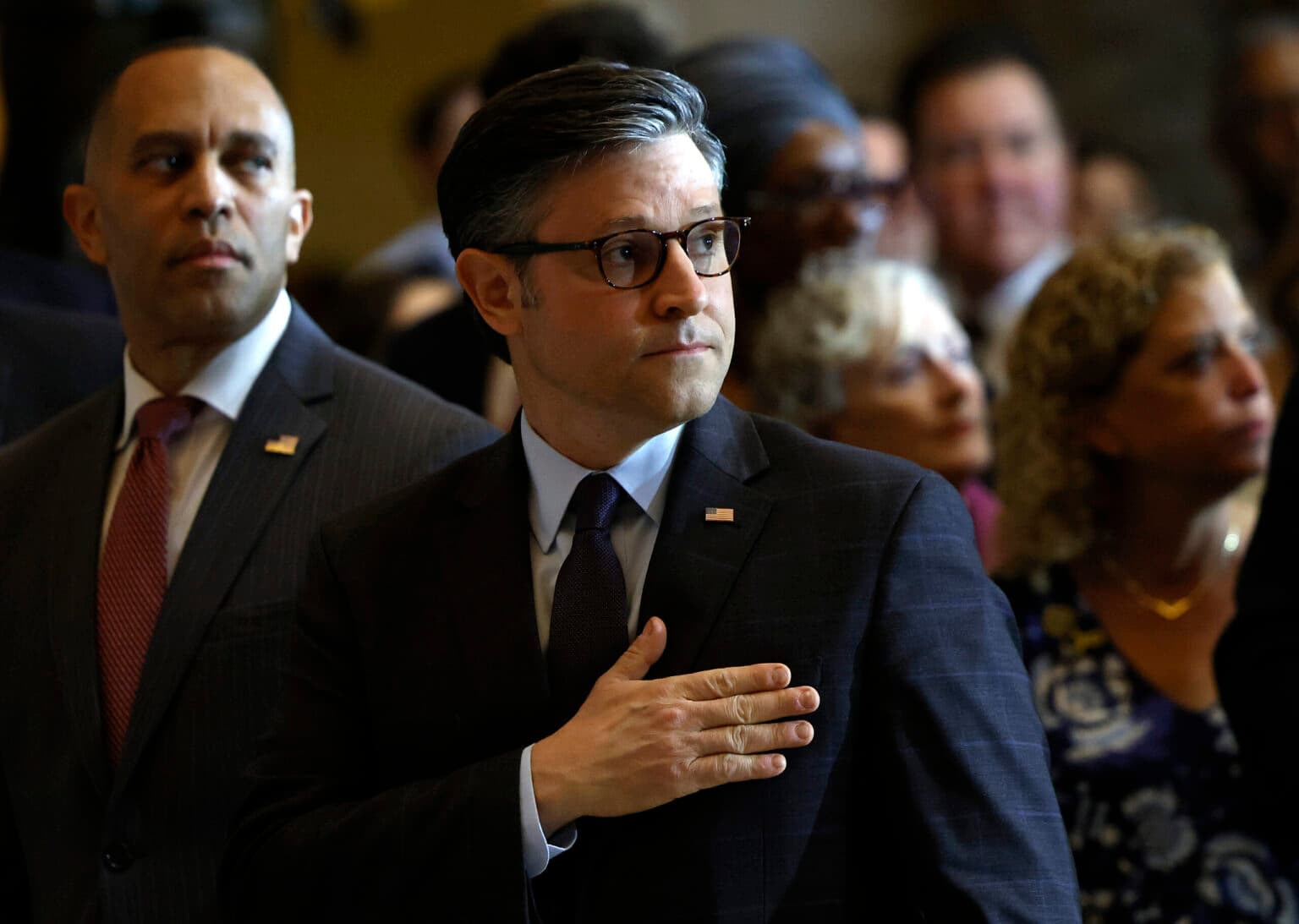
House Speaker Mike Johnson made it official Wednesday: when forced to choose between the political demands of Donald Trump and the moral warning of the head of the Catholic Church, Louisiana’s most powerful Republican chose Trump.
Asked about the growing clash between the White House and Pope Leo XIV, Johnson did not try to calm the situation. Instead, he effectively justified the administration’s attacks on the pope, saying religious leaders are free to speak, but should expect blowback when they “wade into political waters.” Johnson added that he had been “taken a little bit aback” by Leo’s recent remarks condemning war and invoked the Christian concept of “just war” to defend the administration’s posture.
That matters for two reasons. First, Johnson is not some random backbencher freelancing for attention. He is the Speaker of the House, a Louisiana Republican who has built much of his public image around religious conviction and moral certainty. Second, the pope in question is not weighing in on tax policy or partisan messaging. Leo, the first American-born pope, has been condemning the U.S.-Israeli war in Iran, warning against the abuse of power in democratic societies, and arguing that faith cannot be used to sanctify bloodshed. Reuters reported that Leo has said God rejects the prayers of those who wage war and has also criticized Trump’s immigration posture.
Trump, unsurprisingly, responded not with humility but with grievance. In recent days, he called Leo “weak” and “terrible” on crime and foreign policy, urged that “someone please tell Pope Leo” about Iranian repression, and continued escalating the spectacle by reposting an image showing Jesus embracing him after earlier deleting an AI-generated image that portrayed him in a Christ-like way.
Vice President JD Vance joined in as well, warning the pope to “be careful” when speaking about theology. Then came Johnson, offering what was essentially the institutional Republican position: the pope can talk, but the White House gets to punch back. Texas Rep. Troy Nehls took the same line more bluntly, telling Leo to “stay out of politics” and declaring, “Donald Trump is our president.”
What Johnson is really saying is more revealing than the words themselves. He is not merely defending Trump’s right to disagree with the pope. Of course he has that right. He is defending Trump’s entire posture — the sneering, the theological chest-thumping, the demand that religious authority stay in its lane when it challenges state violence, and the assumption that political power gets the final word even in matters of conscience.
That is especially striking coming from a politician who has spent years presenting himself as a man guided by biblical values. When the conflict is between a president threatening whole civilizations and a pope calling for peace, Johnson’s instinct was not to urge restraint, seriousness, or humility. It was to explain why the pope had it coming.
And that gets at something deeper in modern conservatism, including here in Louisiana. For many Republican leaders, religion remains useful so long as it blesses the existing political order. The moment a religious leader applies moral scrutiny to war, nationalism, or state power, the response is no longer reverence. It is irritation. Suddenly the clergy are being “political.” Suddenly moral language is unwelcome. Suddenly the problem is not the bombs, but the bishop noticing them.
Johnson tried to soften his remarks by saying he respects the pope and does not want a theological debate. But that disclaimer does not change the substance. He chose to validate Trump’s reaction rather than the pope’s warning. He chose power over principle, loyalty over moral consistency, and partisan alignment over the inconvenient possibility that the pope might be right.
For a politician who so often speaks as though faith is central to public life, Johnson’s message on Wednesday was remarkably plain: faith is welcome in politics right up until it challenges Trump.