





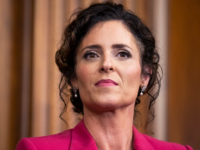













With Louisiana’s 5th Congressional District open for the first time in years, Democratic candidate Lindsay “Rubia” Garcia is trying to make the case that this is not the cycle for cautious politics.
In an interview with The Bayou Progressive, Garcia described herself as a teacher, advocate, organizer, and newly minted lawyer who has spent years building a public voice online and in her native New Orleans community. Now, she is trying to turn that profile into a campaign in one of the state’s most sprawling and heavily Republican-leaning districts. The seat is open because U.S. Representative Julia Letlow is running for the Senate, and Garcia is one of several Democrats competing in the new closed primary system for Congress, with the primary set for May 16.
Garcia said her life and politics were shaped by a mix of deeply Louisiana experiences: growing up in New Orleans, teaching in public schools, becoming known online through political commentary, and eventually attending Southern University Law Center as a nontraditional student while raising children.
“I think anyone at this juncture who wants to participate in the political party system has to be a little bit crazy,” Garcia said, laughing early in the interview. But beneath the joke was a serious argument: that too many voters feel unrepresented, too many Democrats are too timid once they get power, and too much of politics has become performance instead of action.
That theme ran through nearly every answer she gave. Garcia repeatedly framed herself less as a polished institutional candidate than as someone shaped by conflict, public advocacy, and a willingness to absorb political risk. Her pitch is not that she is the safest Democrat in the field. It is that she is the one most prepared to confront the current moment without apology.
A former teacher, Garcia said her time in the classroom changed how she understood both politics and inequality. She described teaching history, civics, geography, and economics, then watching students confront realities that did not line up with the optimistic version of America they were often taught to believe in. She said that disconnect helped shape her public voice online, where she first gained a large following by speaking candidly about education and the conditions her students faced.
But the experience she returned to most often in the interview was the 2019 Hard Rock Hotel collapse in New Orleans.
Garcia described the catastrophe — which killed three workers and left two bodies in the wreckage for months — as a turning point in her public advocacy. She said her students were among those walking past the site, seeing the remains of a worker still visible behind a tarp in downtown New Orleans, and trying to process what that said about whose lives were valued.
For Garcia, the horror of the Hard Rock collapse was not only the deadly failure itself, but what she saw as the public normalization of disrespect toward working people and Black communities. She said the event crystallized for her the gap between the values schools try to teach children and the values many institutions actually model.
That experience pushed her more deeply into activism, and eventually toward law school. Garcia said Southern helped sharpen her understanding of how power actually works, giving her more than just credentials. It taught her how policy is structured, where leverage sits, and how difficult it is to win change from outside the room.
“I’m tired of talking online,” Garcia said, summarizing the transition from commentator to candidate. The problem, she argued, is not that public commentary is useless. It is that social media rewards volume, conflict, and aesthetics in ways that often drown out substance. Law school, she said, reinforced her belief that if people want actual policy outcomes, they have to understand the board, not just yell from the sidelines.
That tension — between commentary and governance — may define the central test of her candidacy.
Garcia already has something many first-time congressional candidates do not: a public platform (over 1 million followers on Facebook, over 200,000 on Instagram, and over 270,ooo on Tik Tok) and a recognizable political voice. Her challenge is proving that those assets can translate into a serious district-wide campaign across a 14,000-square-mile seat that stretches across dramatically different communities and local concerns. She acknowledged that difficulty directly, but insisted it does not intimidate her.
Instead, Garcia says her strategy is simple: go everywhere, meet people where they are, and make the campaign as human as possible. She talked at length about wanting to speak directly with farmers, rural voters, workers, and young people leaving Louisiana because they do not see a future here.
On policy, Garcia said she wants voters to understand her campaign through three broad priorities: affordability, healthcare, and justice.
She framed affordability not as an abstract economic debate, but as a daily question of whether people can feed their families, keep up with bills, and maybe have enough left over to enjoy life once in a while. She said too many people are working hard and still falling behind, and argued that public policy should be judged by whether it materially improves people’s lives.
On healthcare, Garcia was unequivocal. “Healthcare is a human right,” she said, rejecting the idea that people in the wealthiest country in the world should be one illness away from financial collapse.
And on justice, she uses the term broadly — encompassing racial justice, environmental justice, workers’ rights, education, and government accountability. She spoke about wanting stronger oversight, more forceful congressional action, and a political style that is less fixated on politeness and more willing to confront concentrated power.
Garcia also made clear that she does not see herself as a conventional party-line Democrat. She said she only recently formally joined the Democratic Party after years as “no party,” and repeatedly described herself as “not your orthodox Democrat.” Still, she argued that the Democratic coalition is the more viable vehicle for the kind of populist, pro-worker, pro-democracy politics she wants to advance.
That populist streak came through most clearly when she was asked about the difference between Democrats and Republicans in 2026. Her answer was less about partisan branding than about power: who government serves, who bears the consequences, and whether politics is being driven by ordinary people or by billionaires, corporations, and entrenched interests.
Even then, Garcia was careful not to reduce every voter to a party label. She repeatedly said she believes most people, regardless of party, want similar basic things: decent wages, stable healthcare, good schools, safe communities, and leaders who will actually fight for them. In that sense, her campaign is also making a gamble about persuasion — that even in a gerrymandered district, there is space for a candidate who speaks in sharper moral terms but grounds those terms in everyday material concerns.
Garcia said that if elected, she would want to serve on the House Judiciary Committee and the Appropriations Committee, reflecting both her legal background and her interest in oversight and federal spending. For a first-time candidate, that answer was also revealing. She is not running as someone content to simply cast symbolic votes. She is presenting herself as someone who wants to confront institutions directly.
Whether that message can carry her through a Democratic primary and then into a competitive general election is another matter.
Garcia is a first-time candidate running in a district designed to favor Republicans, and she is doing so in a race where money, organization, and geography are all real obstacles. Still, Garcia’s candidacy taps into a real frustration inside Democratic politics: the belief that too many candidates sound focus-grouped, too many officeholders govern defensively, and too many voters are desperate for someone who sounds like they actually mean it.
Asked what she most wants voters in the 5th District to know about her before they make up their minds, Garcia’s answer was less polished slogan than worldview. She said she wants people to understand that she is not offering a detached policy platform so much as a life shaped by the same pressures many of them are living.
“I’m just a teacher with a smartphone,” she said.
That line is a little self-effacing, but it gets at the heart of the candidacy. Garcia is trying to turn a grassroots, digital-age form of advocacy into an electoral argument: that politics does not belong only to the polished, the connected, or the machine-backed. In a district as difficult as the 5th, that may not be enough on its own. But it is, at minimum, a distinct case.