
















Tia LeBrun, who entered Louisiana’s 3rd Congressional District race as a Democrat, announced that she has changed her party registration and will now run as a No Party candidate in the newly configured district.
The move comes after months of legal and political chaos surrounding Louisiana’s congressional elections, including the cancellation of the original U.S. House primary and the adoption of a new congressional map. For candidates who had spent the spring campaigning under one set of rules, the shift did more than move an election date. It changed the electorate, the map and the basic strategy of the race.
LeBrun said as much in her announcement video, framing the switch not as an ideological break, but as a response to the new political reality.
“Changing my party registration does not change who I am, what I believe, or why I entered this race,” LeBrun said. “I am the same Houma Nation member, educator, wife, mother, and advocate for Louisiana families that I was when I first announced my candidacy.”
LeBrun said she initially entered the race as a registered Democrat and accepted contributions while running as a Democratic candidate. She defended those contributions as legal and transparent, while acknowledging that questions about her party switch had already begun circulating.
“I appreciate the question because voters deserve transparency,” she said.
That transparency now comes with a strategic calculation. The 3rd District race is no longer moving through the closed Democratic primary LeBrun originally entered. It is now headed into Louisiana’s fall open-primary system, where candidates from all parties appear on the same ballot and voters are not separated by party registration.
In that environment, LeBrun is trying to reposition herself as a candidate whose appeal is rooted less in party identity than in the shared pressures facing south Louisiana: insurance costs, coastal loss, disaster recovery, healthcare access, education and the cost of living.
“This district is made up of Democrats, Republicans, Libertarians, and voters who belong to no party at all,” LeBrun said. “It includes teachers, veterans, fishermen, oil and gas workers, healthcare professionals, small business owners, tribal communities, farmers, and working families.”
“My responsibility is not to represent one political party,” she added. “It is to represent all of them.”
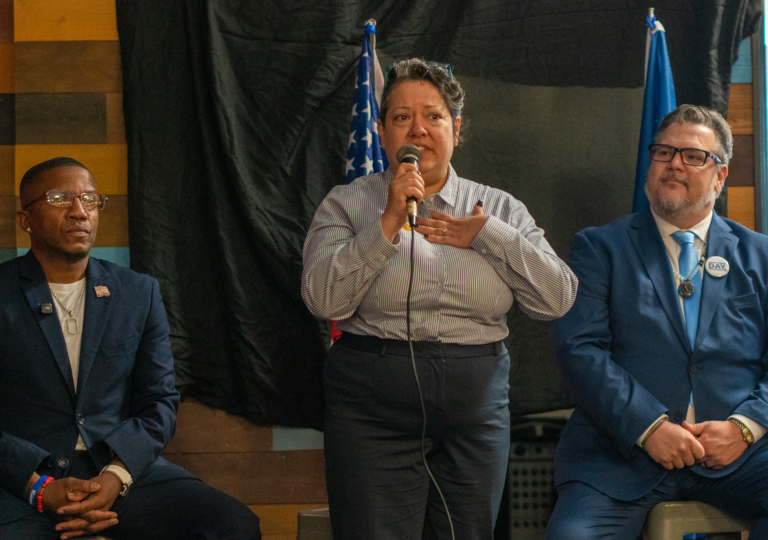
That message is not entirely new for LeBrun. During the To The People, For The People Democratic Roadshow, she often framed the 3rd District race around coastal communities and working families rather than national partisan branding. In Lake Charles, she argued that even voters who like Republican incumbent Clay Higgins can be reached when the conversation turns to groceries, gas and the daily cost of living. In Houma, she emphasized the importance of coastal communities, the United Houma Nation and the need to keep campaigning even as state leaders threw the congressional elections into uncertainty.
LeBrun has also used the campaign to stake out positions that fit comfortably within the Democratic field she originally joined. She has called for raising wages, strengthening the child tax credit, protecting public education funding, defending FEMA’s role in disaster response and taking a more cautious approach to carbon capture, data centers and other industrial projects that ask Louisiana communities to absorb risk.
That is part of what makes LeBrun’s move politically notable. She is not suddenly running as a conservative or abandoning the issue set she carried as a Democrat. She is making a ballot-label decision after the race she entered effectively ceased to exist in its original form.
It is also a decision with obvious risks.
No Party candidates can sometimes present themselves as above partisan dysfunction, but they also give up the built-in infrastructure and voter cues that come with a major party label. In a federal race against an incumbent like Higgins, that is not a small thing. Voters may say they dislike party labels, but campaigns still run on money, organization and recognition — and party labels still help voters make quick decisions in crowded races.
LeBrun was already running in a difficult race. Before the election calendar was upended, the Democratic State Central Committee endorsed John Day in the 3rd District Democratic primary, not LeBrun. And neither Democrat had raised much money or shown the kind of financial muscle typically needed to seriously threaten a Republican incumbent in a district drawn to favor Republicans.
But the old Democratic primary no longer exists. That gives LeBrun an opening to argue that the old assumptions about the race no longer apply either.
Her announcement was careful not to attack Democratic voters or distance herself from the people who supported her original campaign. Instead, she framed the decision as an adaptation to a disrupted process and a redrawn district.
“The decision to change my registration was not about abandoning my values,” LeBrun said. “It was a strategic decision made in response to the unprecedented cancellation of the congressional primary election.”
That may be the clearest summary of the move. LeBrun is betting that in a newly configured 3rd District, after months of election disruption, a No Party label gives her more room to compete than the Democratic label she started with.
Whether voters agree is the harder question.
LeBrun closed her announcement by asking voters to judge her by her record and platform, not her party registration.
“At the end of the day, I am not running to represent a political party,” LeBrun said. “I am running to represent you.”