












The Louisiana Public Service Commission sided with Meta this week in a fight over whether the technology giant should have to substantiate the claims being used to justify billions of dollars in new Louisiana power infrastructure.
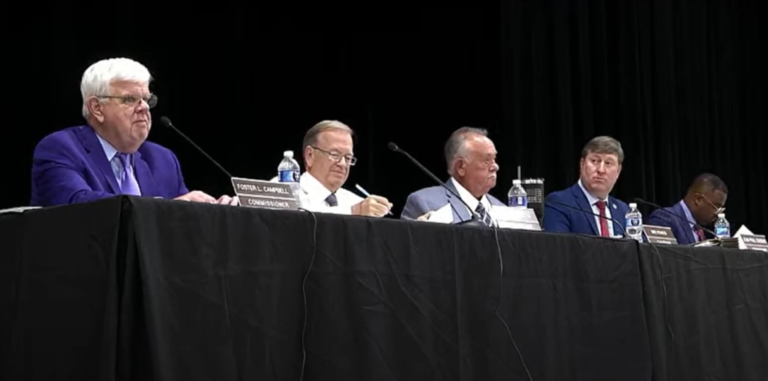
In a 3-1 vote Wednesday, the commission overturned a ruling from Chief Administrative Law Judge Melanie Verzwyvelt that would have required Meta to provide records supporting its projections for investment, permanent employment and electricity demand at its sprawling Hyperion data center in Richland Parish.
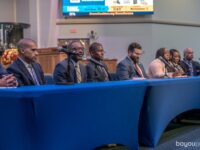
District 3 Commissioner Davante Lewis cast the lone vote to allow the subpoena to stand. Republican Commissioners Eric Skrmetta, Jean-Paul Coussan and Mike Francis voted to block it. Commissioner Foster Campbell was absent.
In an interview with The Bayou Progressive following the decision, Lewis accused his colleagues of abandoning the PSC’s fundamental responsibility to the people it regulates utilities on behalf of.
“I think my colleagues completely had a dereliction of their duty,” Lewis said. “Our job is to protect the public interest.”
While the official minutes and a transcript from Wednesday’s meeting had not yet been published as of Friday afternoon, firsthand accounts of the proceeding, the commission’s published agenda and Lewis’s interview establish that the commission granted Meta’s request for immediate review and reversed the administrative law judge’s decision during the meeting.
The distinction at the heart of the dispute is important.
Verzwyvelt had not ordered Meta to dump its confidential business records onto the internet. Nor had she granted the full scope of information initially sought by the Alliance for Affordable Energy and Union of Concerned Scientists, which are challenging Entergy Louisiana’s newest application to power Meta’s expansion.
The judge narrowed the subpoena considerably.
She ordered Meta to produce documentation supporting three (3) central categories of claims: how much the company expects to invest in Louisiana, how many permanent jobs it expects the project to create and how much electricity the Hyperion campus is projected to consume.
Verzwyvelt rejected broader requests involving detailed load patterns, sustainability communications and information about Meta’s assets and financial guarantees.
The records she did order produced would have entered the regulatory discovery process, where confidential information can be protected under commission procedures. It was not an order for indiscriminate public disclosure.
Meta nevertheless argued that the calculations constituted confidential business information and trade secrets that could place the company at a competitive disadvantage in the rapidly developing artificial intelligence industry.
Verzwyvelt rejected Meta’s effort to reverse her ruling before referring the dispute to the full commission.
On Wednesday, three commissioners did what the judge would not: They shielded the company from having to answer the narrowed questions at all.
The numbers matter because Louisiana is being asked to build around them
The fight is not an academic dispute over corporate paperwork.
Entergy is asking the PSC to approve an enormous new generation and transmission buildout primarily intended to accommodate Meta’s rapidly expanding electricity demand.
The current application includes seven additional natural gas generating units, battery storage projects and hundreds of miles of transmission infrastructure. Those projects would come on top of three gas-fired plants already approved last year to serve Meta’s original plans in Richland Parish.
Independent analysis filed in the case places the proposed capital infrastructure in the current proceeding at more than $15 billion, including approximately $7.1 billion for four Richland Parish gas units, $5.8 billion for three Pointe Coupee Parish units and more than $1.4 billion for major transmission infrastructure.
The scale of Meta’s project has also changed dramatically.
Louisiana officials originally announced the development in 2024 as a roughly $10 billion project expected to create at least 500 permanent jobs. Meta has since said its Louisiana investment will exceed $50 billion, that the Hyperion campus will eventually reach five gigawatts of computing capacity and that more than 1,000 operational jobs will be created.
Those are extraordinary numbers.
They are also numbers that Meta, following Wednesday’s vote, will not have to substantiate through the subpoena Verzwyvelt approved.
Lewis said the employment and power-demand projections were not peripheral requests. They go directly to whether the proposed infrastructure serves the public interest.
“When we have determined that the public interest includes understanding economic development and whether or not that justifies infrastructure being built for the price tag that it is, or understanding how much power a said data center needs, these were two very simple questions,” Lewis said. “Easy data to produce that would help us evaluate the public interest.”
Entergy has relied on Meta’s projections while arguing that the massive buildout is justified. When pressed for the foundation of Meta’s employment and electricity-demand assumptions, the utility has relied on figures supplied by Meta rather than independently verified calculations.
In other words, the PSC is being asked to decide whether Louisiana should authorize infrastructure costing tens of billions of dollars based in significant part on projections supplied by the company demanding the power.
And on Wednesday, a majority of commissioners decided the groups challenging those assumptions do not get to examine the work behind them.
The commission chose not to ask
Lewis said his colleagues did not call a witness, question the parties or explain where Verzwyvelt had erred before voting to reverse her.
“Instead of asking a single question, calling a single witness or justifying where they found our administrative law judge to be wrong, my colleagues, just in a blink of an eye, said, ‘We don’t want to make Meta have to answer any questions because this is a political witch hunt,’” Lewis said.
Lewis rejected that characterization.
“I think this is just to ensure that the people of Louisiana benefit,” he said.
Neither Meta nor Entergy offered testimony defending the projections during Wednesday’s discussion, according to contemporaneous accounts of the meeting. Entergy regulatory affairs executive Larry Hand was invited to speak and declined. A Meta representative was likewise offered an opportunity to testify and declined.
The PSC nevertheless sided with them.
The decision effectively asks the public to trust the representations of Meta, Entergy and state economic development officials while restricting the ability of consumer advocates to independently test those representations in the regulatory proceeding where their accuracy matters most.
The debate over Meta’s Louisiana expansion has increasingly centered on whether the project will deliver enough economic growth, customer savings and sustained electricity demand to justify the extraordinary infrastructure being built around it.
Entergy says it will.
Meta says it will.
Louisiana economic development officials say it will.
But when consumer advocates sought documentation allowing those claims to be tested, the commission intervened on Meta’s behalf.
The timing makes the decision harder to defend
Wednesday’s vote also came one day after new reporting raised serious questions about how independently the commission has operated from Entergy in previous proceedings involving Meta.
Recent reporting revealed that metadata from a Microsoft Word document showed Hand – Entergy Louisiana’s vice president of regulatory and public affairs – authored a motion supporting the original Meta power project that was later adopted by the PSC.
Hand emailed the proposed motion to Campbell two days before the commission’s August 2025 vote. Commission lawyers later read language from the document into the record as Campbell’s motion, and substantially the same language appeared in the PSC’s official minutes.
The document even included language describing Campbell’s own political biography.
The investigation identified another instance in which Hand drafted language later used by commissioners in a separate Entergy proceeding involving Hyundai’s planned steel mill.
None of that proves the commissioners who voted Wednesday acted improperly. But it makes transparency all the more important, not less.
A regulatory commission whose decisions determine what monopoly utilities can build, how much they can charge and how billions of dollars in financial risk are divided between corporations and ordinary customers cannot credibly respond to questions about its proximity to the companies it regulates by shielding more information from scrutiny.
Particularly when the company benefiting from that secrecy is helping drive the largest electricity expansion Louisiana has contemplated in generations.
A precedent for the next data center
Lewis warned that the vote extends beyond one subpoena or one corporate development.
Asked what the decision communicates about Louisiana’s future oversight of artificial intelligence companies and data centers, Lewis said it suggests that sufficiently large investment promises can override the normal protections expected from public regulators.
“As long as you put a dollar figure in front of Louisiana officials, all other things are obsolete,” Lewis said.
He said protections, assurances and a full understanding of the public consequences appear to become secondary when officials are presented with a large enough number to promote.
That concern is particularly significant as Louisiana officials aggressively recruit more data centers and other energy-intensive industrial developments.
The Meta proceeding will help establish the regulatory standard those companies encounter: whether their economic and energy projections must survive independent scrutiny, or whether the promise of investment is itself enough.
On Wednesday, the PSC chose the latter.
Ratepayers are still being asked to assume the risk
Entergy maintains that Meta will pay the costs associated with serving its facilities and has projected billions of dollars in benefits or savings for other customers over the next two decades.
Consumer advocates dispute how secure those protections really are.
Expert testimony submitted on behalf of the Alliance for Affordable Energy and Union of Concerned Scientists argues that Entergy’s projected benefits depend on aggressive assumptions about Meta’s future electricity consumption, construction expenses and other variables. Their analysis found that relatively modest changes in those assumptions could eliminate much of the claimed benefit to ordinary customers.
One of those variables is precisely what Wednesday’s subpoena fight concerned: how much electricity Meta will actually use.
That makes the PSC’s decision difficult to separate from the broader question it will confront later this year.
The commission is scheduled to decide in December whether Entergy should be allowed to proceed with the next phase of the Meta buildout. It has already placed that proceeding on an accelerated timetable and eliminated the usual requirement that the administrative law judge issue a formal recommendation before commissioners vote.
Now the commission has also prevented intervenors from obtaining the underlying Meta records that its own administrative law judge concluded were relevant to evaluating the proposal.
Louisiana is not being asked to approve a neighborhood warehouse or another ordinary industrial customer.
The state is contemplating an energy system built around electricity demand comparable to that of a major American city, supplying one of the wealthiest technology companies in the world, through infrastructure whose costs will be measured in tens of billions of dollars.
There may ultimately be a compelling argument that the investment is worthwhile. But the larger the promise, the larger the public risk and the more extraordinary the public commitment, the stronger the case should be for scrutiny.
Lewis said he plans to continue demanding answers despite being isolated in Wednesday’s vote.
“While we may be lonely in the vote, we are numerous in the questions and in the support,” Lewis said. “I will continue lifting up those concerns, fighting to ensure that we have answers, demanding transparency – and the work doesn’t stop.”
Louisiana’s utility regulators had an opportunity Wednesday to require Meta to substantiate the promises being used to transform the state’s electrical system.
Instead, they chose to require less.