











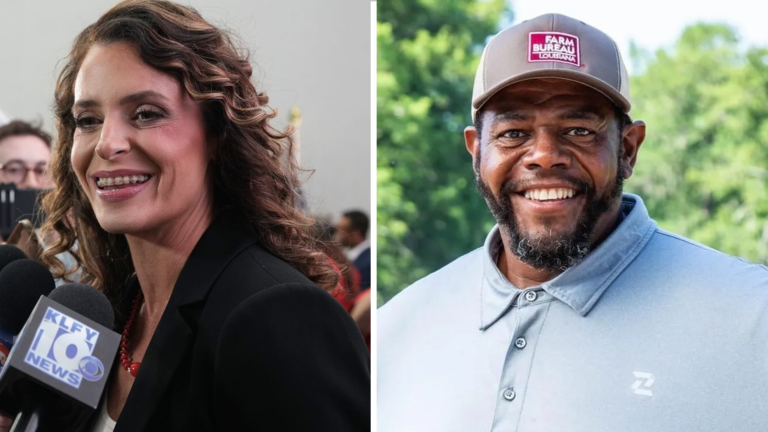
For the second time in two months, a poll commissioned by Democrat Jamie Davis’ U.S. Senate campaign shows Republican Julia Letlow leading by just four points.
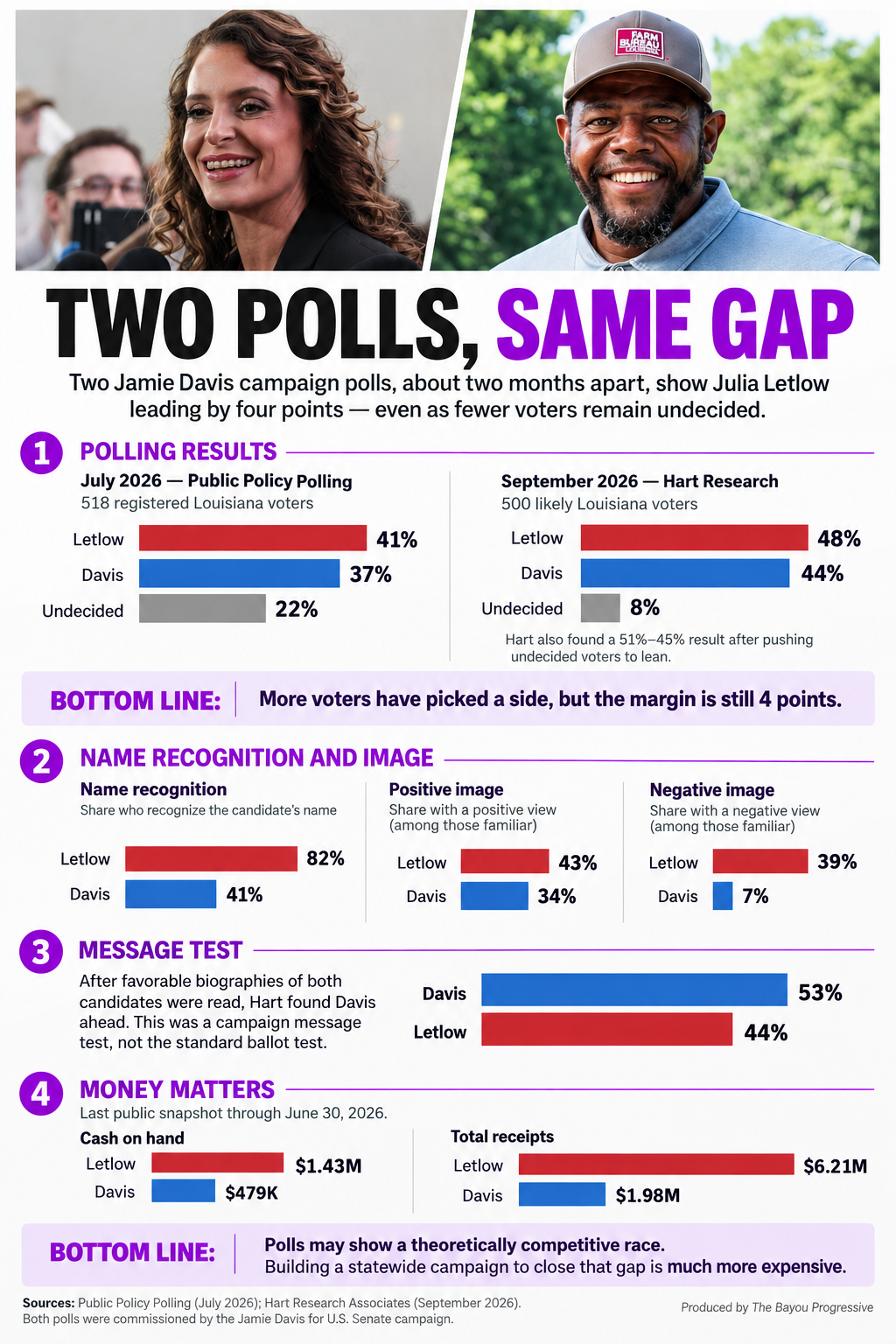
Hart Research Associates found Letlow at 48% and Davis at 44% among 500 likely Louisiana voters surveyed Sept. 17 through 19, with 8% initially undecided. The poll has a stated margin of error of plus or minus 4.5 percentage points.
Those numbers are strikingly similar to the campaign’s July survey from Public Policy Polling, which found Letlow leading Davis 41% to 37%, also a four-point margin. That earlier poll surveyed 518 registered voters and found a much larger 22% still undecided.
That similarity is both the most encouraging and most sobering part of the new poll for Davis.
The race has not widened. But it has not narrowed, either.
Over roughly two months and across two different polling firms, both candidates gained seven percentage points while the share of voters choosing neither fell dramatically. In July, nearly a quarter of the electorate was undecided. Hart now finds just 8% unwilling to initially choose between Davis and Letlow.
Both surveys were commissioned by the Davis campaign. There has still been no comparable publicly released independent general-election poll of the race, and that remains an important limitation. A polling ledger reviewed by The Bayou Progressive currently lists the Hart and PPP surveys as the only two published general-election polls between Davis and Letlow.
Hart’s full toplines add some complexity to the headline number. When voters who initially declined to choose a candidate were pressed to say which way they leaned, Letlow’s support rose to 51% and Davis’ to 45%, leaving 4% unsure. Hart’s pollster told The Bayou Progressive that he considers the initial 48 – 44 result the standard horse-race measure, with the additional percentages representing voters who only chose a candidate after being pushed for a preference.
For Davis, however, the more important finding may be how many voters still do not know much about him.
Hart found Letlow with 82% name recognition, compared with just 41% for Davis. Among voters who expressed an opinion, Davis was viewed positively by 34% and negatively by 7%, while Letlow registered at 43% positive and 39% negative.
That gives Davis an obvious strategic argument: there remains a large bloc of Louisiana voters who have not formed an opinion about him.
But an opportunity to introduce yourself is not the same thing as having the resources to do it.
Hart tested that proposition by giving voters favorable biographies of both candidates. Letlow was described as the first Republican woman elected to Congress from Louisiana, a former higher-education professional endorsed by Gov. Jeff Landry and President Donald Trump who would support a conservative “America First” agenda. Davis was described as a third-generation farmer, businessman and former Tensas Parish police juror focused on affordability and health care.
After hearing both biographies, the poll showed Davis ahead 53% to 44%.
That result is significant as a message test, but it should not be confused with a conventional ballot test. Hart confirmed that Letlow’s biography was always presented first and Davis’ second, meaning Davis’ introduction came immediately before the final vote question. The pollster also said respondents who initially remained undecided during the informed questions were pushed for a preference and folded into the candidate totals rather than separately identified as leaners.
In other words, the result suggests that Davis’ biography can move voters under the conditions of the survey. It does not establish that simply increasing his name recognition would produce a nine-point lead in November.
The July PPP poll offered a somewhat more restrained version of the same theory. It also found Davis substantially less defined than Letlow: 55% of respondents said they were unsure how they viewed Davis, compared with 26% for Letlow. But after respondents heard additional biographical and campaign information about both candidates, PPP still showed Letlow ahead by four points, 42% to 38%.
Taken together, the two surveys do not necessarily show a Davis surge. They show something potentially more consequential — and more complicated.
They suggest a race that may be closer than Louisiana’s recent partisan history would ordinarily imply, but also one that has remained stubbornly static while the pool of undecided voters shrinks.
And that puts the financial disparity between the campaigns at the center of the story.
The latest regular Federal Election Commission reports available for both campaigns cover fundraising through June 30, immediately after Louisiana’s primary season. Letlow’s Senate committee had reported $6.21 million in total receipts and $1.43 million in cash on hand. About $4 million of those receipts came through transfers from other authorized committees.
Davis’ campaign had reported just under $1.98 million in receipts and about $479,000 in cash on hand over the same broader campaign period.
While the next fundraising report isn’t due until October, the June 30 filing remains the last complete public financial snapshot and it illustrates the scale of the problem Davis faces.
Hart’s own memo essentially acknowledges it. The firm argues that Davis has room to grow if he can increase his statewide profile and communicate his message to voters.
The operative word is “if.”
Introducing a largely unknown candidate to millions of voters across Louisiana is expensive. It requires television, streaming, digital advertising, direct mail, field staff, organizers and repeated voter contact — particularly when the opponent already begins with dramatically higher name recognition.
And Letlow has not had to rely on her campaign account alone.
Outside groups spent heavily in Louisiana’s Republican Senate primary, with FEC filings showing more than $11 million in independent expenditures supporting Letlow during the cycle. There was no comparable independent spending in support of Davis, either during the primary or since. Much of that money was spent during the Republican primary rather than reserved for November, and independent groups are legally separate from the campaign. But it illustrates the scale of outside financial support that has already been willing to engage on Letlow’s behalf.
That is what makes the new poll simultaneously notable and incomplete.
For Davis, another four-point survey provides evidence that the race is not simply behaving like the overwhelming Republican margins Louisiana has produced at the presidential level. It also reinforces the argument that he has room to improve because so many voters still do not know him.
But two months have now passed between polls, more voters have made up their minds, and the margin has not changed.
If the central theory of Davis’ campaign is that greater familiarity can move voters his way, the remaining weeks before the Nov. 3 general election will test whether the campaign can afford to create that familiarity at statewide scale.
Read the Hart Research Associates polling memo below: