
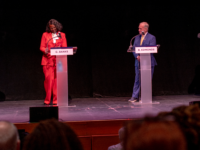

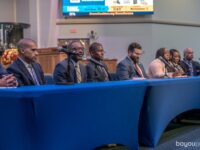





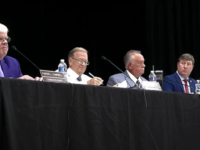
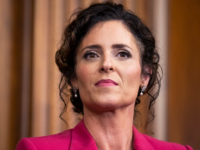
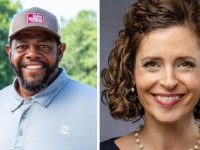




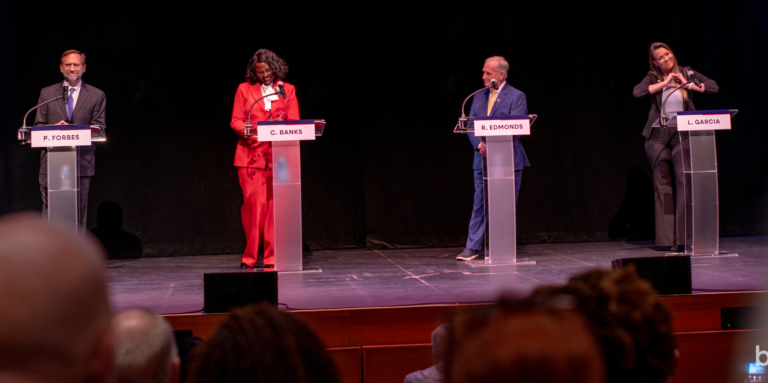
Four candidates for Louisiana’s newly redrawn 6th Congressional District took the stage Friday night at Baton Rouge’s Manship Theatre for what was billed as a debate but often felt more like a televised candidate forum.
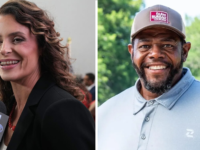
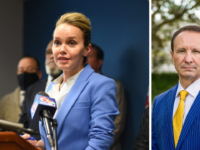
Democrats Chauna Banks, Pat Forbes and Lindsay “Rubia” Garcia were joined by Republican state Sen. Rick Edmonds for the hour-long WBRZ event. Republican state Sen. Blake Miguez, who qualified for the debate alongside the other four candidates, declined to attend, with moderator Sylvia Weatherspoon citing a previous engagement.
That absence helped define the night almost as much as anything said onstage.
The four candidates rarely engaged one another directly, and there were few of the sharp exchanges traditionally associated with a political debate. But the format still provided one of the clearest looks yet at how the leading candidates see both themselves and the race.
Here are seven takeaways.
1. Blake Miguez gave Rick Edmonds the Republican stage to himself
The most consequential decision of the evening may have been made by the candidate who never appeared.
Miguez entered 2026 seemingly positioned as one of Louisiana Republicans’ next members of Congress. President Donald Trump endorsed him in February when Miguez was running for the 5th Congressional District, calling him a “MAGA Warrior.” But after the congressional map changed and Miguez moved into the 6th District race, that endorsement did not formally follow him into his new campaign.
Now, with fewer than four weeks before Election Day, Miguez skipped the campaign’s major televised debate in the district’s largest media market.
WBRZ’s qualifying poll had Edmonds leading the field at 13.8 percent, followed by Banks at 13.2 percent, Miguez at 9.7 percent, Garcia at 7.7 percent and Forbes at 7.6 percent, with more than a third of voters still undecided.
That made Friday an unusually valuable opportunity for a candidate still introducing himself to large portions of the district.
Instead, viewers saw one Republican.
Edmonds made sure they noticed.
In his closing statement, he finally went directly after his absent rival, pointing toward Miguez’s empty podium and accusing him of missing roughly 200 votes during the legislative session.
“I’m not that guy,” Edmonds said. “I’m a guy that works hard. I get the job done in Louisiana, and I’ll do it in Washington.”
Whatever Miguez’s reason for missing Friday’s event, the political effect was straightforward: for an hour on Baton Rouge television, Edmonds looked less like one Republican candidate among several and more like the Republican nominee waiting for November.
2. Edmonds made the most explicit partisan pitch of the night
Edmonds did not appear particularly interested in winning over the overwhelmingly Democratic room.
He instead used the debate to make a remarkably straightforward case that Republican voters can trust him to be a reliable member of the team in Washington.
Asked how he would benefit from Louisiana currently holding two of the most powerful positions in the U.S. House, Edmonds emphasized his personal relationships with Speaker Mike Johnson and Majority Leader Steve Scalise, noting that he had served as Johnson’s pastor for a decade.
“I have met with both of these men and assured them that I’ll be a team player,” Edmonds said.
That phrase captured much of his performance.
While Democrats criticized the war with Iran, Edmonds supported it. While the three Democrats opposed recent SNAP cuts, Edmonds supported them. While all three Democrats opposed allowing elected officials to sign nondisclosure agreements while negotiating major economic development projects, Edmonds supported the practice.
On immigration, Edmonds broadly defended the administration’s enforcement posture, arguing that the country had allowed millions of undocumented immigrants to enter and saying he would “err on the side” of Americans harmed by immigrants who commit violent crimes.
He similarly embraced a heavier state law enforcement presence in major cities and said there were circumstances where deploying the National Guard for domestic policing was appropriate.
And when asked about the wave of massive industrial projects receiving state tax incentives, Edmonds offered perhaps the least qualified endorsement onstage, describing Louisiana as being in an “economic renaissance” and saying the nearly $300 billion in announced investment was “the greatest thing since the Louisiana Purchase.”
The argument was consistent: Louisiana is on the right track, Republicans are largely on the right track, and Edmonds has the relationships and legislative experience to join them and keep things moving.
It was less insurgent MAGA than institutional Republicanism — and seemingly designed to draw a direct distinction with Miguez without having to spend the night talking about him.
3. Pat Forbes made a John Bel Edwards-style appeal — for better or worse
Forbes was easily the most subdued of the three Democrats, but that was largely consistent with the argument he has made throughout the campaign.
He is not asking voters to see him as a movement candidate or ideological warrior. He is asking them to see him as someone who knows how government works and has spent decades making it work.
His answers repeatedly returned to his 20 years in disaster recovery and his experience working across different levels of government. Asked about securing funding for a new Mississippi River bridge, Forbes pointed to his work with former Gov. John Bel Edwards securing billions in federal disaster assistance after hurricanes and floods.
On FEMA, flood insurance and infrastructure, the pattern continued: Forbes usually responded less like a partisan candidate than a former administrator explaining how he would approach the problem.
It is a distinctly John Bel Edwards-esque pitch — fitting for a candidate backed by the former governor.
And on paper, it makes sense for the new 6th District. A Democrat trying to compete in a district drawn to elect a Republican probably does need some support from voters who do not ordinarily vote Democratic.
The question is whether Forbes can get through the first election with that message.
Democratic base voters are angry, energized and increasingly looking for candidates willing to confront the Trump administration directly. Forbes certainly did some of that Friday — attacking the war in Iran, tariffs and congressional Republicans for surrendering institutional power to the president — but his broader disposition remains intentionally technocratic and bipartisan.
His campaign is betting that competence itself can be the message.
Whether Democratic voters are currently in the mood to reward that argument is another question.
4. Chauna Banks leaned into effectiveness — while reminding voters what her election would mean
Banks occupied some of the same pragmatic territory as Forbes, but delivered it with considerably more energy.
Again and again, she returned to her 12 years on the East Baton Rouge Metro Council, where Democrats were consistently in the minority.
When candidates were asked how they would operate if control of Congress changed, Banks noted that she served through three terms on a 7-5 Republican-majority council while still delivering housing, infrastructure and other investments for her district.
“It does not matter what the numbers are, what the parties are,” Banks said. “Building relationships — and because I have common-sense politics, I’ve been successful.”
It was perhaps the clearest articulation of her pitch: judge her by what she has already managed to accomplish without having the votes on her side.
But Banks also made room for a different kind of appeal.
In her closing statement, she reminded voters that she would become only the fifth woman elected to Congress from Louisiana. Her campaign has also emphasized that she would be the first Black woman Louisiana has ever sent to Congress.
Banks was not the most polished speaker onstage, but she appeared to arrive with a clear game plan. She was animated, generally upbeat and repeatedly returned to evidence from her own record — from housing to economic development to disaster response — to support the argument that she already knows how to operate as a minority-party legislator.
If Forbes’ argument is “I know how government works,” Banks’ was closer to “I have already proven I can make government work even when my party does not control it.”
5. Garcia was the most forceful Democrat — but also the most uneven
Garcia brought perhaps the most obvious passion to the stage.
She repeatedly framed issues through questions of economic power, constitutional rights and whether government institutions were actually working for ordinary people. On economic development incentives, she offered one of the cleaner lines of the evening:
“Accountability is not an enemy of innovation.”
Garcia said she supported major economic projects but argued that tax incentives should come with measurable commitments for permanent local jobs, wages, environmental impacts and workforce development.
Her strongest moment may have come on immigration.
After Edmonds defended the administration’s approach, Garcia rejected the idea that current enforcement efforts were primarily targeting violent criminals and criticized arrests at churches and other aggressive tactics. Her answer drew applause from the audience despite moderators having discouraged reactions.
On policing, she rejected both a larger State Police presence and use of the National Guard for local law enforcement, arguing instead for investments in education, recreation and community programs.
“I’m not for defunding the police,” Garcia said. “I’m for refunding the community.”
Garcia was commanding when she was on familiar ground, but some answers were less disciplined. She leaned heavily on personal biography throughout the evening and occasionally appeared to be working through questions in real time rather than delivering a fully developed policy answer.
That was especially visible during the rapid-fire paddle portion.
Asked whether she supported “biological males participating in biological female sports,” Garcia repeatedly asked for clarification before saying she disliked the framing and asking for an opportunity to explain. The moderator moved on.
The same discomfort surfaced during a question about bringing the U.S. Space Academy to Louisiana, where Garcia appeared reluctant to reduce a more complicated policy question to a simple support-or-oppose paddle.
Those moments reinforced both the strength and weakness of her candidacy: Garcia is often the candidate most visibly determined to challenge the assumptions behind a question, but that instinct can make her appear less polished in formats that reward short, direct answers.
6. For something called a debate, there was remarkably little debating
Perhaps the strangest element of the night was how cordial it all was.
For most of the hour, the candidates answered questions in succession without responding to one another. There were few direct contrasts, virtually no rebuttals and almost nothing resembling the candidate-to-candidate exchanges viewers generally associate with a debate.
Forbes entered prepared for something more confrontational. In his opening statement, he immediately tried to put Edmonds and the absent Miguez in the same box, arguing that Republican candidates could not simultaneously promise unwavering support for Trump while claiming they would reduce the cost of living.
“You’re either going to vote against this war, vote against these tariffs, vote to reverse that tax bill that gives billionaires tax breaks, or you’re going to work for the people,” Forbes said.
But the confrontation never really developed.
Garcia occasionally directed an answer toward Edmonds. Banks and Forbes drew ideological contrasts with Republicans more broadly. Edmonds saved his only explicit attack on another candidate for his closing remarks about Miguez.
Otherwise, the candidates were largely cordial — sometimes even friendly.
That made the night less useful for determining how these candidates might respond under political pressure from one another, but arguably more useful for understanding the fundamental cases each is making to voters.
Edmonds wants Republicans to see a proven conservative legislator with relationships already waiting in Washington.
Forbes wants voters to see an experienced administrator who knows how to bring federal resources home and has little interest in ideological theater.
Banks wants them to see a veteran local official who has already demonstrated she can deliver results while governing from the minority.
Garcia wants them to see someone willing to confront institutions and policies she believes have stopped serving ordinary people.
7. WBRZ deserves credit for hosting the debate, but voters deserved to hear from the entire field
There is something to be said for the fact that Friday’s debate happened at all.
In Louisiana, competitive congressional races do not always receive the kind of sustained local television coverage that voters in other states might reasonably expect. WBRZ deserves credit for dedicating an hour of prime-time programming to an open congressional seat, particularly in a district that has been dramatically redrawn just months before voters head to the polls.
But that recognition comes with a significant criticism: five of the ten candidates seeking the seat were never invited to participate.
Republicans Monique Appeaning, Larry Davis III, Michael Mebruer and Stephen Wagley, along with Libertarian Rufus Craig, were excluded under criteria that limited participation to the five highest-polling candidates in a survey commissioned by the Greater Baton Rouge Economic Foundation.
The poll, conducted by JMC Analytics and Polling September 19-21, surveyed 790 likely voters and carried a reported margin of error of 3.5 percentage points. WBRZ published the leading candidates’ results and some methodological details, but the full polling report, including its questionnaire, demographic breakdowns and detailed results for excluded candidates, does not appear to have been made publicly available.
That matters because the poll was not merely being used to describe the state of the race. It was being used to determine who deserved access to one of the campaign’s most consequential media opportunities.
And the results themselves hardly suggested a settled field. The leading candidate, Edmonds, registered just 13.8 percent support, while 35.7 percent of respondents remained undecided. Even Forbes, the fifth and final candidate to qualify, stood at just 7.6 percent.
Under those circumstances, using a single survey to determine which candidates would receive an hour of district-wide television exposure raises legitimate questions about whether the selection process was serving voters or simply reinforcing the visibility of candidates who were already better known.
To its credit, WBRZ also made separate candidate interviews available for those who did not qualify for the debate. But individual interviews posted online are not equivalent to participation in a live, televised event alongside one’s opponents.
There are legitimate logistical challenges to organizing a debate with ten candidates. But this was an open congressional seat with no incumbent on the ballot, in a district whose voters have barely had time to adjust to its new boundaries. The unusually compressed election calendar only made the opportunity for broad candidate exposure more important.
An open seat presents voters with a choice. It should not fall to a single, largely unpublished poll to narrow that choice before they have had the opportunity to hear from everyone seeking the office.