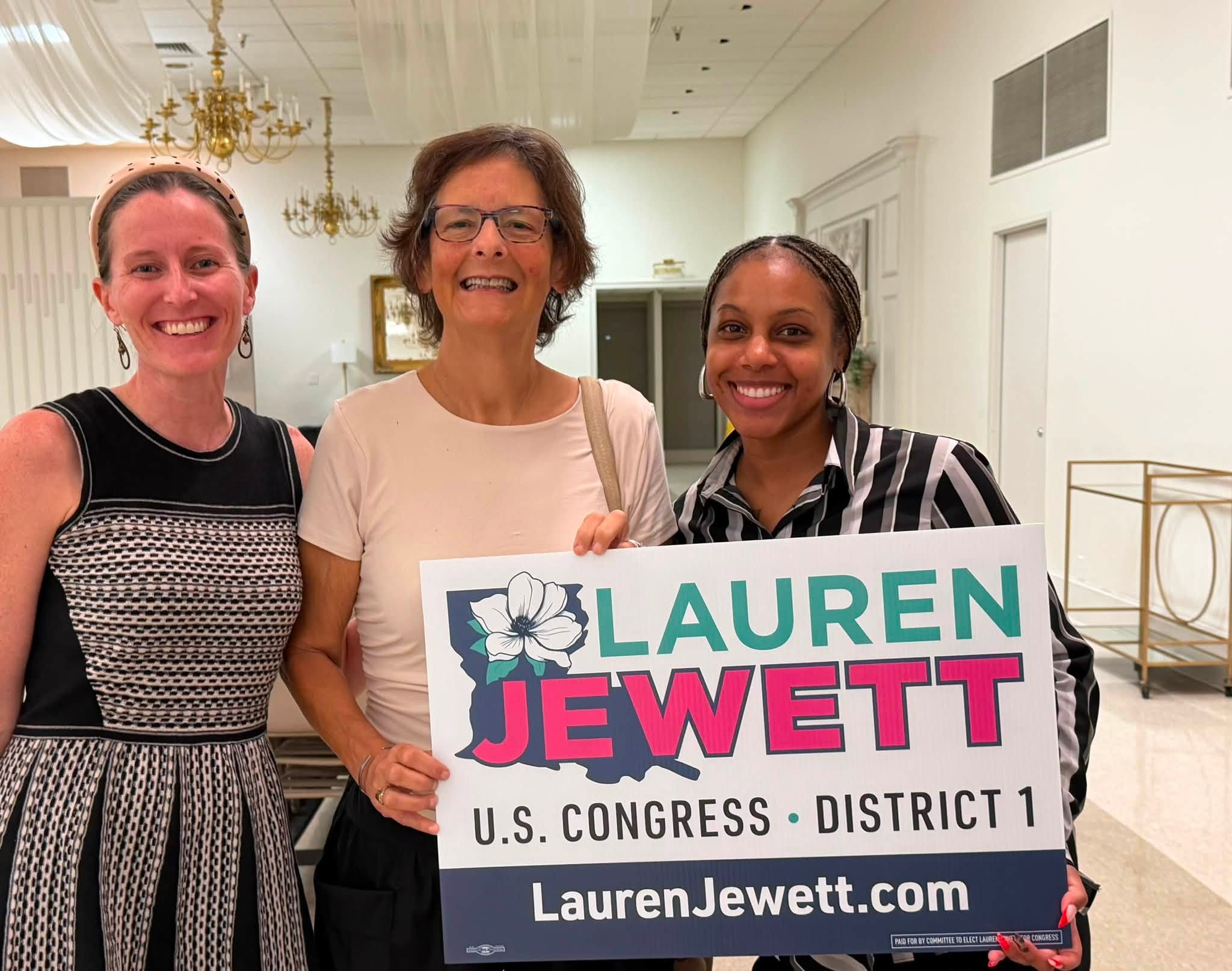
Lauren Jewett knows the odds.
The Metairie special education teacher is running for Congress in Louisiana’s 1st Congressional District, a reliably Republican seat represented for the past 18 years by House Majority Leader Steve Scalise. Scalise has more than $10 million flowing through his campaign operation this cycle. Jewett had raised just under $143,000 through July 18.
She also thinks that accepting those odds as destiny is part of how Louisiana Democrats got here.
“I’m not Pollyannaish about this,” Jewett told The Bayou Progressive in a wide-ranging interview Friday. “We have hurdles. We have a huge hill to climb.”
But, she argues, Democrats cannot build the infrastructure necessary to eventually compete in places like Louisiana’s 1st District if they concede those districts election after election.
“We have to be running somebody every single time,” Jewett said. “It could be this election. It could be 2028. It could be 2030.”
It is an argument that reflects both the difficulty of Jewett’s campaign and the unusual circumstances under which she is running it.
Jewett originally entered the race under Louisiana’s new closed-primary system and effectively became the presumptive Democratic nominee when her only intraparty opponent withdrew. Then the U.S. Supreme Court’s decision in Callais v. Louisiana set off another round of redistricting, Gov. Jeff Landry postponed the scheduled U.S. House elections, and the Legislature restored the state’s traditional open (or “jungle”) primary system for congressional races.
The result was that Jewett had to qualify again — including collecting a second round of signatures after her original nominating petition was effectively wiped away.
“The rules were changed in the middle of the game,” Jewett said during qualifying earlier this month.
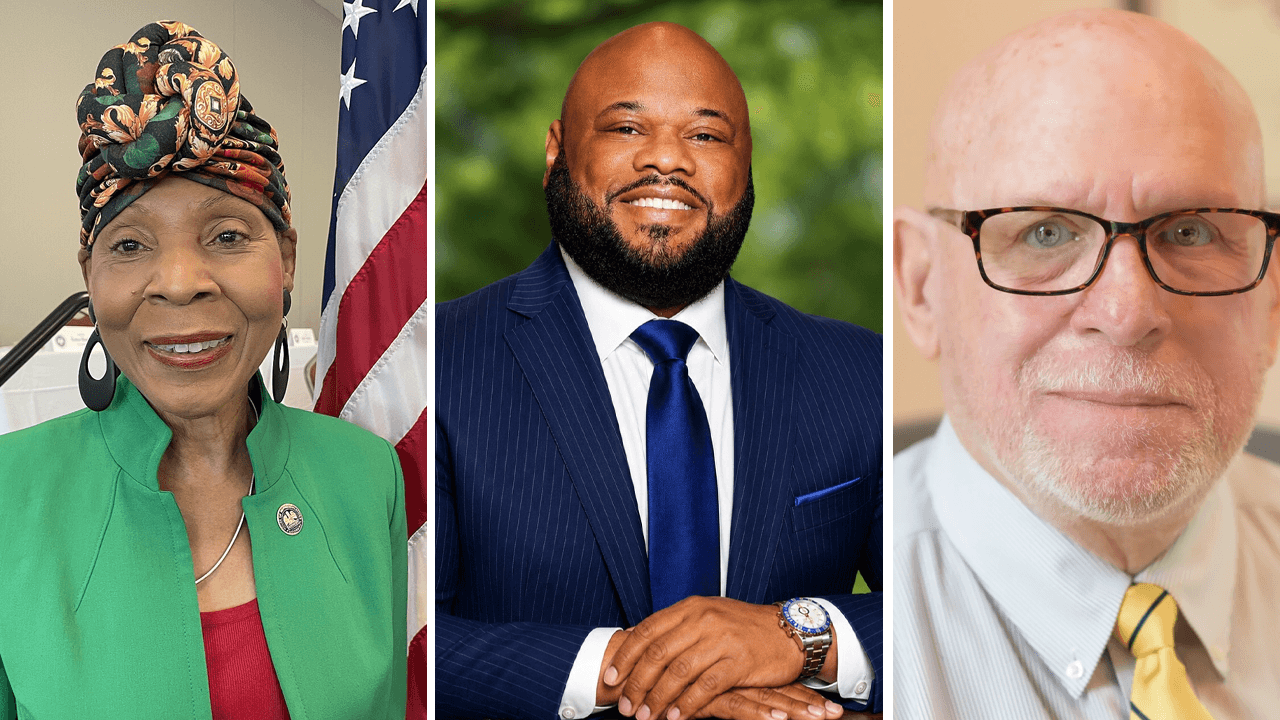
The new 1st District now stretches across portions of eight parishes, from suburban Jefferson and St. Tammany into coastal communities in Lafourche and Terrebonne. Jewett is still the only Democrat among four candidates appearing on the Nov. 3 ballot. Scalise is joined by Republican Randy Arrington and no party candidate E. “Liddy” Glass.
For Jewett, the upheaval also came with a financial cost.
She said fundraising slowed dramatically after the congressional elections were suspended as donors became confused about whether there would even be a race. National organizations stopped responding to endorsement applications, she said, cutting the campaign off from potential money, volunteers and other resources.
“I had to downsize and restructure what my staff was doing to be able to come back at full force for the month of August,” she said.

A teacher’s case for Congress
Jewett has spent more than 16 years working in Louisiana schools, primarily in special education. She previously ran unsuccessfully for Jefferson Parish School Board and the state Board of Elementary and Secondary Education before becoming active in Louisiana Democratic Party leadership.
She traces much of her political education to organized labor. Her grandmother was both a special education teacher and union president, and Jewett later became active in her own union.
Her decision to seek elected office grew out of the COVID-19 pandemic, she said, when teachers found themselves on the front lines of debates over reopening schools and classroom safety. What followed was a political backlash against educators over issues ranging from race to curriculum.
“I thought education was not a divisive thing,” Jewett said. “It was very bipartisan. People want good schools. People care about children.”
Her work in special education also convinced her that policymakers frequently make decisions about systems they do not understand.
That experience now forms the core of her argument for Congress: government works differently when the people writing laws have firsthand experience with the consequences.
“The people who are closest to the problem usually have better solutions, or they’re closer to the solution,” Jewett said.
She points to the issues her students bring into the classroom — unstable housing, hunger, inadequate healthcare and families struggling to make ends meet — as evidence that education policy cannot be separated from broader economic policy.
“I see children come in my classroom who didn’t get a good night’s sleep because of affordable housing issues,” she said.
The same argument extends to her own life. Jewett spoke about paying student loans, watching homeowners and flood insurance premiums increase and dealing personally with the aftermath of Hurricane Ida, which damaged her roof and carport.
“I’m an average everyday person,” she said. “I gotta pay my bills. I gotta pay for gas and groceries.”
Jewett supports raising the federal minimum wage, which has remained $7.25 per hour since 2009, reducing prescription drug costs and protecting federal flood insurance. She also argues that Congress needs to address broader economic pressures that eventually show up in household budgets.
“People should be able to have their basic needs for housing, food, healthcare,” Jewett said. “And then they should be able to thrive, too.”
Jewett calls for pause on new AI data centers
Jewett’s decidedly progressive economic message comes at a time when Louisiana’s aggressive pursuit of industrial development has hit a new fever pitch with its recent embrace of some of the world’s largest AI companies and their respective infrastructure.
State leaders have embraced massive new investments in petrochemical facilities, carbon capture projects and, increasingly, hyperscale data centers. Supporters argue those projects can bring billions of dollars in investment and new jobs into Louisiana.
Jewett says economic development is necessary, but not at any cost.
“Technology is not a bad thing. Innovation is not a bad thing,” she said. But she questioned whether Louisiana and the federal government have adequately studied the enormous electricity and water demands associated with artificial intelligence infrastructure.
Asked specifically about new AI data centers, Jewett went further.
“I do think there should be a moratorium right now until we can do more research,” she said.
Jewett emphasized that her proposed pause would apply to the construction of data centers rather than artificial intelligence technology itself.
She said she is skeptical of generative AI as well, particularly its use in schools and creative professions, but stopped short of advocating a ban. Instead, she called for stronger guardrails around privacy, children’s use of AI and the technology’s impact on employment.
She also framed the issue through Louisiana’s long history of welcoming industries that provide jobs and tax revenue while leaving communities to absorb environmental and public-health costs.
“People move to places for good schools and good community,” Jewett said. “They’re not just moving for jobs.”
Abolish ICE — but not immigration enforcement
Jewett also took a position that places her firmly on the progressive wing of the national immigration debate.
“I have signed a pledge that I would commit to abolish ICE,” she said.
She pointed to aggressive immigration raids, masked federal agents and reports of citizens and other people being wrongly targeted as evidence that U.S. Immigration and Customs Enforcement has lost legitimacy.
Jewett said immigration enforcement activity in southeast Louisiana has also created fear among immigrant families, including families with children in local schools.
But when asked whether abolishing ICE meant eliminating federal immigration enforcement altogether, Jewett said no.
She instead described the problem as one of institutional legitimacy — arguing that ICE should be replaced by a different enforcement structure operating with stronger due-process protections.
“We have to do something different,” she said.
Jewett supports a clearer pathway to citizenship, more resources for processing immigration cases and protections for immigrant workers, including seasonal workers who have become an important part of Louisiana’s seafood and agricultural industries.
She also rejected rhetoric that broadly associates immigrants with criminal activity.
“These are our neighbors,” Jewett said. “These are people who contribute to our community.”
Iran, Gaza and congressional war powers
Jewett was similarly critical of American foreign policy.
She said Congress should not have allowed the United States’ current military involvement against Iran to proceed without congressional authorization, arguing that lawmakers have surrendered too much of their constitutional war-making authority.
Asked whether she would have supported military action against Iran if authorization had actually come before Congress, Jewett was less definitive, saying she would have needed to evaluate the intelligence and proposed operation.
But she repeatedly returned to the consequences for civilians.
“If that was the vote to do that, no,” she said when discussing strikes that killed children. “These are civilians.”
Jewett said she approaches war partly through what she called a “disability lens,” noting that armed conflict both disproportionately harms people already living with disabilities and creates new disabilities while destroying the infrastructure necessary to provide care.
She also called for ending U.S. military assistance that supports Israel’s continued war in Gaza.
“We shouldn’t be having aid to countries that are dealing with human rights abuses across the world,” she said.
Jewett drew a distinction between criticism of the Israeli government’s actions and antisemitism, while also acknowledging increased antisemitism and Islamophobia as legitimate concerns.
“I want what’s best for kids here, and I want what’s best for kids abroad,” she said.
The case against Scalise
Ultimately, Jewett’s campaign still has to answer the most basic question confronting any challenger: Why replace the incumbent?
In Scalise’s case, the challenge is particularly steep.
The Jefferson Parish Republican, who served in the Louisiana House and Senate before taking former Governor Bobby Jindal‘s congressional seat in a 2008 special election, has represented the area for 18 years and risen to become House Majority Leader, making him one of the most powerful members of Congress. His seniority and leadership position provide an obvious argument for keeping him there.
Jewett makes the opposite case.
Scalise has now spent roughly three decades in elected office between the Louisiana Legislature and Congress. Jewett argues that longevity has created distance between the congressman and the everyday concerns of his constituents.
“Has there been improvement in your quality of life in the past 30 years?” she asks voters.
She also criticizes Scalise for his close alignment with President Donald Trump and argues that congressional Republicans have become too willing to defer to executive power.
“We have a party loyalist right now who’s in that position and is doing the president’s bidding,” Jewett said. “I think that’s dishonoring the oath of the Constitution.”
And despite Scalise’s national stature, Jewett argues that his constituents do not see enough of him at home.
She criticized the congressman for relying on telephone town halls rather than holding regular in-person public meetings and contrasted his national political role with her own door-to-door campaign.
“I’m somebody who shows up,” Jewett said. “I’m here knocking on doors in the heat of Louisiana while our congressman is stumping for other people.”
That, more than any individual policy proposal, may be Jewett’s central pitch.
She is not pretending to possess Scalise’s fundraising network, seniority or political power. Her argument is that those things have not necessarily translated into a government that feels closer or more responsive to the people living in the district.
And even if Democrats cannot immediately erase the enormous Republican advantage in LA-1, Jewett says surrendering the district guarantees that nothing changes.
She compares it to the Buffalo Bills fans she grew up around in upstate New York — people who continued sitting in the snow through losing seasons because abandoning the team was never really an option.
“We still need people to go and vote,” Jewett said. “We still need people to participate in the process of democracy.”
For Jewett, that applies to candidates, too.
“We just don’t write it off because they’re not gonna win.”