

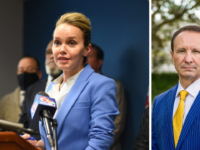





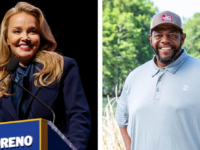
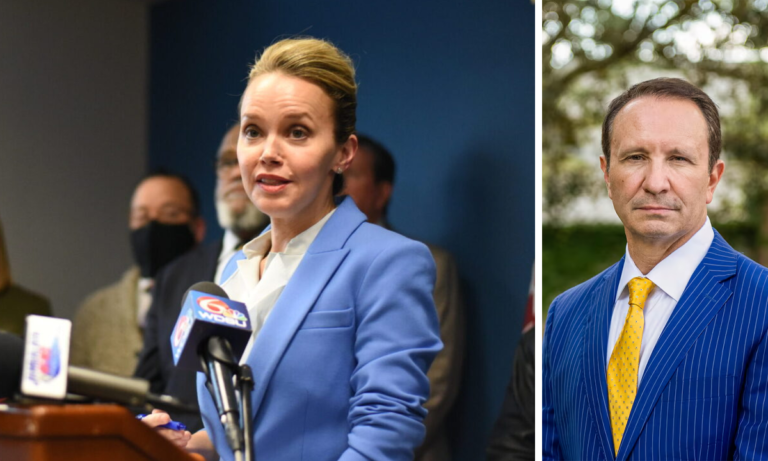
Gov. Jeff Landry has reached an unusual point in his increasingly bitter relationship with New Orleans Mayor Helena Moreno: he will not speak to her, but he would still like to be thanked.
Landry took to social media Friday afternoon after Moreno issued a statement marking the end of the Louisiana National Guard’s eight-month deployment in New Orleans. Moreno thanked the Guard members who served in the city, their families and the longstanding partnership between the Guard and local public safety agencies.
I want Louisiana to see this: @HelenaMorenoLA has thanked everyone for the National Guard’s presence in New Orleans—except the two people responsible for it: President @realDonaldTrump and me. pic.twitter.com/PXIrXnZas8
— Governor Jeff Landry (@LAGovJeffLandry) August 21, 2026
She did not thank Landry.
She did not thank President Donald Trump.
Landry noticed.
“I want Louisiana to see this,” the governor wrote on X. “@HelenaMorenoLA has thanked everyone for the National Guard’s presence in New Orleans — except the two people responsible for it: President @realDonaldTrump and me.”
The complaint would be notable enough on its own. It becomes considerably stranger in light of Landry’s declaration just one week earlier that he personally will not speak with Moreno until an investigation determines whether she or members of her administration had any involvement in the grand jury proceedings that briefly resulted in the indictment of Attorney General Liz Murrill.
“She’s always free to have a discussion with my staff,” Landry said last week. “I’m not going to be speaking to them personally until this investigation is done.”
In other words, the governor of Louisiana has decided that he doesn’t want to speak to the mayor of the state’s largest city because he’s mad at her.
Apparently, however, gratitude remains expected.
The episode is petty. But beneath the pettiness is a more substantive disagreement over what, exactly, Moreno was thanking people for.
The Louisiana National Guard is concluding an eight-month deployment that began with roughly 350 soldiers arriving in New Orleans in late December. The mission was later extended with a smaller force, and troops are expected to leave the city by the end of August.
Moreno’s statement was directed squarely at those troops.
“We are incredibly grateful to the men and women of the Louisiana National Guard as they prepare to conclude their eight-month deployment in New Orleans,” she said. Moreno noted that Guard members have long assisted New Orleans during Mardi Gras and other major events and said the past eight months had strengthened that relationship.
There is nothing especially difficult to understand about the distinction she was making.
The soldiers did not choose to deploy themselves to New Orleans. They received orders and carried them out. Once there, they worked alongside local agencies, assisted with public safety operations and, by most accounts, treated the city and its residents professionally. They were placed into the middle of a political argument they did not create and then tasked with making the assignment work.
New Orleans officials, including Moreno, found ways to make use of them.
That included the kinds of functions the Guard has historically performed in the city during Mardi Gras and other major events, as well as freeing local law enforcement personnel to concentrate on duties only civilian police could perform. The Guard itself described its role as a “force multiplier,” not as a replacement for the New Orleans Police Department.
Thanking those men and women for doing that job well is not the same thing as thanking the politicians who decided troops needed to be there.
And that distinction matters because Landry and Trump did not merely provide additional manpower to New Orleans. They attached a political story to the deployment.
For years, both men have used New Orleans and other heavily Black, Democratic-led cities as symbols of disorder, dysfunction and failed urban governance. When Trump began discussing sending troops into New Orleans, he described the city as “quite bad” and suggested the federal government could quickly “straighten out” conditions there. Landry enthusiastically welcomed the prospect and subsequently described cities in the very state that he was elected to serve as “war zones” while promising that law and order was returning.
Those descriptions bore an increasingly strained relationship to what was actually happening in New Orleans.
Violent crime had already been declining sharply before the Guard arrived. New Orleans ended 2025 with a third consecutive annual decline in violent crime, and homicides had fallen to levels not seen in decades. Murders, shootings, robberies and carjackings were all substantially below their recent peaks before soldiers began regular patrols.
That did not stop Trump from repeatedly presenting the Guard deployment as evidence that his intervention had rescued the city.
It also did not require Moreno to agree with him.
This is the political tightrope she has walked throughout the deployment. Moreno could recognize that the people actually sent into New Orleans behaved professionally, worked constructively with local agencies and made themselves useful wherever their orders allowed without endorsing the premise that New Orleans needed to be occupied by military personnel in the first place.
She can appreciate the soldiers while rejecting the spectacle.
She can thank the Guard without thanking the men who portrayed her city as a problem requiring military correction.
That difference grows more important as the domestic use of federal forces becomes less exceptional.
Trump has increasingly treated deployment of the National Guard and other federal personnel into American cities as an ordinary instrument of presidential power. Troops have appeared in multiple Democratic-led cities under broad claims involving crime, immigration enforcement and public order. Reuters reported this week that thousands of Guard members deployed to Washington have played only a limited direct role in criminal cases despite their highly visible presence throughout the capital.
At the same time, the country is approaching an election in which the role of federal forces has become an explicit question.
When Trump was asked in May whether he would send National Guard troops or ICE officers to polling locations during the midterms, he declined to rule it out, saying he would do “anything necessary to make sure we have honest elections.” Voting-rights organizations have since issued guidance responding directly to the possibility, while Democratic senators have sought assurances from military leaders that troops will remain out of the election process.
That is the broader environment in which deployments like the one in New Orleans now exist.
To say the quiet part out loud, the concern is that Trump and allies like Landry are conditioning the country to accept something that would have been politically radioactive not long ago: the routine deployment of military personnel inside American communities, including in circumstances freighted with obvious political significance.
The fear is not difficult to understand. Each deployment makes the next one seem a little less extraordinary. Each image of uniformed troops patrolling an American city lowers the temperature around a practice that, a decade ago, would have produced alarm across much of the political spectrum. And Trump has already refused to rule out using the National Guard or federal immigration officers around polling places, saying he would do “anything necessary” to ensure what he calls honest elections.
That is why the precedent matters so much heading into the fall. If the administration ultimately decides to deploy federal forces in connection with the elections, it would be doing so in a country that has already spent months being taught that troops on American streets are simply another tool available to the executive branch.
For communities that have historically borne the brunt of aggressive policing, federal intervention and voter suppression, that distinction is not academic. Neither are the racial and cultural signals embedded in repeated portrayals of Black-led cities as places that must be subdued, restored or “straightened out” by outside authority.
For critics of this administration, that is not paranoia. It is the danger of normalization happening in real time.
Moreno’s statement managed to acknowledge the people in uniform without laundering all of that into a ceremonial thank-you to the politicians who sent them.
Landry apparently found the distinction offensive.
His grievance is also arriving in the middle of a broader confrontation with Moreno that has already affected matters far more serious than social-media etiquette. Landry has refused to meet with her while demanding answers about the Murrill grand jury investigation, and the dispute has coincided with New Orleans being locked out of State Bond Commission approvals as the city grapples with substantial financial problems.
Those are real issues with real consequences for hundreds of thousands of Louisiana residents.
A functioning relationship between the governor and the mayor of New Orleans would therefore seem useful.
For now, Landry has chosen another arrangement.
He will not sit down with Helena Moreno.
He will not speak to Helena Moreno.
He will allow his staff to speak to Helena Moreno.
But when Helena Moreno thanks Louisiana National Guard members for eight months of service without including Jeff Landry’s name, the governor will make time to ensure Louisiana knows about it.
Perhaps that is the clearest explanation of their relationship available.
Landry does not currently want Moreno’s conversation.
He would simply like her appreciation.
Isn’t that precious?