












A four-point U.S. Senate race in Louisiana would be a political earthquake.
Donald Trump carried the state by 22 points less than two years ago. Democrats have not won a Louisiana Senate election since Mary Landrieu’s last victory in 2008. The Cook Political Report continues to classify the seat as Safe Republican, while RealClearPolling’s page for the general election does not list a single public poll in the matchup.
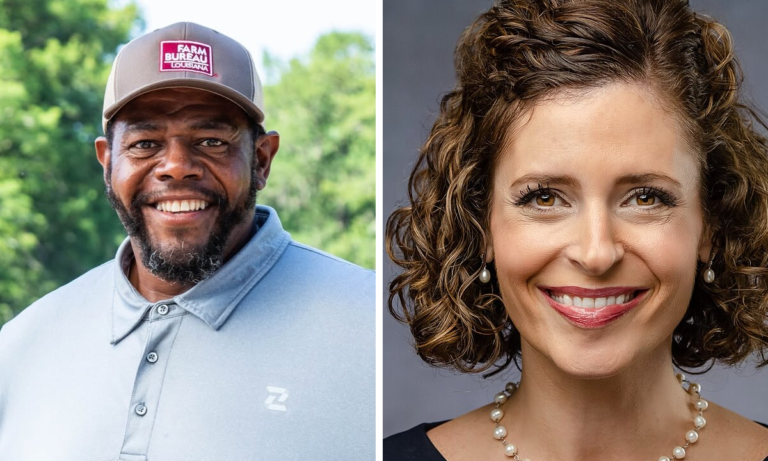
But just this week, U.S. Senate Democratic nominee Jamie Davis’ campaign released a survey showing Republican nominee Julia Letlow ahead by only four points.
The campaign-commissioned poll, conducted by Public Policy Polling on July 21 and 22, initially found Letlow leading Davis 41% to 37%, with 22% of registered Louisiana voters undecided. After respondents heard biographical descriptions of both candidates, the result moved to 42% for Letlow and 38% for Davis, with 20% undecided.
Those numbers are unquestionably notable. However, a close examination of the polling report shows both real warning signs for Letlow and substantial reasons to remain cautious about what the result means. It also shows that one of the Davis campaign’s central claims about the survey — that its message moved voters toward him — may not yet be reflected in the final ballot test.
What the campaign released
The Davis campaign commissioned and paid for the survey, which Public Policy Polling conducted among 518 registered Louisiana voters. 33% of respondents participated by landline, while 67% responded through a text-to-web survey.
The Bayou Progressive requested the underlying polling report after receiving a press release announcing that the race stood at 42%–38% in Letlow’s favor.
The campaign subsequently provided a three-page PPP topline report containing the complete question wording, overall results and demographic composition. It also confirmed that the initial ballot question was asked before voters heard any biographical or campaign information.
The campaign also informed The Bayou Progressive that it has not received a margin of error, detailed weighting methodology or demographic crosstabs from PPP.
The poll also surveyed registered voters rather than likely voters. That distinction matters in Louisiana, where the composition of the registered electorate frequently bears little resemblance to the increasingly smaller group that ultimately turns out, particularly in nonpresidential elections.
None of those limitations makes the poll illegitimate. PPP is an established polling firm with a long record of surveying federal and state elections. But the details & methodology are important factors needed to evaluate an unusually consequential result.
The cleanest ballot test showed Letlow ahead 41%–37%
Before respondents received any information about either candidate, PPP asked:
“The candidates for US Senate this fall are Democrat Jamie Davis and Republican Julia Letlow. If the election was today, who would you vote for?”
The result was:
- Julia Letlow: 41%
- Jamie Davis: 37%
- Undecided: 22%
That initial question is the survey’s most useful measurement of the race because it came before the poll introduced information intended to influence how respondents viewed the candidates.
After voters heard positive biographical descriptions of Davis and Letlow, PPP asked the ballot question again. Both candidates gained one point, producing the 42%–38% result highlighted in the campaign’s press release. Undecided voters declined from 22 to 20%, but the four-point margin did not change.
Among voters who selected a candidate after the biographies, Letlow received roughly 52.5% and Davis 47.5%.
That is a far closer division than Louisiana’s recent federal statewide results would suggest. But the unusually large undecided share is doing a lot of heavy lifting.
The real story may be Republican hesitation, not Democratic conversion
The poll’s composition does not appear facially overly Democratic.
Respondents reported voting for Trump over Kamala Harris by 60% to 38% in 2024 — almost precisely matching Louisiana’s actual presidential result. 47% identified as Republicans, 33% as Democrats and 20% as independents.
The racial composition was 65% white, 28% Black and 7% other. Women made up 52% of respondents, and the regional breakdown included 36% from the New Orleans metro area, 21% from Baton Rouge, 14% from Lafayette and 11% from Shreveport.
Davis’ 37% on the initial ballot is almost identical to Harris’ 38% showing in the same sample. Letlow, however, begins 19 points below the 60% who reported voting for Trump. The 22% undecided share nearly matches that missing portion of the Republican presidential coalition.
Without crosstabs, there is no way to say definitively who those undecided voters are. Some may be Democrats unfamiliar with Davis. Some may be independents dissatisfied with both candidates. Some may be Republicans who dislike Letlow, have become disaffected by the MAGA movement, or remain bruised from the contentious GOP primary and runoff.
But the aggregate numbers suggest that the poll is capturing a largely consolidated Democratic vote alongside a much less consolidated Republican electorate. That is a vulnerability for Letlow, but it is not necessarily the same thing as Davis having a legitimate chance to convert those voters by Election Day.
Republicans who are reluctant to support their nominee in July can still return to the party by November. For Davis to turn temporary Republican hesitation into a competitive general election, he must persuade those voters not merely to dislike or distrust Letlow, but to cross the ballot and vote for a Democrat.
Letlow is weaker than a Louisiana GOP nominee should be
The survey does contain genuine warning signs for Letlow.
Only 35% of respondents viewed her favorably, compared with 39% who viewed her unfavorably. Another 26% were unsure. That leaves Letlow with a net favorability rating of negative four points despite more than five years in Congress and months of statewide campaigning.
Davis was viewed favorably by 26% and unfavorably by 18%, giving him a positive eight-point rating. But 55% still did not know enough about him to form an opinion.
The contrast creates both an opportunity and a risk for Davis. He currently has more room to introduce himself without carrying Letlow’s negative rating. But low name recognition does not guarantee that voters will like what they learn, and building statewide recognition requires substantial money, organization and repeated exposure.
The survey’s finding on Trump may be even more consequential.
Although 60% of respondents said they voted for Trump in 2024, only 47% approved of his current job performance. 46% disapproved, leaving him with a net approval rating of only one point in a state he carried overwhelmingly.
If that erosion is real, Letlow’s decision to present herself as a loyal extension of Trump could become less politically valuable in the general election than it was during the Republican primary.
Letlow won the GOP nomination after securing Trump’s endorsement and repeatedly emphasizing her willingness to work in lockstep with his administration. That alliance helped her defeat incumbent Sen. Bill Cassidy and state Treasurer John Fleming. It may not carry the same force with a broader November electorate if a meaningful share of Trump’s former voters has become dissatisfied with his performance.
Again, the missing crosstabs prevent a direct connection between Trump’s declining approval and Letlow’s 41% showing. But the overlap is difficult to ignore.
The campaign message received better reviews — but moved no votes
The Davis campaign’s press release argued that voters “respond far better to Davis’ message than to Letlow’s” and said Letlow’s message moved more voters away from her than toward her.
The first portion of that claim is supported by respondents’ immediate reactions. The second is considerably more complicated.
PPP presented voters with a message describing Letlow as a loyal conservative endorsed by Trump and Gov. Jeff Landry. It referenced her support for continued military involvement in Iran, the current approach to immigration, data centers, carbon capture and the SAVE Act. It also said she would use her congressional experience to lower costs and grow Louisiana’s economy.
30% said the description made them more likely to support Letlow, while 36% said it made them less likely. Another 30% said it made no difference.
Respondents then heard Davis described as a practical farmer focused on Louisiana rather than Washington politics. The message highlighted Medicaid, threatened hospital closures, opportunities for young people, opposition to partisan gerrymandering and lowering costs for working families. It also reminded voters that Letlow supported the federal budget legislation associated with Medicaid cuts.
38% said that message made them more likely to support Davis. 14% said it made them less likely, and 45% reported no difference.
Davis’ message plainly received the better immediate reaction. But the two descriptions were not neutral or equivalent. Letlow’s combined positive biographical language with several issues selected because they could create vulnerabilities. Davis’ was overwhelmingly affirmative and included a direct contrast with Letlow on Medicaid.
More importantly, PPP asked the ballot question one final time after both messages.
The result was still Letlow 42%, Davis 38% and 20% undecided — exactly where the race stood before the campaign messages were introduced.
The messages affected how respondents described their reactions, but they did not change how respondents said they would vote.
Davis said in the campaign’s release that “the more they learn about this race, the more we close the gap.” Within this particular survey, however, that gap never closed. Letlow led by 4 points before the biographies, after the biographies and after the campaign’s message testing.
That does not mean Davis’ message is ineffective. It may help reinforce existing supporters, improve favorability or provide a foundation for future persuasion. But the poll does not demonstrate that the message moved the actual race in his direction.
One poll cannot reclassify the race
There is no meaningful body of public general-election polling against which to compare these findings. As of publication, RealClearPolling lists no surveys in the Letlow-Davis matchup, and the Louisiana poll does not appear among PPP’s own publicly released polls.
That makes the Davis campaign survey the first substantial data point in a race otherwise governed by Louisiana’s partisan history, fundraising, candidate name recognition and political assumptions.
Those assumptions continue to favor Letlow heavily. National forecasters still consider the seat safely Republican, and prediction markets give the Republican nominee an overwhelming likelihood of victory.
A single internal survey of registered voters — especially one without a disclosed margin of error, weighting methodology or crosstabs — does not justify discarding all of that evidence.
But neither should the poll be ignored.
It shows Letlow below 50%, carrying a negative favorability rating and failing to consolidate a sizable portion of voters who supported Trump less than 2 years ago. It shows Davis holding approximately the Democratic presidential baseline despite limited statewide name recognition. And it suggests that dissatisfaction with Trump may be creating at least some political space in a state where Republican nominees ordinarily begin with a decisive advantage.
For Davis, that is an opening. It is not yet a pathway.
His challenge is to turn Republican hesitation into actual crossover support while introducing himself to the 55% of voters who have no opinion of him. That will require a level of fundraising, paid communication, field organization and third-party investment that Louisiana Democratic candidates have rarely received in recent cycles.
Letlow’s challenge is simpler: consolidate the Republican electorate. Unless Davis can prevent that from happening, the race will likely move closer to Louisiana’s normal partisan outcomes as Election Day approaches.
The poll offers the clearest evidence so far that Louisiana’s Senate race may be more competitive than conventional wisdom suggests. Whether that opening is durable — and whether Davis can turn Republican hesitation into crossover support — will require additional polling to determine.
Methodology: Public Policy Polling surveyed 518 registered Louisiana voters July 21–22 through automated landline calls and text-to-web responses. The Jamie Davis for U.S. Senate campaign commissioned and paid for the poll. 33% of respondents participated by landline and 67% by text. Neither the campaign nor PPP has yet provided a margin of error, detailed weighting methodology or demographic crosstabs.