

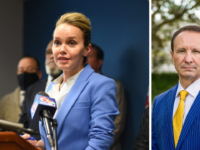















As Louisiana’s 2026 legislative session begins, State Representative Mandie Landry does not sound like someone expecting a loud, dramatic showdown at every turn.
That, in her view, may be part of the problem.
In an interview with The Bayou Progressive, the New Orleans Democrat described the opening days of the session as oddly subdued — not because the stakes are low, but because Republicans have already won so many of the ideological fights they set out to win over the last two years that this year feels more like consolidation than conquest. The 2026 regular session began March 9 and runs through June 1, with Gov. Jeff Landry opening the session by pushing priorities that include bolstering the LA GATOR voucher program, judicial changes, workforce alignment, and eliminating the state inspection sticker requirement.
“From what it seems, it seems that everyone knows this is it before election year,” Landry said. “You see a lot of workhorse bills.”
That may sound less alarming than the culture-war frenzy that has defined so much of recent Louisiana politics. But what Landry is describing is not moderation. It is something more familiar and, in some ways, more durable: a governing class settling in after getting much of what it wanted.
“There’s of course the governor,” she said. “There’s always a big push against New Orleans because that’s very political and easy for them and all the same things over and over again. But it’s not — the goals of the session, at least from the governor and the Republican majority, do not seem to be what they have been the past few years. And frankly, it’s because they won so many battles.”
That is a more revealing diagnosis of the current Capitol mood than the usual chatter about momentum or messaging. Republicans do not have to behave like insurgents when they already control the governor’s mansion, both chambers of the Legislature, and every statewide elected office worth mentioning. They own the direction of state government. The question now is less what they want to tear down than what they intend to normalize.
Landry’s response this year is not to match spectacle with spectacle. Instead, she has filed a broad set of bills rooted in a simpler idea: protection.
“Probably about 80% of what I filed I call protection bills,” she said.
On paper, her agenda stretches across consumer protection, criminal justice, healthcare, AI, victims’ rights, and prison policy. In practice, the through-line is clearer than it first appears. She is trying to use the Legislature, even from the superminority, to make life a little less predatory.
That means trying to stop people burdened by court fines and fees from being pushed into even deeper debt through credit reporting. It means expanding access to certificates and degrees for incarcerated people seeking early release credits. It means broader use of facility dogs for victims, greater transparency in healthcare billing, and requiring AI chatbots and political campaigns to disclose when artificial intelligence is being used. It also means taking aim at hidden fees in everyday transactions, from real estate to other consumer purchases. Those issues line up with a session that, at least so far, has also included debate over statewide bills on AI, healthcare, education, carbon capture, and other bread-and-butter policy fights rather than only symbolic headline-grabbers.
If she could only get one bill signed into law, Landry said it would be hospital price transparency.
“It just touches everyone,” she said. “You get those bills and you don’t know why you got it or can’t understand it.”
She is right about that. Few parts of American life feel more arbitrary and infuriating than healthcare billing — a shadowy parallel economy where even insured patients are often left staring at charges they cannot decipher, much less challenge. Landry’s argument is not that transparency alone will solve Louisiana’s healthcare crisis. It won’t. But she is betting that forcing hospitals and providers to be more upfront about costs would at least give patients more leverage in a system designed to keep them confused.
“And our hospitals here are supposed to abide by all of it,” she said, referring to existing federal transparency requirements, “and a lot of them don’t.”
It is an important point because Louisiana politicians, especially on the right, love to talk about affordability in the abstract. They talk about tax burdens. They talk about regulation. They talk about economic freedom. What they talk about much less is the quiet daily experience of being overcharged, misled, or trapped in a maze of opaque costs by institutions with far more power than the average person. That broader affordability squeeze is part of the backdrop to this session, even if it is not always acknowledged directly from the podium. Louisiana’s Republican leadership is entering the year after already enacting a major tax overhaul in late 2024, including a lower flat income tax and a higher state sales tax, changes critics argued would still leave working people carrying more of the load.
Landry’s hidden-fee bills grow from the same instinct.
“You need to tell people what they’re paying for, not wait until the last minute,” she said.
That is not exactly a radical proposition. But in Louisiana, asking businesses, landlords, hospitals, or industries to be transparent about what they are charging people is often treated as an unreasonable burden rather than basic fairness. Landry expects the usual resistance.
“No business wants any more regulation on them,” she said. “But you do have plenty of bad actors and if you’re doing the right thing, what do you care?”
That answer gets at a familiar tension in this Legislature. Business-friendly rhetoric in Baton Rouge often works as a euphemism. It rarely means supporting small consumers trying to avoid being ripped off. More often, it means making sure powerful industries are not inconvenienced by oversight.
Landry also sounded alarms about artificial intelligence, an issue still treated by many lawmakers as distant, niche, or merely technical. Her warning was less about some sci-fi future than about a Legislature that remains too old, too slow, and too casual about what AI is about to do to politics, work, and public trust.
“I think as usual my colleagues are slow to come around to realize no, this is something that can affect all of society,” she said. “Not just like a fun computer thing.”
That may prove to be one of the more important observations of the interview. Louisiana leaders have been eager to celebrate the economic promise of data centers and emerging tech, particularly in North Louisiana, but far less eager to grapple with what happens when the technology itself begins reshaping labor markets, public information, and institutional accountability faster than government can respond.
Landry was candid about the tension. AI can speed things up. It can lower costs. It can make life easier. It can also be wrong in ways that are polished enough to fool people who do not know to double-check it.
“I put a research question into it recently,” she said, describing a legal query she tested with an AI tool. “It came back with a few cases and the descriptions were spot on. I’m like, ‘I could have written that.’ That’s great. And so I go look up the cases and they were hilariously wrong.”
That is the problem in miniature. Not that the machine always fails, but that it can fail persuasively.
If Landry’s own legislative agenda is one half of the story, the other is the condition of Louisiana Democrats in a state where Republicans hold nearly every lever of power.
She did not romanticize the situation.
“The last couple years I’ve kind of just been rattling around on my own,” she said.
It was a striking line, and a revealing one. Not because it suggests she is isolated personally, but because it captures the broader disorder of Democratic politics in Louisiana. The party is not just outnumbered. It is fragmented by geography, local priorities, donor weakness, institutional drift, and the reality that many Democratic legislators spend much of their time trying to secure benefits for their own districts rather than acting as part of a coherent statewide opposition.
For Landry, survival in that environment means working angles where she can find them — building relationships with committee chairs, talking directly with the governor’s office when necessary, and identifying opposition early enough to blunt it. It is less glamorous than grand resistance rhetoric, but far more honest.
There are moments, she said, when Democrats can matter. They come when Republicans are divided, when attendance is thin, or when the governor’s side is trying to pass something so consequential that every vote counts. But those moments are narrow, and they depend as much on Republican weakness as Democratic leverage.
That reality is sobering. So was her implication that for many lawmakers, particularly outside New Orleans, the central task of legislative service is not ideological combat but bringing money back home before voters render judgment next year.
That may be the most useful frame for understanding this session. Not as a season of dramatic philosophical conflict, but as a practical staging ground before the 2027 election cycle, with lawmakers tending to local promises while the broader power structure remains largely intact.
Still, Landry made clear that there is value in filing bills even when the odds are long.
“You need to keep [the] conversations [going],” she said.
She pointed to gun bills and legislation involving crisis pregnancy centers as examples of proposals that may not pass now but still serve a purpose: forcing issues into the public record, showing constituents that someone is paying attention, and making clear that the right does not get to move through the Capitol uncontested.
That is a healthier understanding of legislative politics than the empty obsession with bill-pass percentages and “wins” that often dominates end-of-session bragging. As Landry put it, a lawmaker can rack up victories on license plates and bike lanes and still leave the major fights untouched.
And if there was one area where she seemed most eager for voters to connect cause and effect, it was healthcare.
Asked what Republicans most do not want voters tracing back to their own choices, Landry did not hesitate.
“I think anything healthcare related,” she said. “This push to get people off Medicaid or to not give people health care, it’s mean.”
More than that, she argued, many Louisianans still do not connect collapsing access to care with the policy decisions that create it.
“There’s a lot of parts of the state where it takes an hour to get to a hospital,” she said. “That is the fault of your elected officials.”
That is the line Louisiana Republicans should have to answer for more often than they do. Not just whether they can cut taxes, bash New Orleans, or repackage privatization as reform, but whether the state they run is actually livable. Whether people can see a doctor. Whether they can understand a bill. Whether they can afford basic services. Whether government is protecting them from abuse or simply standing aside while better-connected interests take their cut.
Mandie Landry is not under any illusion that this Legislature is about to become a progressive engine. What she is doing instead is more modest and, in some ways, more serious: identifying the places where state government still has the power to make daily life less arbitrary, less extractive, and less cruel.
In Louisiana, that now counts as a fight.