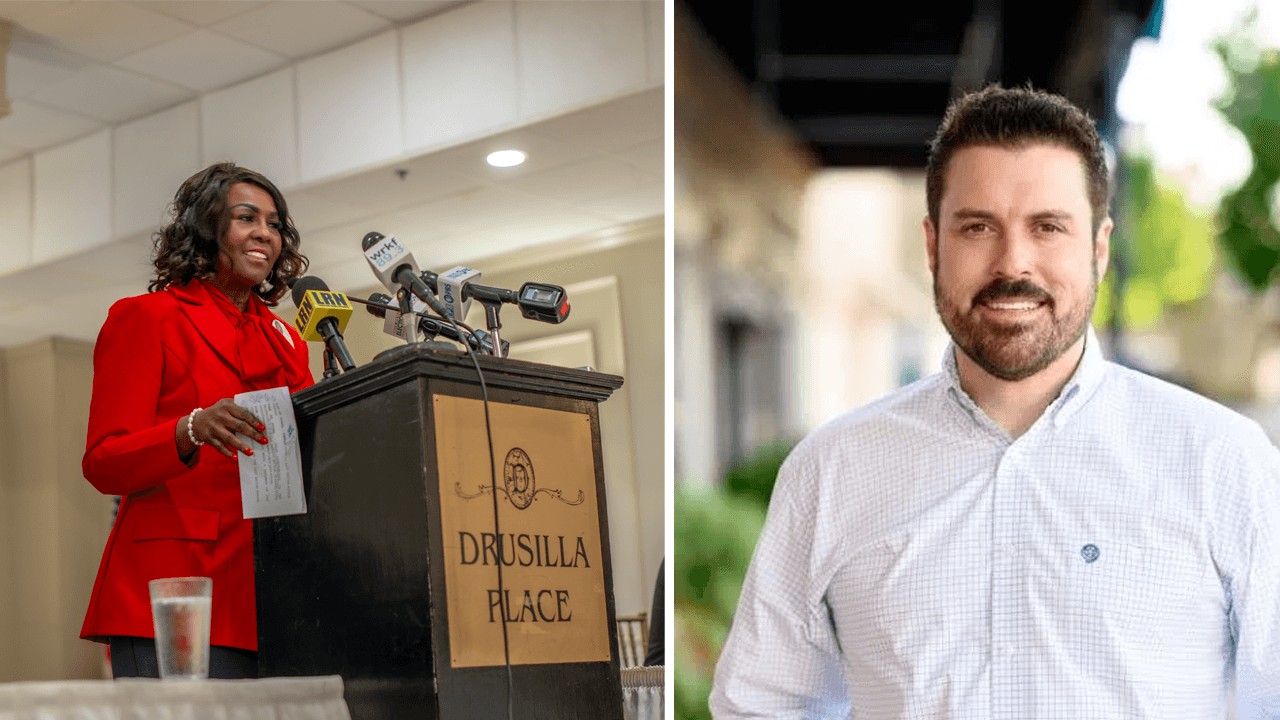
Democrat Chauna Banks emerged as the top vote-getter in Louisiana’s fiercely contested 6th Congressional District election Tuesday night, overtaking Republican state Sens. Blake Miguez and Rick Edmonds in the final stages of vote counting to secure a place in the December 12 runoff.
Banks, a former East Baton Rouge Metro Council member who entered the race with considerably less financial backing and statewide campaign infrastructure than her leading Republican opponents, received 50,878 votes, or 19.4%, according to unofficial election returns. Miguez finished second with 50,213 votes, or 19.2%, while Edmonds narrowly missed the runoff with 49,241 votes, or 18.8%.
With all 541 precincts and 11 absentee reporting units counted, Banks finished just 665 votes ahead of Miguez. Edmonds, who had held second place for much of election night, finished 972 votes behind Miguez and 1,637 votes behind Banks.
The result sets up a Democrat-versus-Republican runoff in a congressional district Louisiana lawmakers redrew earlier this year specifically to create a more favorable electoral landscape for Republicans, following a U.S. Supreme Court ruling that invalidated the state’s previous congressional map.
It also represents a significant political development for Banks, whose campaign had attracted comparatively little attention amid a crowded 10-candidate contest dominated by Republican fundraising, outside spending and competition between Miguez and Edmonds.
An election-night reversal
For much of Tuesday evening, the race appeared headed toward a runoff involving Miguez and Edmonds, two Republican state senators who had emerged as leading candidates in preelection polling and fundraising.
Miguez maintained a lead as precinct results arrived, while Banks and Edmonds competed closely for second place. At one point, Edmonds had opened a lead of more than 3,000 votes over Banks with nearly all precincts reporting.
But the outstanding absentee returns dramatically reshaped the contest. Banks gained enough ground not only to move past Edmonds but also to overtake Miguez, finishing first in a race where the top three candidates were separated by fewer than 1,700 votes.
The final results leave little doubt about the extraordinary fragmentation of the field. No candidate received even 21% of the vote, and fewer than four-tenths of a percentage point separated the two Republicans competing for the final runoff position.
Behind the leading three candidates, Democrat Lindsay “Rubia” Garcia finished fourth with 33,544 votes, or 12.8%, followed by Republican Stephen Wagley with 28,169 votes, or 10.8%. Democrat Pat Forbes received 23,820 votes, or 9.1%.
Republicans Larry Davis III, Monique Appeaning and Michael Mebruer, along with Libertarian Rufus Craig, accounted for the remaining votes.
For Banks, the outcome means advancing from a competitive multicandidate field to a head-to-head contest against Miguez, who entered the election with one of the largest campaign financial operations in Louisiana.
A Democratic showing in a redrawn Republican district
The result is particularly notable given the circumstances that produced the election.
Earlier this year, the U.S. Supreme Court ruled in Louisiana v. Callais that the state’s congressional map, adopted in 2024 to establish a second majority-Black district, violated constitutional protections against racial gerrymandering.
Gov. Jeff Landry subsequently suspended the state’s scheduled congressional primaries, and the Republican-controlled Legislature adopted a replacement map that substantially altered the boundaries and political composition of the 6th District.
The changes eliminated the majority-Black configuration of the district represented by Democratic Congressman Cleo Fields and replaced it with a substantially more Republican electorate. Fields ultimately declined to seek reelection, choosing instead to pursue a return to the Louisiana State Senate.
The newly configured district was widely expected to favor Republicans, and the presence of six Republican candidates reflected the opportunity party leaders saw to reclaim a congressional seat held by a Democrat.
Banks’ first-place finish complicates that narrative, although the combined vote totals demonstrate the challenge Democrats will face in December.
Together, the six Republican candidates received approximately 150,248 votes, representing 57.4% of ballots cast in the congressional contest. The three Democrats collectively received 108,242 votes, or 41.3%. Libertarian Rufus Craig received the remaining 1.3%.
Those figures illustrate the underlying Republican advantage in the electorate that participated Tuesday. They also show that the December runoff will involve a substantially different contest, with voters choosing between two candidates rather than dividing their support among 10.
The results alone do not establish how supporters of the eliminated candidates will vote in December, or whether the runoff will attract the same electorate.
Miguez’s financial advantage meets an unexpected opponent
Miguez entered the election with a considerable financial advantage over most of the field.
According to federal campaign finance records, his campaign raised approximately $7.75 million through October 14 and spent more than $6.2 million. His fundraising substantially exceeded that of Edmonds, who raised approximately $697,000, and Wagley, who raised approximately $874,000.
Miguez also benefited from significant outside political spending, while Edmonds faced substantial advertising expenditures opposing his candidacy.
The Republican contest became increasingly contentious in its closing weeks, with outside organizations financing attack advertisements and the candidates competing for support among overlapping segments of the district’s conservative electorate.
Banks, by comparison, mounted a far less financially prominent campaign, drawing on her years of experience representing portions of Baton Rouge on the Metro Council and her relationships within the local Democratic electorate.
Banks served on the Metro Council from 2013 through 2024 and previously sought higher office. Her campaign emphasized household affordability, government accountability and the need for stronger representation of communities she argued had been overlooked in government spending and policy decisions.
During an interview with The Bayou Progressive ahead of Election Day, Banks discussed her record on the Metro Council, the challenges facing historically underserved communities and her decision to enter the congressional contest.
Miguez, meanwhile, campaigned on his conservative record in the Louisiana Legislature and his support for Republican priorities. A former state representative who now represents Senate District 22, Miguez has positioned himself as a staunch conservative and ally of the state’s Republican leadership.
The runoff will place those contrasting political backgrounds before voters in a district spanning communities with substantially different demographic, economic and political interests.
The other Democratic campaigns
Banks’ emergence also comes after a competitive contest among three Democrats who offered different approaches to winning the newly configured district.
Garcia, a progressive activist from New Orleans, built her campaign around economic inequality, government accountability and a more confrontational approach to Republican leadership. Her campaign drew attention through public appearances, grassroots organizing and efforts to mobilize progressive voters.
Forbes, a former state official and engineer endorsed by former Gov. John Bel Edwards, emphasized his experience in government administration and economic development, positioning himself as a candidate capable of attracting voters across party lines.
Their combined support accounted for more than 57,000 votes, exceeding Banks’ own total. Those voters will be among the constituencies both runoff candidates must consider as the field narrows.
The primary also highlighted the degree to which the Democratic vote remained divided despite the district’s new Republican orientation. Banks, Garcia and Forbes collectively attracted more than 41% of the electorate, a sizable share in a district redesigned with Republican representation in mind.
Whether that support translates into a similarly competitive runoff will depend in part on turnout and how voters respond to the choice between Banks and Miguez.
A five-week fight for the seat
The December 12 runoff will determine who succeeds Fields in Congress and will bring an end to an election process reshaped by months of litigation, redistricting and changes to Louisiana’s election calendar.
For Republicans, the outcome will determine whether the new congressional map delivers the additional Republican-held seat its architects sought to create. For Democrats, Banks’ advancement provides an opportunity to contest a district that appeared considerably less favorable following the Legislature’s redistricting decisions.
Both candidates now face a compressed runoff campaign, with just over five weeks to consolidate support, attract voters who backed eliminated candidates and persuade those who did not participate in Tuesday’s election.
The contest will also determine whether Banks’ first-place finish was principally a product of the crowded field or evidence of a broader coalition that can compete in the newly configured district.
What Tuesday’s results established is that neither Republican frontrunner secured the top position, and one of them will not appear on the December ballot.
Instead, Banks enters the runoff having received more votes than any other candidate in a congressional district that, only months ago, was redrawn to make a Democratic victory substantially more difficult.