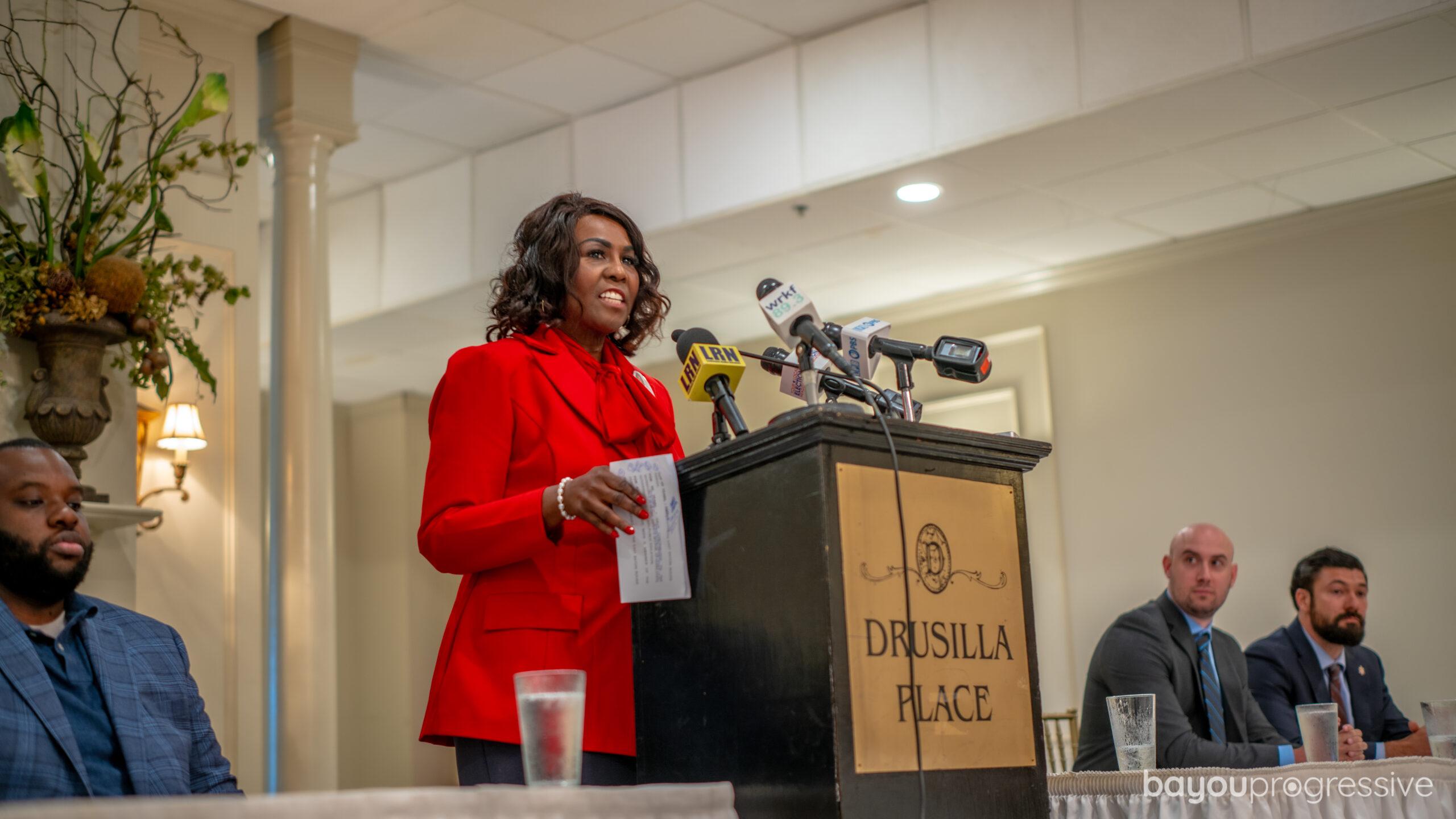
For much of her political career, state Rep. C. Denise Marcelle has worked to change the laws governing Louisiana. Now, she’s asking East Baton Rouge Parish voters to give her a different responsibility: applying them from the judicial bench.
The longtime Baton Rouge Democrat is seeking to become the next justice of the peace for District 4, a position that would take her from the Louisiana Legislature to a local courtroom where disputes over rent, evictions and small civil claims can carry enormous consequences for the people involved.
In an interview with The Bayou Progressive, Marcelle described the move as a natural progression of a career she says has always been rooted in the legal system, even as she acknowledged that her approach to helping residents would necessarily change.
“At this juncture in my career, I believe that it’s time for me to do a shift from the policy to the judicial bench,” Marcelle said, calling her candidacy a “full circle moment.”
Marcelle will face fellow Democrat Taneshia Flowers in the December 12 runoff after finishing first in a five-candidate field on November 3. Marcelle received 15,258 votes, or 46.2%, while Flowers finished second with 11,212 votes, or 34%.
The race comes amid a significant restructuring of East Baton Rouge’s justice of the peace courts. Under Act 950, approved by the Legislature earlier this year, the parish’s court districts have been redrawn, and justices of the peace have been granted concurrent jurisdiction with city courts over certain eviction proceedings.
Flowers also won a separate special election on November 3 to fill the remainder of an unexpired term in the former Ward 2, District 3 court. That term expires at the end of the year, making the December runoff a contest for a full six-year term in the newly configured District 4.
For Marcelle, who has spent much of the past two decades in elected office, the race represents another possible transition in a political career that has included service on the East Baton Rouge Metro Council, more than a decade in the Louisiana House, and two unsuccessful campaigns for mayor-president.
It also follows her unsuccessful 2024 challenge to Baton Rouge City Constable Terrica Williams, another court-related position that would have required her to leave the Legislature.
From writing the law to applying it
Although the justice of the peace is a judicial position, its responsibilities are considerably narrower than those of a district or city court judge. Under Louisiana law, justices of the peace generally handle civil claims involving $5,000 or less, along with eviction proceedings and certain property disputes. They can also perform marriage ceremonies and exercise limited criminal magistrate functions.
The courts are intended to provide relatively accessible venues for resolving smaller legal disputes, often involving residents who do not have attorneys.
Marcelle points to her professional experience as a paralegal, legal secretary and licensed notary public, along with previous employment in the East Baton Rouge Parish Sheriff’s Office and Baton Rouge City Constable’s Office, as qualifications for the position.
She said she has worked in the legal profession for more than four decades, including for attorneys who later became judges. She also earned a criminal justice degree from Southern University after joining the Metro Council and spent eight years on the House’s criminal justice committee.
“I’ve always touched criminal justice in some way, shape, form, or fashion,” she said.
While Marcelle’s experience spans both law enforcement and legal administration, the justice of the peace position is primarily a civil judicial office. Louisiana does not require justices of the peace to be licensed attorneys.
Among the most consequential responsibilities of the court are eviction proceedings, which often place judges in the position of resolving disputes between property owners and tenants facing significant financial hardship.
Asked how she would approach a case in which a landlord had a legitimate legal claim but a tenant was experiencing extraordinary financial difficulties, Marcelle acknowledged the limits of what she could do.
“The law is what the law is,” she said. “I can’t force someone to say you got to allow them to remain here.”
Marcelle said her responsibility would be to apply the law while treating both parties fairly and helping residents identify resources that might assist them outside the courtroom. She pointed to rental assistance programs and services available to people experiencing domestic violence or other circumstances that disrupt their financial stability.
She also acknowledged the financial obligations landlords may face, noting that some depend on rental income to pay mortgages and other property expenses.
Her comments underscore an important distinction between her current position and the office she is seeking. As a legislator, Marcelle can advocate for changes to laws and public funding. As a justice of the peace, she would be responsible for deciding individual cases according to existing law.
That responsibility includes evaluating whether landlords have established legal grounds for eviction and whether tenants have valid defenses, rather than simply granting an eviction because rent is disputed or unpaid.
Marcelle said she believes compassion can coexist with those responsibilities, even when the outcome of a case is unfavorable to one of the parties.
“You can be polite to people even though they’re going through a tough situation,” she said.
Beyond her approach to individual cases, Marcelle has made court accessibility and efficiency central elements of her campaign platform.
Her proposals are relatively straightforward: showing up for hearings on time, making the court available to both landlords and tenants, ensuring paperwork is processed promptly, and treating people with courtesy throughout the process.
“If I was going to start my court at 9 o’clock, I don’t show up at 10,” Marcelle said.
She said she has heard complaints about delays and inconsistent availability in local justice of the peace courts, although she did not identify specific cases or officials. Those complaints have not been independently verified.
For Marcelle, however, the larger point is that the operation of a court should not create unnecessary difficulties for people already navigating a legal dispute.
“It’s consistency for me,” she said.
An activist who became a politician
Marcelle’s career in elected office began with an experience she describes as almost accidental.
Before running for the Metro Council, she was involved in community organizing, helping coordinate activities for children and seniors, supporting back-to-school giveaways and participating in Juneteenth events.
She said community members repeatedly encouraged her to seek office, despite her preference for working outside government.
“I was hijacked in the running for office by my community,” Marcelle recalled.
After initially resisting those requests, she eventually agreed to challenge an incumbent Metro Council member and won.
Her political career later took her to the Louisiana House, where she was elected in 2015 following the death of Rep. Alfred Williams. She has represented House District 61 since then, serving through two gubernatorial administrations and a period of increasingly pronounced partisan divisions at the State Capitol.
That transition from community activist to legislator, she said, required a difficult adjustment in expectations.
Marcelle recalled entering elected office believing that other public officials shared her sense of urgency about addressing problems affecting their communities. She gradually discovered that agreement on an issue did not always translate into a willingness to act.
“I found myself getting frustrated with people who didn’t want to fight,” she said.
She described experiences in the Legislature in which colleagues would privately praise her proposals but decline to support them publicly.
“They’ll vote against your bill because of party lines or because of somebody said something to them, and they just can’t vote for it,” Marcelle said. “But in the back room, they tell you you got a great bill.”
Over time, she said, she learned to approach legislative work with greater patience, recognizing that progress often required repeated attempts rather than immediate victories.
That lesson has been particularly relevant to her work on environmental issues, including drinking water quality and pollution.
Marcelle recalled becoming increasingly concerned about the effects of contaminated water and air on Louisiana communities and repeatedly introducing legislation aimed at addressing those problems.
She also criticized what she sees as the influence of industry interests and campaign contributions on lawmakers’ willingness to support environmental protections.
One example of that work was House Bill 354 in 2025, which proposed additional chlorine testing alongside drinking-water samples collected under federal lead and copper regulations. The legislation was referred to the House Health and Welfare Committee but did not advance.
For Marcelle, experiences like those illustrate both the limitations of legislative power and the persistence she believes public service requires.
“Sometimes it’s a timing,” she said. “It may not happen when you think it should happen, but if you keep working on it and you keep pushing, sometimes those things happen.”
A changing Baton Rouge
Marcelle’s political career has also coincided with substantial changes in Baton Rouge’s local government, demographics and political landscape.
She has served during the mayoral administrations of Kip Holden and Sharon Weston Broome and watched Republican Sid Edwards take office in January 2025. Her own campaigns for mayor-president in 2016 and 2020 placed her directly in the middle of debates about the parish’s direction.
Asked to assess the political evolution of Baton Rouge across those administrations, Marcelle emphasized that each mayor inherited markedly different circumstances.
She characterized Holden’s administration as particularly focused on downtown development and modernization, while crediting Broome with efforts to improve relationships between law enforcement and communities following the 2016 police killing of Alton Sterling.
The Sterling shooting, subsequent protests, killing of three law enforcement officers and catastrophic flooding that summer created extraordinary challenges for the city just months before Broome took office.
Marcelle said the political and financial landscape has shifted again under Edwards, particularly following the incorporation of St. George and the expiration of extraordinary federal assistance associated with the COVID-19 pandemic.
The loss of tax revenue following St. George’s incorporation has contributed to significant financial pressure on the city-parish government. The Edwards administration implemented department reductions and layoffs in 2026 as local officials adjusted to the changed revenue structure.
Marcelle believes those pressures will continue to shape the services local government can provide.
“We’re going to continue to see some issues with funding around services for the city due to that,” she said.
Her assessment comes as the Edwards administration has submitted its proposed 2027 budget, which seeks to maintain services after the previous year’s reductions while addressing continuing financial and staffing challenges.
For Marcelle, the changing circumstances of the last decade illustrate how decisions made by one administration, or by voters themselves, can shape the options available to future leaders.
A different measure of public service
Despite her years in elected office, Marcelle’s most personal reflection during the interview had little to do with legislation, political campaigns or the workings of government.
Asked to identify a moment when she believed she had made the greatest difference in someone’s life, she spoke about helping a woman who struggled with addiction, repeated incarceration and separation from her family.
Marcelle said she continued supporting the woman through repeated setbacks, even as others began losing hope that her circumstances would improve.
For Marcelle, the experience was deeply personal. She disclosed that she has been in recovery from addiction herself for many years, a history she said gives her particular concern for people who struggle to obtain treatment, mental health services and the support needed to rebuild their lives.
She recalled helping the woman regain stability and reconnect with her family, describing her continued recovery as a source of tremendous pride.
“I didn’t give up on her,” Marcelle said.
It was an accomplishment she described as more meaningful than the awards and recognition she has received throughout her public career.
The experience also helps explain her continuing emphasis on treatment resources and support services, even as she prepares for a possible judicial role in which her authority to intervene in people’s personal circumstances would be more limited.
Marcelle argues that her years in public service, legal work and community advocacy have prepared her for that transition. The December runoff will determine whether District 4 voters agree.
Her opponent, Flowers, enters the contest having won a separate election to serve the final weeks of an existing justice of the peace term, while Marcelle is campaigning on the legal and government experience she has accumulated over several decades.
For Marcelle, the potential move from the State Capitol to a local courtroom represents a change in responsibilities, but not necessarily a departure from the work that originally drew her into public life.
The question now is whether that experience will translate into the kind of impartial, efficient and accessible court she says she wants to lead.
Voters will make that decision on December 12.