Louisiana’s newly redrawn 6th Congressional District is becoming an expensive battleground for Republicans, with millions flowing into campaign advertising and outside political groups spending heavily to influence the contest. Meanwhile, three Democrats are trying to build support with considerably smaller budgets in a district specifically redrawn to favor the GOP.
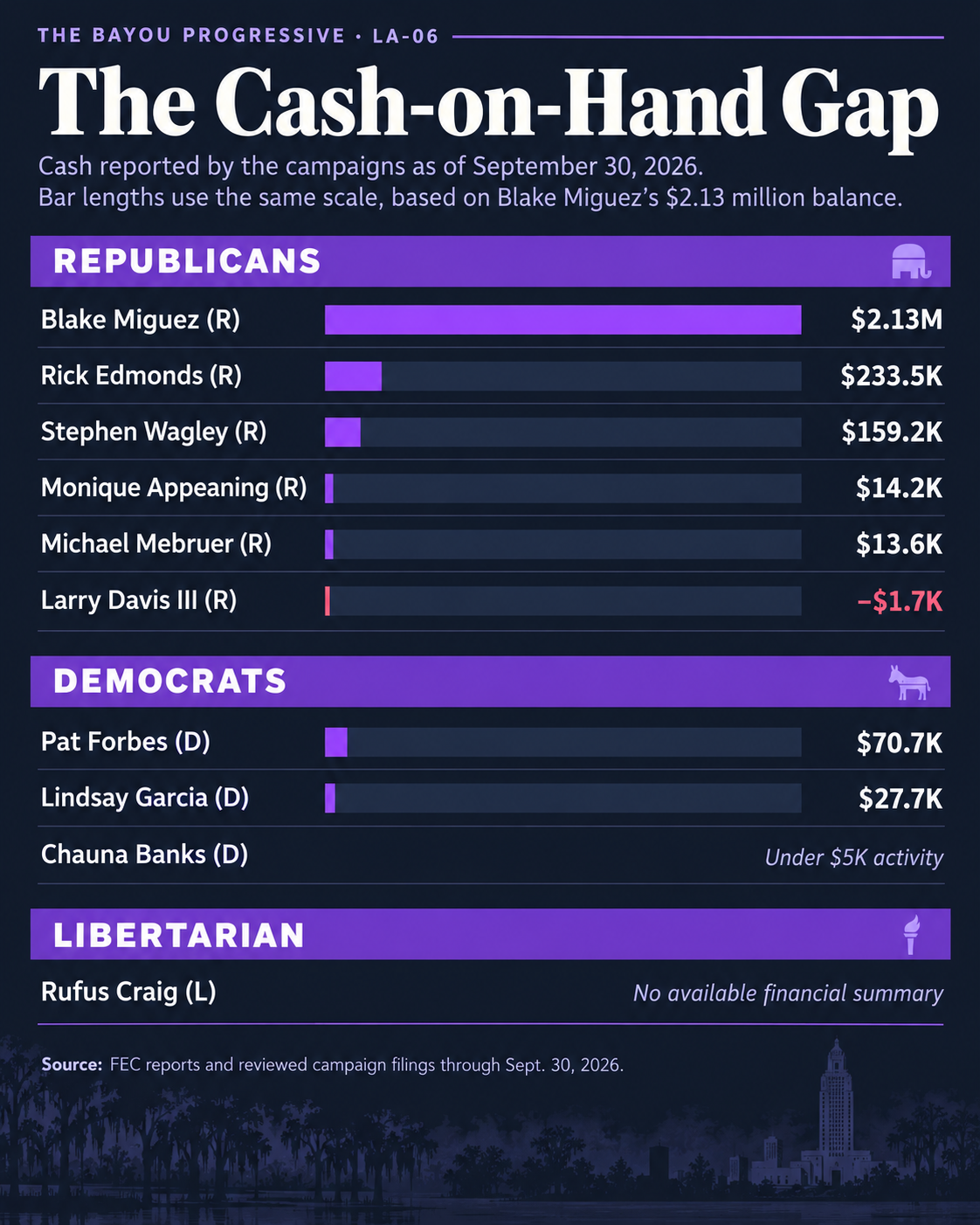
New federal campaign finance reports reveal the scale of that divide. Republican state Sen. Blake Miguez entered October with $2.13 million in cash on hand, compared with $233,528 for fellow Republican state Sen. Rick Edmonds and $159,226 for Republican Stephen Wagley.
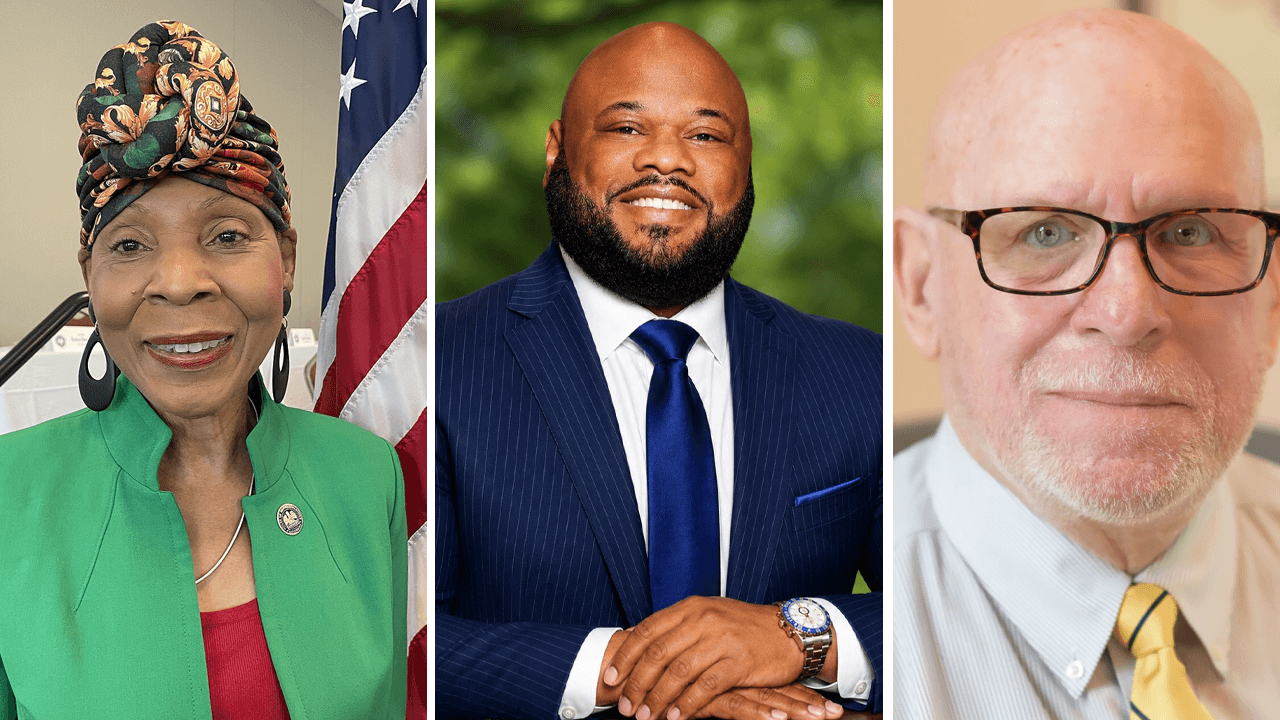
Democrats Pat Forbes and Lindsay “Rubia” Garcia reported $70,662 and $27,700, respectively. Former East Baton Rouge Metro Councilwoman Chauna Banks confirmed her campaign had not raised or spent $5,000 through September.
But the most revealing story isn’t simply who has the biggest bank account. It’s how that money is shaping the race, from Miguez’s conspicuous absence at the recent televised debate to the national conservative organizations spending more than $1 million attacking Edmonds.
With early voting beginning Tuesday, October 20, here are six takeaways from the latest financial disclosures.
1. Miguez Has $2.1 Million Left to Spend — and a Television Campaign That Doesn’t Require Him to Show Up
Blake Miguez was noticeably absent from the October 9 WBRZ congressional debate, leaving Rick Edmonds as the only Republican onstage alongside Democrats Forbes, Garcia and Banks.
The moderator attributed Miguez’s absence to a scheduling conflict. But the decision also highlighted a striking difference in how the two leading Republican fundraising operations are approaching the race.
While Edmonds used the debate to make his case directly to voters, Miguez, a resident of Louisiana’s 3rd district, has spent heavily putting his message on television.
His campaign reported nearly $490,000 in media purchases between July 19 and September 30, helping finance an extensive advertising presence across the Baton Rouge market.
Public television station records confirm repeated placements on WAFB and WVLA, including 51 thirty-second commercials on WAFB during a single September advertising period costing approximately $36,000.
Miguez’s ability to finance that level of advertising puts his decision to skip the debate in a different political context. He surrendered an hour of free television exposure and a chance to answer questions directly, but his campaign has paid for repeated opportunities to deliver its own message without interruption.
That doesn’t establish why he declined to attend. It does demonstrate that his campaign has the resources to maintain an extensive media presence independently of candidate forums.
And those resources are considerable.
Miguez reported approximately $7.65 million in cumulative campaign receipts through September, including nearly $3.9 million in contributions and $3.51 million in personal loans.
His campaign has spent more than $5.5 million during the election cycle, yet retained $2.13 million heading into October.
That financial strength is especially notable given the WBRZ qualifying poll, which found more than a third of likely voters undecided in September. Edmonds led that survey with 13.8%, while Miguez registered 9.7%.
Money alone doesn’t establish voter support. But Miguez, who currently lives in New Iberia, has demonstrated the ability to finance sustained advertising while retaining considerably more money than any other candidate entering the final weeks.
2. National Super PACs Are Financing an Expensive Republican Fight — and Some of the Money Is Difficult to Trace
The campaigns’ own financial reports only tell part of the story.
National conservative organizations have poured substantial sums into the 6th District contest, particularly through independent advertising attacking Edmonds.
Club for Growth Action has reported approximately $1.39 million in spending opposing Edmonds, making the state senator one of the organization’s more significant targets in this election cycle.
The group, affiliated with the conservative Club for Growth organization that endorsed Miguez, has also reported approximately $361,000 in independent spending supporting Miguez, including a major additional expenditure disclosed in mid-October.
On the other side, Louisiana First Victory Fund has reported approximately $238,000 in spending supporting Edmonds and another $188,000 opposing Miguez.
Together, those reported expenditures amount to more than $2 million in outside political activity associated with the contest between the two Republicans.
That money is separate from what either candidate has raised or spent directly. But it is financing an advertising fight that voters may experience alongside the candidates’ own television, mail and digital campaigns.
The sources of that money are also revealing.
Campaign finance records identify Wampold Companies, associated with prominent Baton Rouge developer Mike Wampold, as a $50,000 contributor to Louisiana First Victory Fund.
A much larger contribution of approximately $280,000 came from A Public Voice, a politically active nonprofit organization.
Unlike a conventional political action committee, a 501(c)(4) nonprofit generally does not have to publicly disclose its underlying donors. That means voters can identify A Public Voice as a source of funding for the super PAC without necessarily knowing whose money ultimately financed the contribution.
It is an example of how money can move into federal political advertising through organizations that disclose some financial activity while shielding the identities of their original donors.
The distinction matters because Louisiana First Victory Fund has supported Edmonds and opposed Miguez, while Club for Growth Action has spent much larger sums attacking Edmonds and promoting Miguez.
And while neither candidate controls those independent expenditures, the outside spending has considerably expanded the financial scale of the Republican contest.
The result is a race shaped not only by Louisiana donors and candidate spending, but by national political organizations with substantial resources and different financial disclosure requirements.
3. Edmonds Has Establishment Connections. The Fundraising Hasn’t Matched the Expectations.
For Rick Edmonds, the financial disclosures raise a particularly interesting question: Why hasn’t a campaign backed by prominent Capital Region business and political figures attracted more money?
Edmonds entered the race positioned as a conventional Republican alternative to Miguez’s more confrontational political style.
His campaign emphasized his legislative experience, relationships with influential Louisiana Republicans, and support from established business interests.
In June, Edmonds announced a finance leadership committee featuring prominent figures including Wampold, LABI chairman Scott Ballard, and businessman Richard Lipsey.
The campaign also hired a finance director with Republican National Committee and Trump administration experience, signaling an ambitious fundraising operation.
But the latest filings reveal a considerably smaller campaign treasury than those institutional relationships might have suggested.
Edmonds raised approximately $134,760 in new contributions between July 19 and September 30, bringing his cumulative campaign contributions to nearly $492,000.
Miguez, by comparison, has attracted nearly $3.9 million in contributions, even before accounting for his personal loans.
Edmonds also spent nearly as much as he raised during the latest reporting period, investing approximately $69,000 in digital advertising and another $34,600 with a political polling and research firm.
His campaign entered October with $233,528 in cash on hand, virtually unchanged from July.
The disconnect is particularly striking given Edmonds’s message at the recent televised debate.
With Miguez absent, Edmonds made an explicit pitch to Republican voters that he would be a reliable member of the party’s governing team in Washington. He emphasized his relationships with House Speaker Mike Johnson and Majority Leader Steve Scalise, supported major elements of the Trump administration’s agenda, and presented himself as an experienced Republican who could work effectively within the party.
As The Bayou Progressive reported in its debate analysis, Edmonds seemed determined to establish himself as the dependable, mainstream Republican option.
Yet his campaign’s own fundraising remains far behind Miguez’s, and the national conservative money being spent against him substantially exceeds the independent spending reported in his favor.
That doesn’t mean Edmonds lacks institutional support. His finance committee and the contributors to Louisiana First Victory Fund demonstrate that he has it.
But the filings suggest that those relationships have not translated into the level of direct fundraising one might expect from an established Republican legislative leader making a concerted appeal to the party’s business and political establishment.
4. Three Democrats, Three Different Messages — and Very Different Financial Resources
The financial picture is considerably different for the Democrats, who are competing against one another as well as the Republican field.
Forbes, Garcia and Banks have offered distinct arguments throughout the campaign, differences that were particularly visible during the recent WBRZ debate.
Forbes has emphasized experience and crossover appeal. The former state official is campaigning on his disaster recovery work and ability to navigate government, with the backing of former Gov. John Bel Edwards and other prominent Louisiana Democrats.
His campaign raised $108,126 in individual contributions during its first two months, with nearly $118,000 in total receipts including a relatively modest candidate loan.
Forbes spent approximately $47,300 through September, investing in direct mail, digital communications, text messaging and campaign consulting. He entered October with $70,662 available.
Garcia has taken a more confrontational, populist approach. Her campaign has emphasized economic inequality, government accountability, constitutional rights and direct opposition to Trump administration policies.
Her financial disclosures reflect a different fundraising operation.
Garcia reported $26,971 in third-quarter contributions, with approximately 84% of that money coming from smaller contributions that did not require individual donor identification.
She has raised $87,231 in individual contributions across the election cycle, with no reported PAC contributions.
Her campaign has invested in consulting, voter data, campaign materials, digital outreach and fundraising operations, spending approximately $35,700 during the latest period.
Garcia entered October with $27,700 in cash on hand, down from approximately $36,300 in July.
The contrast between Forbes and Garcia is both political and financial. Forbes is promoting his institutional experience and ability to work across political divisions, while Garcia is emphasizing grassroots engagement and a more confrontational approach to Republican governance.
Both have demonstrated the ability to attract individual contributions. But Forbes enters the final stretch with more than twice Garcia’s cash reserves.
Banks faces an even more difficult financial situation.
The former Metro Councilwoman filed a statement with the FEC confirming that her campaign had not raised or spent $5,000 through September 30, leaving her without a detailed quarterly financial disclosure.
That limitation compounds the geographic challenges created by redistricting.
Banks represented communities in northern East Baton Rouge Parish for twelve years, but much of her former council district now lies outside the newly redrawn congressional district.
She is therefore campaigning before an electorate that includes many voters who did not previously have the opportunity to vote for her, without the financial resources reported by her Democratic opponents.
The new district also has a Black voting-age population of approximately 24.5%, a dramatic change from the majority-Black district represented by outgoing Democratic Rep. Cleo Fields.
All three Democrats face substantial financial disparities compared with the larger Republican campaigns. Even combined, Forbes and Garcia reported less than $100,000 in cash on hand heading into October, compared with Miguez’s $2.13 million.
With all three appearing on the same November ballot, the financial differences add another dimension to an already complicated contest among Democrats pursuing sharply different approaches to the race.
5. Wagley Has Raised Little From Donors, but He’s Spent Like a Serious Television Advertiser
Republican newcomer Stephen Wagley demonstrates why fundraising totals alone can be misleading.
Wagley reported approximately $595,635 in total receipts through September, but just $8,635 came from outside contributors. The remaining $587,000 came from loans he made to his own campaign.
Despite attracting relatively little donor money, Wagley has financed a substantial paid advertising operation.
His campaign spent approximately $436,400 during the latest reporting period, including more than $366,000 in media purchases.
Television station records confirm advertising across WAFB, WVLA and WGMB, including a September WAFB invoice documenting 66 thirty-second commercials costing approximately $34,500.
Wagley’s campaign has effectively converted personal financing into substantial television exposure, even without building a large outside fundraising operation.
That distinction is useful when evaluating the resources behind the race.
A strong fundraising operation demonstrates a candidate’s ability to attract financial support beyond personal resources. But a candidate capable of financing hundreds of thousands of dollars in advertising can still maintain an extensive paid communications operation.
Wagley entered October with $159,226 available, giving him additional resources after spending heavily during September.
His presence is another reminder that the Republican financial contest extends beyond the Miguez–Edmonds rivalry.
6. Several Smaller Campaigns Have Already Spent Much of Their Money
The remaining candidates have operated on comparatively limited budgets, although their filings show varying levels of paid campaign activity.
Republican Monique Appeaning has invested in direct mail, digital marketing and local newspaper advertising.
Her campaign reported approximately $108,373 in cumulative receipts, including more than $50,000 in personal loans. But she spent $28,604 during the latest reporting period while bringing in just $4,050, leaving $14,229 available at the end of September.
Republican Michael Mebruer financed his campaign through approximately $70,714 in personal contributions, rather than loans or outside donations. After spending roughly $53,000 during the election cycle, he reported $13,613 remaining.
Republican Larry Davis III reported an even tighter financial position.
His campaign spent more than it received during the latest reporting period, ending September with a negative reported cash balance of $1,692.
That means his filing does not show positive cash reserves available for additional spending, although the negative accounting balance does not necessarily establish a bank overdraft.
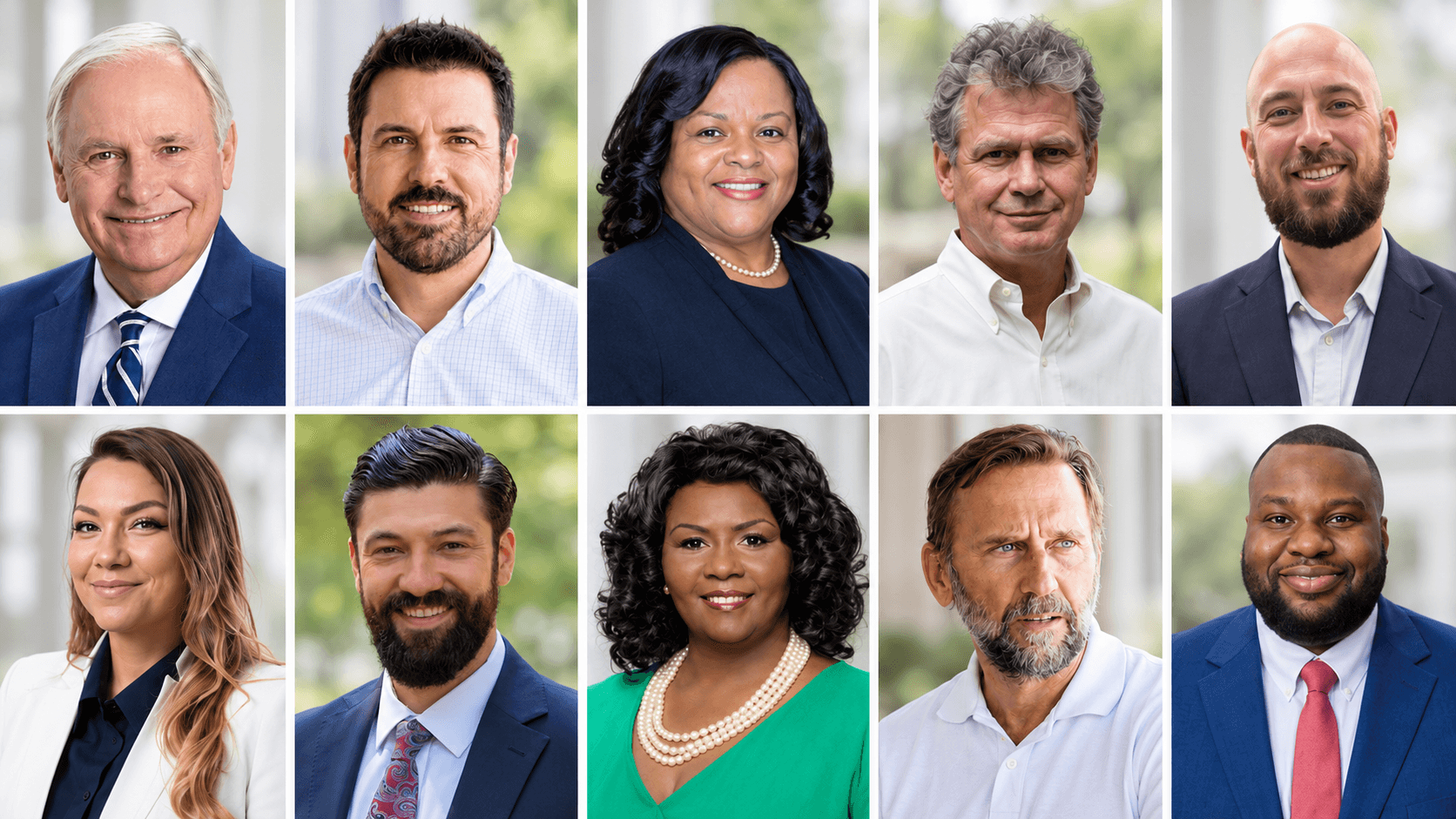
Libertarian Rufus Craig, the tenth candidate on the ballot, had no available 2026 financial summary in the FEC records reviewed for this article.
These campaigns have undertaken varying levels of outreach, but their remaining financial resources are considerably smaller than those available to the better-funded Republican candidates.
The Bottom Line
The 6th District’s latest campaign finance disclosures reveal a race shaped by dramatically different financial resources and political strategies.
Miguez has built the largest campaign treasury, spending heavily on advertising while maintaining millions for the final stretch. Edmonds has emphasized his institutional Republican connections, but his fundraising has fallen well short of Miguez’s, even as outside conservative groups invest heavily in the contest.
Wagley has financed substantial advertising through personal loans, while the three Democrats are campaigning on much smaller budgets with competing messages about how their party should approach the new district.
The September-ending reports do not capture all the money raised or spent since October 1, and financial resources alone cannot measure public support or predict how voters will respond.
But they provide a revealing account of how the candidates have assembled and deployed their money.
With early voting beginning October 20 and Election Day scheduled for November 3, the candidates are entering the final stretch with markedly different capacities to finance advertising, outreach and campaign operations.
And in a district redrawn only months before voters head to the polls, those differences are especially consequential.