Republican U.S. Rep. Julia Letlow narrowly won Louisiana’s U.S. Senate race Tuesday, surviving a remarkably competitive challenge from Democrat Jamie Davis, whose volunteer-driven campaign came within two percentage points of delivering one of the biggest political upsets in the state’s recent history.
With all 3,722 precincts and 64 absentee reporting units counted, unofficial election returns showed Letlow receiving 745,963 votes, or 50.9%, compared with Davis’ 720,106 votes, or 49.1%. The margin of 25,857 votes was a stunning result in a state President Donald Trump carried by more than 22 percentage points just two years earlier.
The Associated Press projected Letlow as the winner late Tuesday, but Davis declined to concede during his election-night remarks to supporters in Baton Rouge, maintaining that the race remained too close to call.
“This thing is way, way, way too tight to call,” Davis told the crowd, which responded with cheers. “We’ve built something that Louisiana has never seen before.”
Davis reiterated his position near the conclusion of his remarks, telling supporters they would not know the outcome until every vote had been counted. Privately, however, Democrats close to the campaign acknowledged that despite the exceptionally narrow margin, there was a growing recognition that the number of outstanding ballots might not be sufficient to overcome Letlow’s advantage.
The result nevertheless marked an extraordinary finish for a campaign that began as a long-shot bid by a third-generation farmer from Tensas Parish, operating with limited institutional backing, a relatively inexperienced statewide campaign team and an organizing operation heavily dependent on volunteers.
For much of the election cycle, Louisiana’s Senate race received relatively little attention from national Democrats, who directed their resources toward states considered more competitive. Davis and his team continued building support through small-dollar contributions, grassroots organizing and an extensive schedule of campaign appearances across Louisiana’s 64 parishes.
By Election Day, they had turned what many political observers initially considered an unwinnable race into one decided by fewer than 26,000 votes.
A campaign built from the ground up
Davis’ campaign was far from financially insignificant, but its resources and political infrastructure differed considerably from those available to his Republican opponent.
According to Federal Election Commission records, Davis raised approximately $5 million through October 14, including nearly $4.95 million from individual contributors. More than $3.7 million of those individual contributions were contributions of $200 or less, reflecting the importance of smaller donations to his fundraising operation.
Letlow, by comparison, raised approximately $7.1 million and spent roughly $6.6 million through the same reporting period, compared with Davis’ $3.8 million in expenditures. Her campaign also benefited from significant financial transfers from her existing congressional campaign and substantially greater support from outside political organizations.
The contrast extended beyond fundraising. While Letlow entered the general election with the backing of President Trump and an established Republican political apparatus, Davis’ operation relied heavily on volunteers and grassroots supporters who spent months knocking on doors, calling voters and organizing events throughout the state.
Campaign manager Corrine Williams, speaking before Davis took the stage Tuesday night, thanked the donors who had helped finance the campaign, saying the average contribution was $19.77. She also recognized the volunteers who spent their summers canvassing neighborhoods, writing postcards and making phone calls.
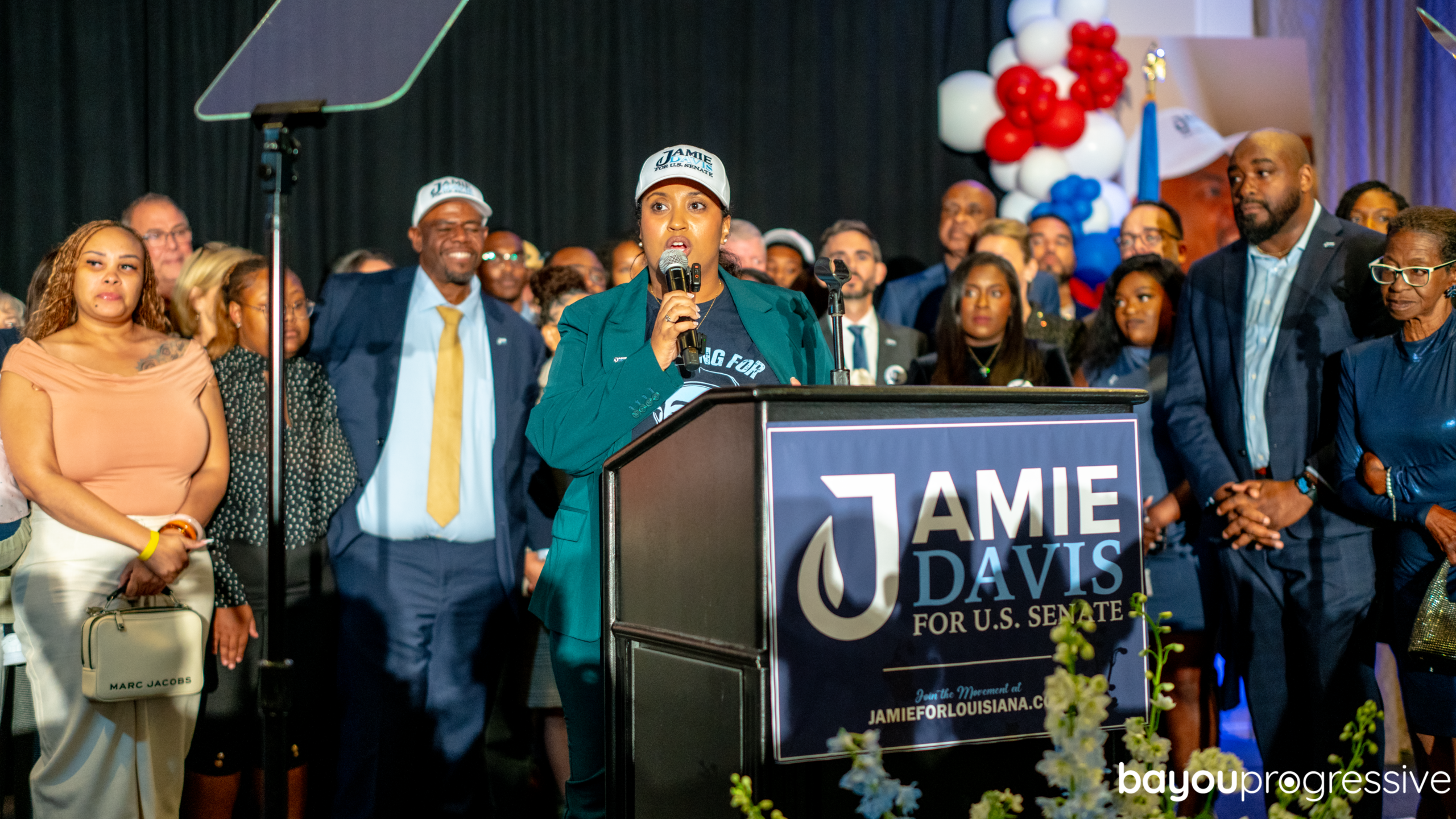
“The postcard writers who wrote until their hands were tired, the phone bankers who called and called and called despite y’all not answering the phone,” Williams said, drawing laughter from the crowd.
Davis echoed those sentiments, crediting supporters rather than himself for the campaign’s unexpected competitiveness.
“To every one of you who knocked on doors in that July heat, who sat in a church parking lot with a clipboard, who drove somebody to the polls today, who had no other way to get there, thank you from the bottom of my heart.”
The campaign also came at a considerable personal cost. Davis said he had spent 326 days on the trail and estimated that he had traveled more than 100,000 miles in various vehicles, often returning home late at night. He thanked his wife, Brenda, and their children for the sacrifices they made throughout the race.
A historically strong Democratic performance
Davis’ performance stands out against the backdrop of Louisiana’s increasingly Republican political landscape.
Trump defeated Kamala Harris in Louisiana in 2024 by approximately 22 percentage points, receiving 60.2% of the vote to Harris’ 38.2%. Davis narrowed that Republican advantage to just 1.8 points, although the presidential and Senate contests involved different candidates, turnout levels and political circumstances.
No Democrat has won a U.S. Senate election in Louisiana since Mary Landrieu secured reelection in 2008. Landrieu subsequently lost her seat to Republican Bill Cassidy in 2014, and Democrats have struggled to mount similarly competitive statewide Senate campaigns since.
Davis also made history in another respect. His 720,106 votes represent the largest number received by a Black candidate in a Louisiana statewide election, surpassing the 565,861 votes Cleo Fields received in his unsuccessful 1995 gubernatorial runoff campaign.
The result followed unusually strong participation among Black voters during Louisiana’s early voting period. Black voters accounted for approximately 34% of early ballots, while registered Democrats cast more early votes than Republicans, providing the first substantial indication that the state’s electorate might be more competitive than anticipated.
Davis’ campaign sought to build on that turnout by emphasizing issues extending beyond traditional partisan divisions, including health care, rising household costs, utility rates and government transparency.
He also made Letlow’s involvement in a nondisclosure agreement connected to Meta’s massive Richland Parish data center a recurring issue, challenging the congresswoman over questions of transparency and stock transactions involving companies connected to the project. Letlow maintained that her financial advisers handled the transactions without her involvement.
The contest tightened considerably during its final weeks, eventually drawing direct intervention from President Trump, who participated in an election-eve telephone rally supporting Letlow and urging Republicans to turn out.
Questions for national Democrats
The close result is likely to renew scrutiny of the national Democratic Party’s decision not to make a significant investment in Louisiana’s Senate race.
Despite Davis’ increasingly competitive polling and substantial grassroots fundraising, national Democratic campaign organizations largely stayed out of the contest. Louisiana Democratic officials and political strategists had publicly expressed frustration over their unsuccessful efforts to secure additional outside support.
Among them was veteran Democratic strategist James Carville, who warned in the final days of the campaign that national Democrats could face difficult questions if Davis ultimately lost by a narrow margin.
That is precisely the situation now confronting the party.
Davis’ performance raises questions about how national Democrats evaluate potential opportunities in presumably heavily Republican states and whether Louisiana’s political landscape is as firmly settled as recent election results have suggested.
For Davis’ supporters, the campaign’s ability to compete without a major national investment has become a central part of its significance. Williams described the effort as something that had challenged assumptions about what Democrats could accomplish in Louisiana.
“In a world that said absolutely not, never, we said right now,” Williams told supporters.
Letlow makes history, Davis signals another fight
Letlow’s victory completes an eventful political year for the Republican congresswoman, who first unseated incumbent Sen. Bill Cassidy in the May Republican primary before defeating State Treasurer John Fleming in the June runoff.
Her election makes her the first Republican woman elected to the U.S. Senate from Louisiana and only the second woman elected to represent the state in the chamber, following Landrieu.
Letlow, who currently represents Louisiana’s 5th Congressional District, will succeed Cassidy when the new Congress convenes in January. Her victory also represents another political achievement for Trump, whose endorsement helped propel her through the contentious Republican nomination contest.
At her election-night gathering in Monroe, Letlow thanked supporters and emphasized the opportunities she sees for Louisiana as she prepares to enter the Senate.
For Davis, however, Tuesday night’s gathering was less a traditional concession speech than a recognition of what his campaign had built and a declaration that its work would continue.
“This campaign turned away from a campaign a long time ago,” Davis told supporters. “It turned into a movement.”
He revisited the campaign’s unlikely beginnings, its Democratic primary contests and the volunteers who joined the operation along the way. He also suggested he remains interested in seeking public office, joking that he would begin another campaign immediately if his wife would give her approval.
Then, turning his attention toward Louisiana’s next major statewide election, Davis delivered a direct message to Republican Gov. Jeff Landry, who faces reelection in 2027.
“Jeff Landry, you’re on notice, buddy.”
The comment drew enthusiastic applause from supporters and offered the clearest indication that Davis does not view his Senate campaign as the end of his political involvement.
Whether that means another candidacy or a continued role in Democratic organizing remains to be seen. But after a race that came far closer than most anticipated, Davis and his supporters leave the election with something Louisiana Democrats have struggled to produce in recent years: evidence that a statewide Democratic campaign can still compete.
And while Davis did not claim victory Tuesday night, he made clear that he believes the political organization built during his Senate campaign has a future beyond this election.
“When we have a fight to get involved in, and it’s a good fight, you can count me in.”