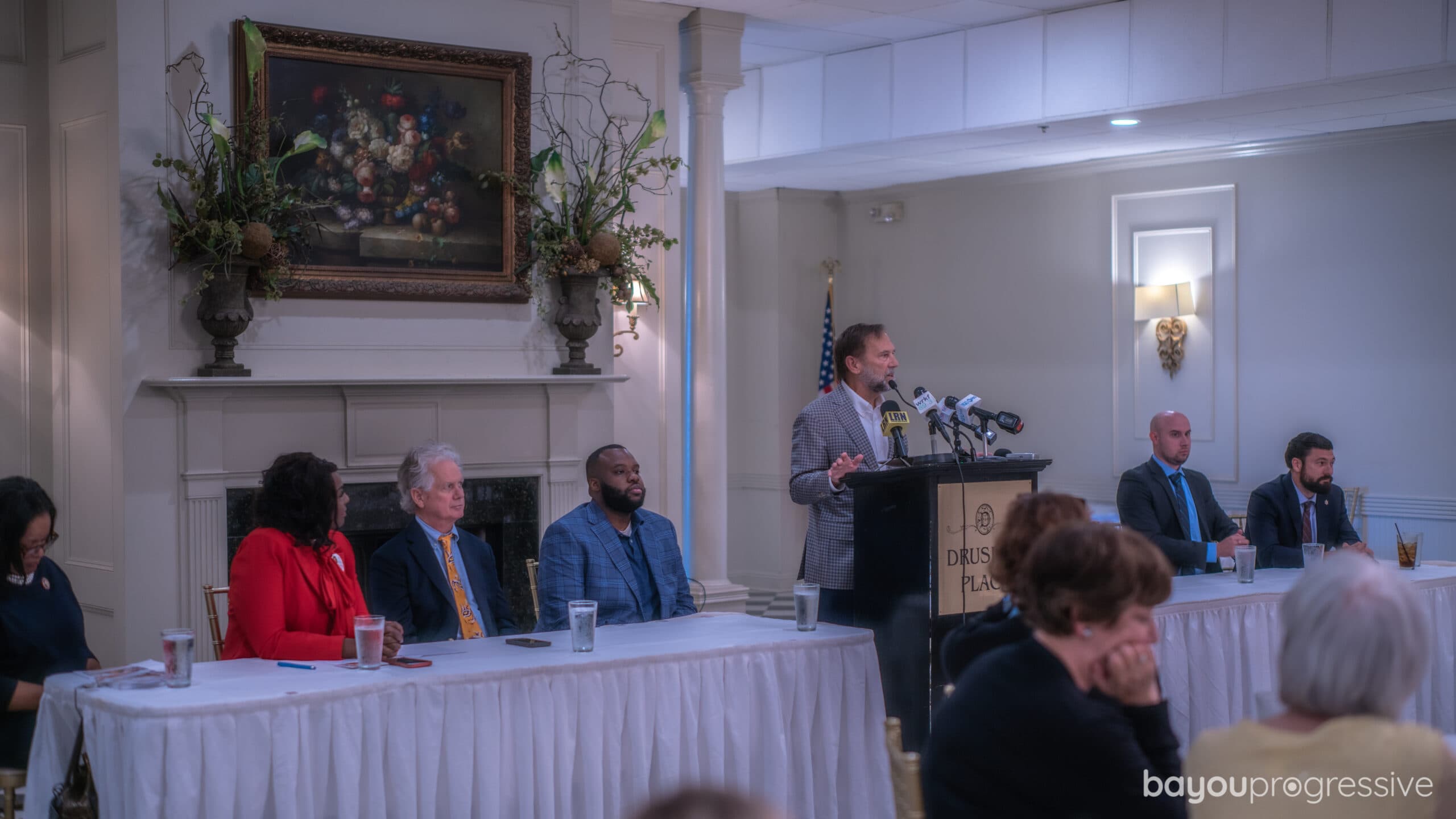
Seven candidates seeking Louisiana’s 6th Congressional District seat gathered Monday at the Baton Rouge Press Club for one final public forum before Election Day, offering competing visions for addressing rising costs, federal spending and government accountability. But three of the race’s more prominent candidates were notably absent.
Republicans Blake Miguez and Rick Edmonds, along with Democrat Lindsay “Rubia” Garcia, did not participate in the hourlong forum at Drusilla Place Catering. Press Club President Kelly Kissel told attendees that Edmonds had notified organizers he might arrive late, but the Baton Rouge state senator ultimately never appeared.
The absences were particularly notable for Miguez and Edmonds, two of the race’s leading Republican contenders, who have pursued markedly different approaches to candidate forums throughout the campaign.
For Miguez, Monday’s absence continued a pattern of declining opportunities to appear alongside his opponents. The New Iberia state senator skipped a September Republican candidate forum in Denham Springs, where Edmonds criticized his absence, and declined to participate in the October 9 televised debate hosted by WBRZ at the Manship Theatre, citing a scheduling conflict. He was also absent from an October forum examining the district’s petrochemical industry and environmental concerns.
Edmonds, by contrast, participated in the WBRZ debate and had previously criticized Miguez for failing to engage in similar public discussions. His own absence Monday meant neither of the two leading Republican contenders was present to field questions during the campaign’s final hours.
With three candidates missing, the remaining contenders had an opportunity to make their final pitches without several of their most prominent opponents sharing the stage.
The participating candidates included Democrats Chauna Banks and Pat Forbes; Republicans Monique Appeaning, Larry Davis III, Michael Mebruer and Stephen Wagley; and Libertarian Rufus Craig.
Affordability exposes sharp differences

The forum’s first question focused on one of the campaign’s central issues: what Congress can realistically do to lower the cost of groceries, gasoline and everyday necessities.
Forbes, a former state official who led Louisiana’s Office of Community Development, placed responsibility squarely on President Donald Trump‘s administration, arguing that the war in Iran and tariffs on imported goods have driven up prices for American consumers.
“Things were going okay. We started a war. The price of oil went through the roof,” Forbes said. “We started tariff wars with every country in the world. Guess what? Everything costs more now.”
Forbes argued that Congress has surrendered too much of its constitutional authority over taxation and military action to the executive branch, allowing policies that have worsened affordability.
Banks, a former East Baton Rouge Parish Metro Council member, similarly blamed the war and tariffs for rising prices, while emphasizing the need for workforce development and economic opportunities for Louisiana families.
Craig, the race’s lone Libertarian, also pointed to the war as a major driver of inflation, arguing that Congress should reclaim its authority over military intervention.
“If you send me to Congress, I will immediately introduce legislation to roll back the War Powers Act, to rein in the presidency, and make Congress do its job,” Craig said.
Republican candidates generally approached the issue differently, emphasizing federal spending, taxation and the national debt.
Wagley, a Baton Rouge businessman, argued that redirecting wasteful federal spending toward reducing the national debt could help curb inflation and strengthen consumers’ purchasing power. Appeaning, a former government analyst, called for strategic reductions in federal spending, including potential cuts to money distributed to state and local governments.
Mebruer, who has emphasized specific policy proposals throughout his campaign, suggested eliminating federal excise taxes, including the gasoline tax, as a way to directly reduce costs for consumers.
Davis, meanwhile, called for reducing spending on entitlement programs and benefits he argued were being improperly directed toward undocumented immigrants.
Social Security brings competing proposals
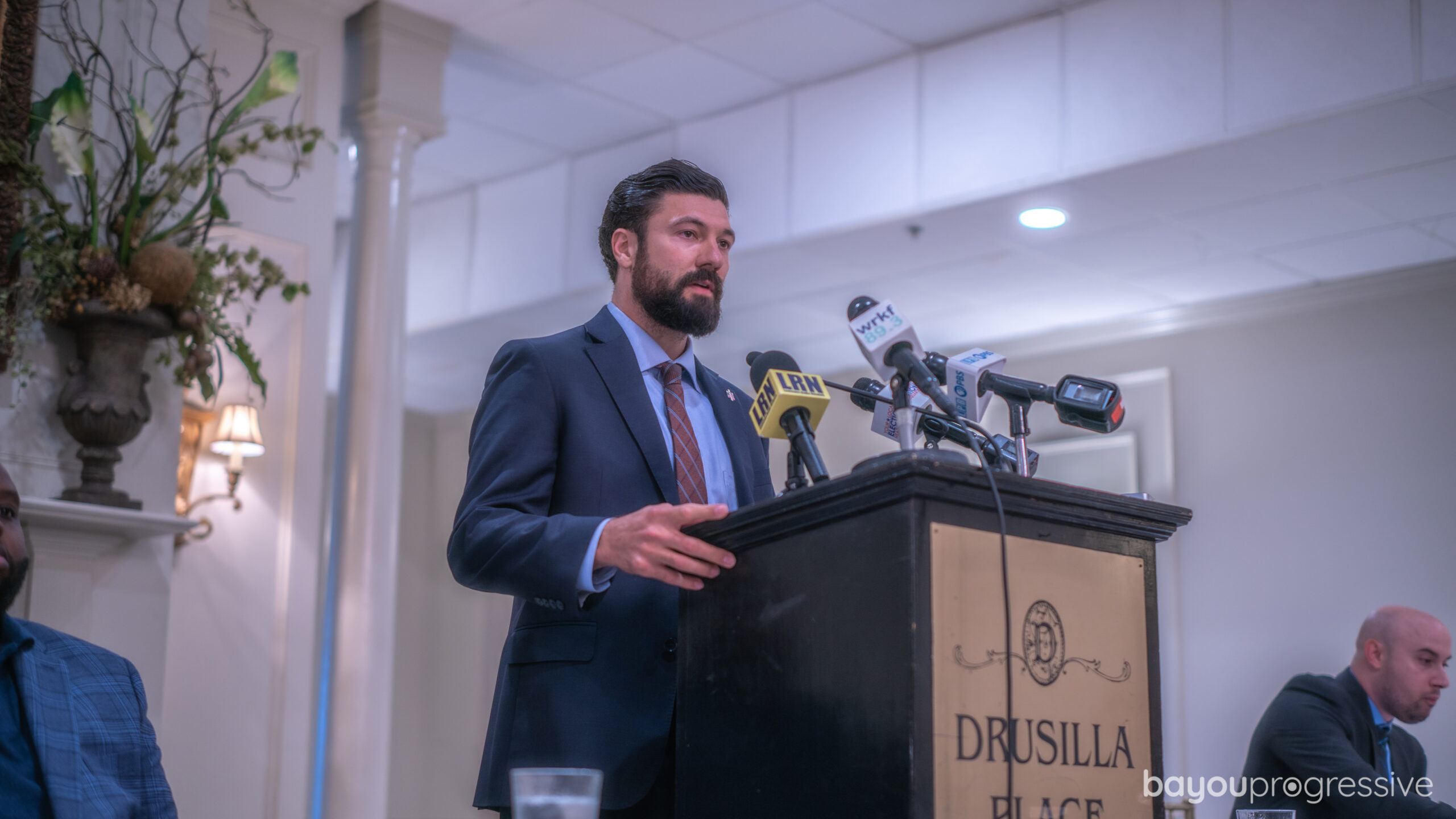
The candidates also confronted the long-term financial stability of Social Security, with several expressing a willingness to make significant changes to the program.
Forbes proposed eliminating the income cap on wages subject to Social Security taxes, arguing that requiring higher earners to contribute on all their wages would resolve much of the program’s projected funding shortfall.
“It’s currently set at $174,000,” Forbes said, arguing that wealthy Americans should not face the same maximum Social Security tax contribution as someone earning a fraction of their income.
Craig similarly supported increasing the taxable earnings cap, though he cited an even lower figure of $140,000 while arguing that high earners effectively receive a tax break once their income exceeds the threshold.
Both candidates understated the actual limit. According to the Social Security Administration, the maximum amount of annual earnings subject to Social Security payroll taxes in 2026 is $184,500, up from $176,100 in 2025. Earnings above that threshold are exempt from the Social Security portion of payroll taxes, although Medicare taxes continue to apply without an income cap.
Despite the inaccurate figures, both candidates were describing a genuine feature of the current system: someone earning $200,000 and someone earning $2 million pay the same maximum amount in Social Security payroll taxes under the existing structure.
Craig and Mebruer also expressed support for gradually increasing the retirement age, while Mebruer suggested that eliminating the earnings cap could potentially allow Congress to reduce the overall Social Security tax rate.
Appeaning suggested examining eligibility ages and potentially establishing an additional investment fund to help sustain the program.
Davis offered one of the more sweeping responses, suggesting younger generations may have to accept that Social Security will look dramatically different from the program available to current retirees.
“I think people in my generation from 1997 to maybe born in 2025, we have to maybe make that concession that we may not have Social Security,” Davis said, suggesting the system may need to be rebuilt around a new trust.
Banks emphasized protecting benefits for seniors who continue working, while Wagley argued that Congress could sustain Social Security by redirecting money from ineffective federal programs.
Immigration and federal priorities divide the field

The candidates were also asked whether they supported the Trump administration’s increased immigration enforcement spending, reductions in Medicaid funding and tax cuts benefiting wealthy Americans and corporations.
Banks rejected those priorities, arguing that federal policy should focus more directly on improving families’ quality of life. She also expressed support for creating pathways to citizenship for undocumented immigrants who have established lives and contributed to their communities.
Forbes similarly criticized the administration’s tax and spending priorities, pledging to reverse tax provisions and reductions affecting Medicaid, food assistance and education.
“We cut benefits to hardworking people around the country to not only give tax breaks to the rich, but to pile debt on our children and grandchildren for years and years to come,” Forbes said.
Davis defended aggressive immigration enforcement, arguing that undocumented immigrants should face legal consequences for entering the country unlawfully. He also contended that federal benefits should be reserved for American citizens.
Mebruer defended increased immigration enforcement spending as a response to border crossings during the Biden administration and challenged the suggestion that wealthy Americans do not pay substantial federal taxes.
Appeaning took a more measured position, calling for scrutiny of immigration enforcement practices while emphasizing the need to protect vulnerable populations amid broader federal spending reductions.
Craig called for immigration reform that would make it easier for people to enter the country legally for work, while also criticizing the federal government’s overseas military commitments and complicated tax code.
Unexpected agreement on transparency

Despite their disagreements on major policy questions, all seven candidates found common ground when asked whether they supported constitutional term limits for members of Congress and opposed the use of nondisclosure agreements by public officials, particularly in economic development matters.
Every candidate supported congressional term limits and opposed the use of such agreements in government, although Banks acknowledged that some confidentiality could be necessary for national security.
Forbes argued that nondisclosure agreements undermine the principles behind public records and open meetings laws, while Craig pledged an unusually expansive approach to transparency if elected, suggesting he would livestream many of his interactions as a member of Congress.
The unanimous responses stood out during an otherwise ideologically divided forum and reflected a broader theme running through the candidates’ remarks: frustration with Washington’s political establishment, even as they disagreed sharply about what should replace it.
Final arguments against the political establishment
In their closing remarks, several candidates returned to the influence of money and political connections in the race.
Forbes criticized unnamed opponents who he said were spending millions of dollars promoting vague promises rather than presenting specific plans.
“A couple of my opponents are career politicians trying to claw their way up the political ladder, and they’re spending millions of dollars telling people ambiguous goals that they have in Washington,” Forbes said.
Wagley similarly urged voters to look beyond campaign spending and evaluate candidates’ records and character, while Mebruer emphasized that he had entirely self-funded his campaign rather than accepting political contributions.
Banks pointed to her 12 years on the Metro Council as evidence that she could deliver results for communities that have historically felt overlooked by government. Appeaning emphasized her experience working across party lines, and Davis argued that Washington needs representatives whose loyalty is to ordinary Americans rather than political parties or powerful individuals.
Craig, meanwhile, made the case for breaking the two-party system altogether, arguing that sending another Republican or Democrat to Washington would only perpetuate the dysfunction he believes has contributed to the national debt.