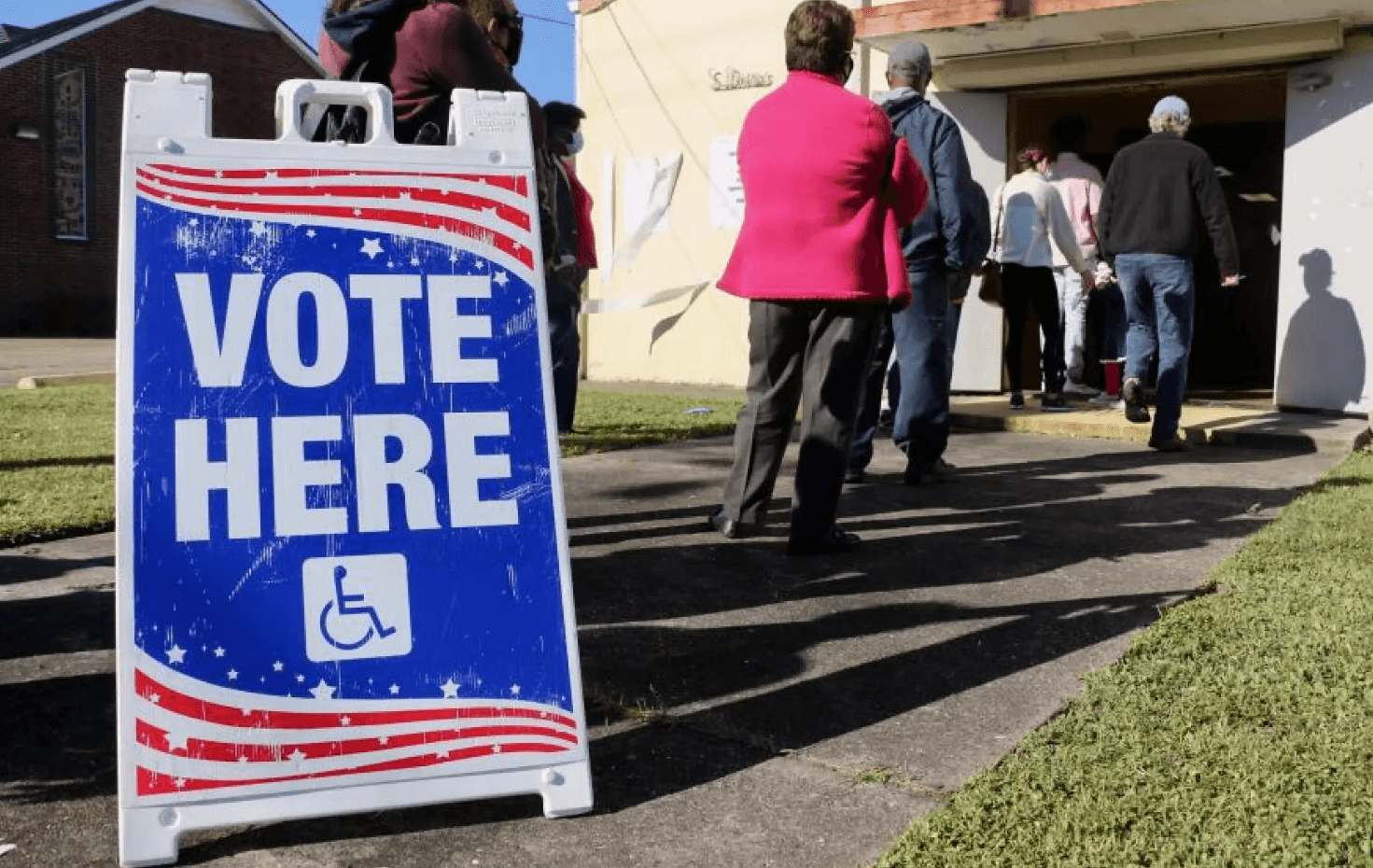
Louisiana voters have delivered one of the strongest early-voting performances in the state’s recent midterm history, casting more than half a million ballots ahead of the November 3 election and producing an electorate that looks markedly different from those of the last several election cycles.
According to the Louisiana Secretary of State’s latest figures, 520,942 Louisianans had voted in person or returned absentee ballots through October 27, the final day of in-person early voting. That’s a roughly 38% increase over the 2022 midterm election and a 65% increase over 2018.
The more interesting story, however, isn’t simply how many people voted. It’s who they are.
Black voters accounted for more than a third of all early ballots, approaching levels last seen during Barack Obama’s historic 2008 presidential campaign. Registered Democrats outnumbered Republicans, women constituted nearly 3/5 of early voters, and heavily Democratic parishes recorded some of the largest increases over the previous midterm election.
For Louisiana Democrats, those figures offer some of the most encouraging signs of voter engagement in years. But whether that enthusiasm translates into a meaningful electoral shift remains an open question, particularly in a state where Republicans have consistently demonstrated their ability to win even when Democrats held advantages in voter registration.
Here are 10 key takeaways from Louisiana’s early vote.
1. Louisiana just blew past its previous midterm early-voting numbers
The most immediate takeaway is the scale of participation.
Louisiana’s 520,942 early and absentee ballots represent an increase of more than 143,000 over the 377,428 reported during the 2022 midterm election. Compared with 2018, when approximately 315,773 early ballots were cast, participation has increased by more than 205,000.
The increase is particularly notable because Louisiana’s overall registered electorate has actually gotten slightly smaller. The state reported approximately 2.98 million registered voters this October, compared with 3.02 million in 2022.
That means about 17.5% of the state’s registered voters have already participated, compared with roughly 12.5% who voted early in 2022.
Of this year’s ballots, 448,525 were cast in person and 72,417 were absentee ballots.
Presidential elections still generate substantially larger early-voting totals. Louisiana recorded approximately 970,000 early and absentee ballots in 2024. But for a midterm election, the current numbers suggest an electorate with considerably more interest in participating than in recent comparable cycles.
The important caveat is that an increase in early voting does not automatically translate into an equivalent increase in overall turnout. Some voters who previously waited until Election Day may simply be voting earlier.
Still, the magnitude of the increase is difficult to dismiss.
2. Black voter participation is approaching its historic 2008 level
Perhaps the most consequential development is the composition of Louisiana’s early electorate.
Of the 520,942 voters who participated, 179,094 were identified as Black, representing 34.4% of the total.
That compares with approximately 26% of early voters in 2022 and 25.5% in the 2024 presidential election.
In other words, Black voters have increased their share of Louisiana’s early electorate by more than eight percentage points compared with either of the last two federal election cycles.
For historical perspective, consider 2008.
During Barack Obama’s first presidential campaign, Black voters accounted for approximately 36% of Louisiana’s early vote.
This year’s figure is just 1.6% points below that benchmark.
Louisiana political analyst John Couvillon told WWL Radio that only the 2008 presidential election and a 2025 constitutional amendment election had produced higher Black shares of the early vote in his comparisons.
There are obvious differences between the elections. The 2008 race featured the possibility of electing the nation’s first Black president. This year’s ballot includes the candidacy of Jamie Davis, a Black Democrat seeking to become the first Black man elected to statewide office in Louisiana since Reconstruction.
It would be premature to attribute the increased participation to any individual candidate. Opposition to the Trump administration, national political dynamics, local campaigns and organized voter outreach could all be contributing factors.
Nevertheless, the numbers suggest an unusually engaged Black electorate, one that resembles a historically significant presidential election more than a conventional Louisiana midterm.
3. Democrats lead Republicans in the early vote, but the comparison with 2024 matters more
Registered Democrats accounted for 221,066 early ballots, or 42.4% of the statewide total.
Republicans accounted for 205,085 ballots, or 39.4%, leaving Democrats with an advantage of 15,981 voters.
The remaining ballots came from 92,922 voters registered without a party affiliation and 1,869 registered with other parties.
For Democrats, the most encouraging comparison is with 2024, when registered Republicans made up approximately 44.6% of Louisiana’s early vote and Democrats accounted for just 36.1%.
This year, Democrats’ share is more than six percentage points higher, while the Republican share is more than five points lower.
But the comparison with 2022 complicates the picture.
Democrats represented approximately 42.2% of the early electorate that year, nearly identical to their 42.4% share today. Republicans, meanwhile, accounted for roughly 42.9%, compared with 39.4% this year.
That suggests the Democratic share hasn’t dramatically expanded relative to the last midterm, even as the overall electorate has grown considerably. Much of the partisan change is the reduction in the Republican share, alongside an increase in voters without major-party registration.
It’s also worth emphasizing that party registration does not reveal how voters actually cast their ballots, especially in Deep South Louisiana where many older white Democrats have voted Republicans for years, despite not formally changing their traditional party affiliation.
Still, an early electorate with more registered Democrats than Republicans, following a presidential election in which Republicans held a substantial advantage, is a meaningful change.
4. The 2008 comparison is encouraging for Democrats, but it also illustrates how much Louisiana politics has changed
There is another reason 2008 deserves attention: It was the last year Louisiana elected a Democrat to the United States Senate.
That November, Democratic Sen. Mary Landrieu won reelection with approximately 52% of the vote, defeating Republican John Kennedy even as Republican presidential nominee John McCain carried Louisiana.
The early-voting electorate that year was overwhelmingly Democratic by registration. According to WAFB, 58% of early voters were registered Democrats, compared with 29% registered Republicans.
Today’s electorate is considerably less Democratic by that measure: 42.4% Democratic and 39.4% Republican.
But those numbers reflect more than enthusiasm. They also reflect nearly two decades of political realignment.
Louisiana once had a substantial population of registered Democrats who regularly supported Republican candidates. Over time, many voters shifted their registration toward the Republican Party or abandoned major-party registration altogether.
That makes a direct comparison between Democratic registration in 2008 and 2026 less revealing than it might initially appear.
The racial comparison, however, is harder to explain away through registration changes alone.
Black voters represented approximately 36% of the early electorate in 2008 and 34.4% today. That is a much closer historical parallel than the partisan registration numbers.
And it underscores a critical distinction: The 2026 electorate may be exhibiting Obama-era levels of Black participation without reproducing the partisan registration patterns of that era.
5. New Orleans and the Baton Rouge region are doing some particularly heavy lifting
The statewide numbers are striking, but the geographic distribution is equally important.
East Baton Rouge Parish leads Louisiana with 53,645 early ballots, followed by Orleans Parish with 47,645 and Jefferson Parish with 44,086.
Compared with the 2022 early vote, those totals represent increases of approximately 37% in East Baton Rouge, 65% in Orleans and 66% in Jefferson.
Together, those three parishes accounted for 145,376 early ballots, nearly 28% of the statewide total.
They were also responsible for a substantial portion of Black voter participation.
Orleans recorded 28,775 Black early voters, East Baton Rouge recorded 25,001, and Jefferson recorded 15,100. Combined, those three parishes accounted for nearly 69,000 Black early voters, more than 38% of all Black early ballots statewide.
Their partisan registration numbers are similarly notable.
In East Baton Rouge, 27,686 registered Democrats voted early, compared with 15,577 Republicans. Orleans saw 35,037 Democratic voters compared with just 3,378 Republicans, while Jefferson recorded 20,165 Democrats and 14,434 Republicans.
For Democrats hoping to compete statewide, strong participation in these population centers is a prerequisite, not an optional advantage.
What makes this year’s figures notable is that those parishes aren’t simply delivering large numbers because of their size. Their participation has increased significantly relative to the previous midterm election.
6. Republican strongholds are also turning out in substantial numbers
Democratic enthusiasm may be one of the most visible features of the early vote, but it would be a mistake to overlook Republican participation.
St. Tammany Parish recorded 40,958 early ballots, including 21,164 from registered Republicans and 10,446 from Democrats.
In Livingston Parish, Republicans accounted for 9,206 of 14,864 early ballots. Lafayette recorded 12,072 Republican voters compared with 9,273 Democrats, while Calcasieu and Bossier parishes also produced significant Republican registration advantages.
The increases compared with 2022 are substantial in many of these areas as well.
St. Tammany’s early vote is approximately 35% higher than four years ago, Lafayette’s is up about 53%, and Livingston’s is up approximately 39%.
The distinction is important because increased Democratic participation is not occurring in isolation. Louisiana’s Republican electorate also appears engaged, even if Democratic-leaning areas are recording some of the larger relative increases.
For the U.S. Senate race between Democrat Jamie Davis and Republican Julia Letlow, that creates an interesting dynamic.
The Democratic coalition appears to be showing signs of greater engagement than in 2024, but the Republican coalition has not disappeared.
And with substantial Republican voting expected on Election Day, the early registration advantage alone offers little basis for predicting the outcome.
7. The youth vote remains one of the biggest unanswered questions
The parallels with 2008 raise an obvious question: Are younger Louisianans experiencing a similar political awakening?
There are some encouraging signs, but the available data do not yet support that conclusion.
WBRZ reported this week that voter registration among Louisiana’s 18- to 20-year-olds had increased approximately 11.5% compared with the 2022 midterm cycle. Southern University students also organized a second-line march to the polls in Baton Rouge on the final day of early voting, part of a broader effort to engage younger voters.
But a separate analysis published October 27 by Tufts University’s Center for Information & Research on Civic Learning and Engagement offered a less encouraging picture for the broader youth electorate.
CIRCLE found that Louisiana was among the states lagging furthest behind its 2022 numbers for registered voters ages 18 to 29, even as youth registration increased nationally.
The findings aren’t necessarily contradictory. The youngest newly eligible voters can experience registration gains while the broader 18-to-29 population declines.
More importantly, registration is not turnout.
Unlike the figures available for race, gender and party registration, the Secretary of State’s published statewide early-voting summary does not provide an age breakdown that would establish how many younger voters actually cast ballots this year.
That leaves a significant unanswered question.
The increased participation of Black voters and registered Democrats is measurable. A comparable youth surge remains a possibility, not an established fact.
If young voters ultimately participate at unusually high rates, that could become one of the election’s defining developments. But we need the data before declaring 2026 another 2008 on that front.
8. Women are accounting for nearly three out of every five early ballots
Women have consistently outnumbered men in Louisiana’s early-voting electorate, but their advantage is somewhat larger this year.
According to the Secretary of State, 301,710 women voted early, compared with 218,966 men. Another small number of records did not specify sex.
Women accounted for approximately 57.9% of early ballots, compared with 55.9% in 2022 and approximately 57.4% in 2024.
That represents a modest but noticeable increase over the last midterm election.
The political implications are less straightforward.
Women are not a politically uniform voting bloc, and Louisiana’s electorate includes substantial numbers of conservative women. The statewide gender breakdown also does not establish how women are voting in particular races.
Nevertheless, women account for the majority of Louisiana’s early-voting participation and are slightly more prominent in this electorate than they were four years ago.
Any serious analysis of the final results will need to consider not only whether that participation continues on Election Day, but also how preferences differ among women by race, age and geography.
9. Nearly 95,000 early voters aren’t registered with either major party
One of the more easily overlooked developments is the number of voters who do not identify with either major party on their registration.
A combined 94,791 early voters were registered with no party affiliation or with smaller political parties, representing approximately 18.2% of the early electorate.
That’s a larger share than in 2022, when those voters accounted for approximately 14.9% of early ballots, although it remains below their approximately 19.3% share in 2024.
Their participation matters for two reasons.
First, the sheer size of the group complicates any attempt to interpret the election through Democratic and Republican registration totals alone.
Second, voters without a major-party registration are not necessarily politically moderate or undecided.
Some consistently support Democrats, others vote reliably Republican, and still others divide their support among candidates and offices.
And many political analysts caution that Louisiana’s unaffiliated voters should not automatically be assumed to favor Democrats, noting the state’s conservative political environment.
In a competitive election, how those voters divide their support could matter considerably more than their registration label suggests.
10. The numbers suggest a different political environment, but Election Day will determine whether it actually changes Louisiana’s results
Taken together, Louisiana’s early-voting figures point toward an electorate that is larger, more racially diverse and somewhat less Republican by registration than those of recent federal election cycles.
The most meaningful development is the increased Black share of the early vote, particularly because of its proximity to the 2008 benchmark.
The significant growth in New Orleans, Jefferson Parish and East Baton Rouge provides additional evidence of engagement in areas where Democrats traditionally need strong participation.
And while Republican strongholds are also seeing elevated turnout, the relative changes in the Democratic electorate are substantial enough to deserve attention.
But there are limits to what these numbers can establish.
Louisiana’s early-voting reports identify voter registration characteristics, not candidate preferences. The electorate that votes on November 3 could look considerably different from the one that has already participated. And the growing popularity of early voting means some of this year’s increase could reflect voters changing when they vote, rather than previously disengaged residents entering the electorate.
For Jamie Davis and other Louisiana Democrats, the figures provide evidence of a potentially more favorable political environment than the one they confronted in 2024. They do not, by themselves, establish that Louisiana is on the verge of electing a Democrat statewide.
For Republicans, the data offer reasons to pay attention but not necessarily to panic. Their party continues to maintain considerable strength in the state, and early-voting participation is only one component of an election.
Perhaps the most revealing comparison is still 2008.
That election demonstrated that Louisiana could produce unusually strong Black participation while remaining Republican at the presidential level. It also demonstrated that a Democratic candidate with sufficient support across the broader electorate could still win statewide.
Eighteen years later, Louisiana is showing some unmistakable echoes of that moment, even if the state’s political landscape has fundamentally changed.
The question now is whether those echoes reflect a temporary surge in early participation or something more consequential about the state’s electorate.
That answer will come on November 3.