









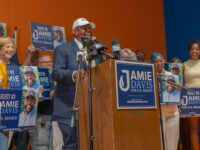





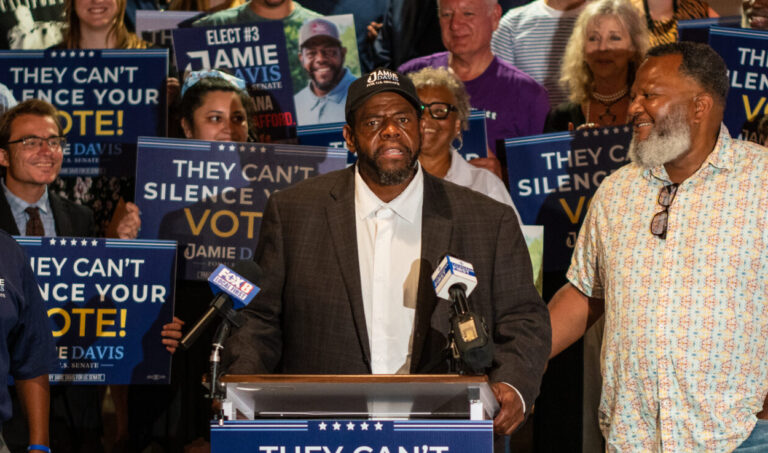
Jamie Davis did not win the Democratic nomination for U.S. Senate outright Saturday night.
But he did win the first round decisively. And the reason is not especially mysterious.
Davis won because he was best positioned for the Democratic electorate that actually showed up: older, heavily Black, deeply rooted in the party’s most consistent voting base, and far less likely to be moved by the kinds of campaign signals that political insiders tend to overvalue.
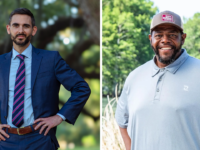
With all 64 parishes and all 3,722 precincts reporting, unofficial results from the Louisiana Secretary of State showed Davis finishing first with 163,507 votes, or 47%. Gary Crockett finished second with 90,764 votes, narrowly edging Nicholas “Nick” Albares, who received 90,480 votes.
Albares conceded Tuesday, making the June 27 Democratic runoff official: Davis versus Crockett.
That 284-vote margin between Crockett and Albares was the shock of the night. But Davis’ 21-point lead over both of them was the bigger lesson.
Louisiana’s first major closed Democratic primary in generations created a highly concentrated electorate. This was not a broad November electorate. It was not a jungle primary electorate. It was not a general public sample of Democrats, independents and persuadable voters. It was a party primary held outside the normal fall election cycle, meaning the people most likely to vote were the people who always vote.
In the Louisiana Democratic Party, that means Black voters. It also means older voters, church-connected voters, civic-network voters and voters who are more likely to respond to trusted local messengers than to debate clips, endorsement graphics or a polished candidate profile.
That is the electorate Davis was built to reach.
Davis, a Black farmer from northeast Louisiana, had the support of major Black institutional networks, including churches, civic organizations, the state party apparatus and local Democratic Parish Executive Committees that largely followed the party’s lead. Progressive activists had also favored him throughout the race.
Given that level of institutional support, there is a fair argument that Davis underperformed by finishing at 47% instead of closing the race outright.
But that critique has limits. Davis still finished 21 points ahead of his nearest opponent. He did not limp into the runoff. He entered it as the clear frontrunner.
The more complicated question is what happened beneath him.
Albares had a real campaign. He was widely viewed as the most articulate candidate in the field. He performed well in forums, campaigned aggressively and entered the final stretch with support that looked meaningful on paper: former Gov. John Bel Edwards, the New Orleans AFL-CIO and Calvin Duncan, the recently elected Orleans Parish clerk of criminal court whose own fight to assume office has become part of the broader battle over Black electoral power in Louisiana.
To Albares’ credit, his campaign seemed to understand that it had very little time to build the kinds of relationships that often decide Democratic primaries in Louisiana. So it leaned hard into the visible markers of legitimacy: endorsements, issue fluency, forum performances, public polish and the image of a campaign that looked ready for prime time.
In other words, Albares tried to make the campaign look and feel credible fast.
That strategy makes sense if the voters are looking for polish. But Louisiana Democratic primary voters are often looking for trust.
And trust is not built on Ballotpedia alone.
The mistake was not that Albares lacked substance. He did not. On the trail, he was a fierce supporter of Medicare for All and reproductive rights. On Election Night, he called for nearly every statewide Republican elected official to resign. That is not exactly the posture of a cautious centrist hiding in the tall grass.
But politics is not just ideology. It is also identity, memory and pattern recognition.
For some Democratic voters, Albares still fit a familiar Louisiana mold: the white candidate who looks, sounds and carries himself like what party leaders imagine a “serious” statewide Democrat should be. That archetype has baggage. Fair or not, it recalls the party’s 2022 Senate race, when many Black Democrats believed Luke Mixon was elevated because Democratic leaders did not want to publicly rally behind Gary Chambers.
That history matters. It shaped how some voters read the race before Albares ever opened his mouth.
The old assumption has always been that a Black Democrat cannot compete statewide in Louisiana, so the safer bet is the candidate who looks like a Southern Senate candidate out of central casting. Saturday’s results did not prove that a Black Democrat can win statewide in November. That is a much harder question. But it did prove something else: in a Democratic primary, especially a closed one, that old assumption can backfire badly.
Albares may have won the insider primary. He did not win enough of the actual one.
Crockett, meanwhile, was the race’s biggest surprise.
Throughout the primary, both the Davis and Albares camps appeared unsure what to make of him. Crockett was often perceived as antagonistic toward both campaigns, sometimes directly and sometimes by implication. His indirect jabs at Edwards functioned as attacks on Albares’ establishment support. His presence in the race also complicated Davis’ presumed advantage with Black Democratic voters.
Then there was the money question. In the waning days of the campaign, both rival camps were reportedly befuddled by the roughly $350,000 Crockett had reported on his FEC filings, money that did not seem to manifest in a large visible campaign operation, major advertising presence or obvious statewide infrastructure.
And yet, Crockett finished second.
That is the point. The race was not operating on the same plane insiders were watching.
Crockett’s support was not obvious in the usual places. It did not announce itself through big endorsements or dominant forum performances. But it was real. And anecdotally, among some Black voters who had not followed every twist of the campaign, the race could be reduced to something much simpler than the campaigns wanted to admit: two Black Democrats and one white Democrat.
That does not mean race was the only factor. But it was absolutely a factor. So were age, habit, trust, geography, church networks, civic networks, anti-establishment sentiment and frustration with Republicans’ ongoing assault on Black political power.
Trying to discuss this race without discussing race would be political malpractice.
The primary unfolded in the aftermath of the U.S. Supreme Court’s ruling in Louisiana v. Callais, which threw Louisiana’s congressional elections into chaos. Gov. Jeff Landry moved to suspend the congressional races, while Republican lawmakers prepared to redraw the map in a way that could eliminate the district currently represented by Cleo Fields, a Black Democrat from Baton Rouge.
That came alongside Republican efforts affecting other Black elected officials, including the fight over Duncan’s ability to assume office in Orleans Parish.
In that context, a closed Democratic primary was never just a low-information Senate race. It was happening inside a broader political moment where Black voters had every reason to see power, representation and respect as central questions.
Davis was best positioned for that moment. Crockett benefited from it more than almost anyone expected. Albares, despite a strong campaign, was still trying to persuade an electorate that was never going to be as moved by polish as his campaign seemed to hope.
That is the lesson.
Political insiders often talk about momentum as if momentum is whatever they can see. An endorsement. A sharp debate answer. A good forum. A flattering write-up. A candidate who feels “serious.”
But voters have their own definitions of seriousness. And in Louisiana Democratic primaries, the voters who show up most consistently are not waiting around for consultants to tell them what legitimacy looks like.
Davis won the first round because he was closest to the electorate that actually exists. Crockett made the runoff because that electorate was broader and less obedient than the party structure assumed. Albares lost, in part, because his theory of the race depended too heavily on elite validation reaching voters who had their own ways of deciding.
Now the runoff is set.
Davis enters as the frontrunner. He has the lead, the infrastructure and the strongest claim to the Democratic base. Crockett enters with something no one can dismiss anymore: proof that his support is real.
The bigger lesson is for Louisiana Democrats.
The party keeps saying it wants to rebuild. Fine. But rebuilding starts with understanding who is still showing up, why they show up and what they actually respond to.
Because Saturday night did not reveal a mystery.
It revealed the electorate.