

The “To The People, For The People” 2026 Democratic Roadshow made its Hammond stop Wednesday night, bringing candidates for U.S. Senate and Congress to Reimer’s Auditorium for a forum shaped by voting-rights uncertainty, affordability, immigration, reproductive freedom, LGBTQ+ protections and environmental accountability.
The forum featured U.S. Senate candidates Nick Albares and Gary Crockett, 1st Congressional District candidate Lauren Jewett, and 5th Congressional District candidates Tania Nyman, Lindsay “Rubia” Garcia and Jessee Fleenor.
The event came during a chaotic final stretch before the May 16 Democratic primaries, as voters continue to navigate confusion caused by Gov. Jeff Landry’s attempt to suspend congressional elections after the Callais redistricting ruling.
Melissa Flournoy, chair of 10,000 Women Louisiana and one of the statewide organizers of the roadshow, opened by reminding attendees that the election was still happening, including five statewide amendments, the U.S. Senate race and local elections in parts of the state.
“We live in a very dangerous time,” Flournoy said, pointing to the Republican-controlled Legislature and governor’s office. She warned that Louisiana Republicans have used their power to roll back civil and voting rights, including efforts to eliminate elected offices and reshape representation.
“If you know people who are on the fence or who say voting doesn’t matter or who cares, it’s not going to make a difference, this is the time to get organized and to get mobilized,” Flournoy said.
The first major candidate question centered on the Callais decision and the broader attack on voting rights.
Jewett said she joined the federal lawsuit led by Garcia and Eugene Collins challenging Landry’s attempt to suspend Louisiana’s congressional primaries after the Callais ruling. The lawsuit argues that Landry’s move violated federal election law, the Constitution and voting-rights protections by trying to halt an election already underway, with ballots mailed and early voting approaching.
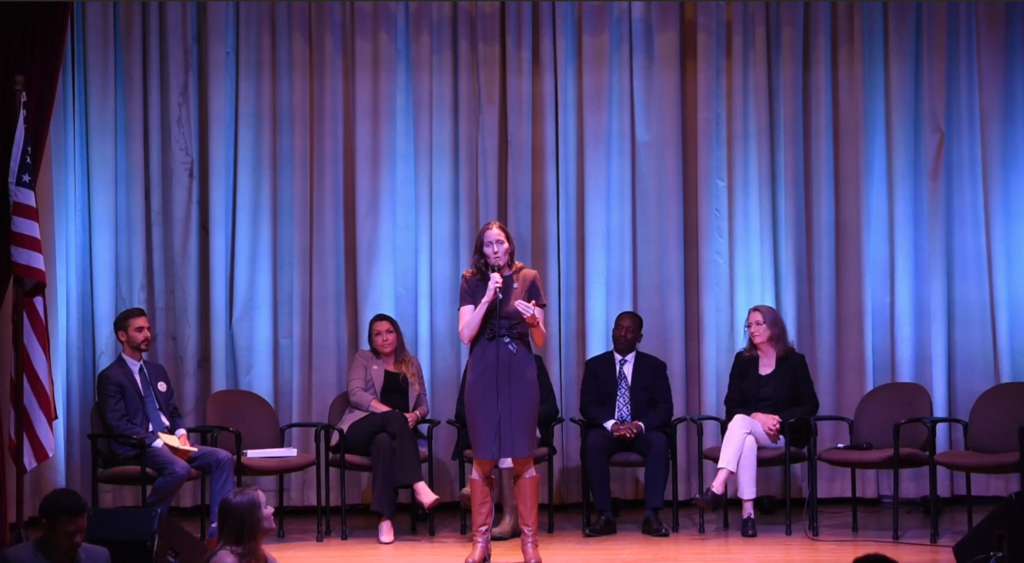
Jewett noted that her case is unique because she had already become the presumptive Democratic nominee in the 1st Congressional District after her primary opponent withdrew from the race earlier. She connected the current fight to Louisiana’s long history of voting restrictions, including the 1898 state constitution, poll taxes, property requirements and non-unanimous juries.
“There have been so many issues that have been barriers to access,” Jewett said. “And so we have to keep fighting back and showing up.”
Garcia, who helped lead the lawsuit, said she was campaigning in Monroe when the decision came down and stayed up through the night researching what Landry might attempt next. She called for a national ban on gerrymandering, regardless of which party benefits.
“All the policy that we’re going to sit here and talk about, none of that matters if we don’t defend the Constitution,” Garcia said.
Fleenor, also part of the lawsuit, called Landry’s action “completely unheard of and unacceptable” and warned that the fallout from Callais could dramatically reduce minority representation in Congress. Crockett said he was honored to join the lawsuit and had also filed action connected to Calvin Duncan, the elected Orleans Parish criminal court clerk whose office Republicans moved to eliminate before he could take office.
Nyman connected the statewide fight to her years of work on East Baton Rouge Parish school board redistricting and charter school expansion, arguing that big money has repeatedly weakened public accountability.
“It’s not Republican versus Democrat or white versus Black,” Nyman said. “It’s money versus the people.”
Albares called the moment “the most anti-democratic chaos since the time of Jim Crow” and said Congress should pass the John Lewis Voting Rights Advancement Act.
On affordability, candidates pointed to wages, housing, infrastructure and corporate power. Garcia said District 5 communities cannot grow without serious investments in roads, bridges, water systems, broadband and housing. Fleenor called for doubling the minimum wage, strengthening unions and “eliminating the concept of billionaires.” Crockett backed a higher federal minimum wage and price protections during crises. Nyman framed her platform as a “New Deal Democrat” approach centered on Social Security, progressive taxation and public investment. Albares called for making billionaires pay their fair share, indexing the minimum wage to inflation, reversing Medicaid cuts and investigating corporate landlords.
Jewett argued that economic insecurity in Louisiana is also environmental, saying pollution and carbon capture projects create long-term costs for families through illness and weakened communities.
“We should not be a toxic dumping ground,” Jewett said.
Health care produced some of the clearest agreement. Candidates broadly supported restoring Affordable Care Act subsidies, reversing Medicaid cuts, protecting rural hospitals and expanding public coverage.
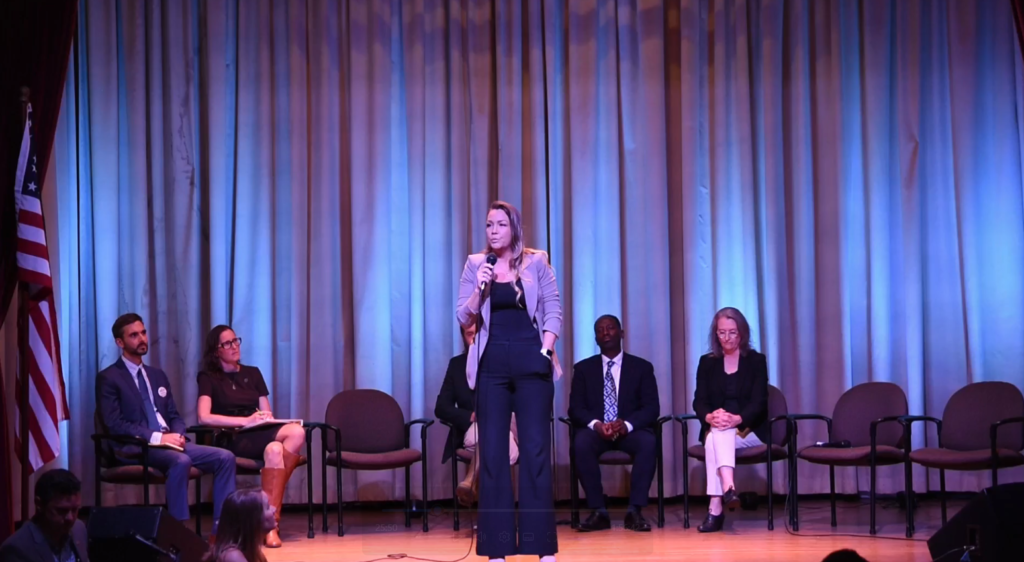
Fleenor said the country should move toward single-payer health care and argued that health insurance should not be a for-profit business. Crockett said the public should have access to the same quality of care members of Congress receive. Nyman warned that privatization could undermine universal coverage if public hospitals are not protected. Jewett said Medicare for All should include dental, vision, mental health, reproductive care and home-based services.
Albares pointed to his work in Gov. John Bel Edwards’ administration, saying Medicaid expansion helped prevent rural hospital closures in Louisiana. Reversing Republican Medicaid cuts, he said, would be his top priority.
“Health care is a human right,” Albares said.
Garcia added that rural health care access in District 5 is inseparable from broadband, especially for elderly residents and veterans who rely on telehealth and mental health services.
Immigration was one of the night’s sharpest exchanges. Crockett called for humanity, due process and legal representation. Nyman said Congress should claw back ICE funding, calling the agency “irredeemable.” Albares called for legal pathways to citizenship and enforcement that respects human dignity.
Jewett said she supports defunding and abolishing ICE, citing long-standing concerns about ICE cooperation in Jefferson Parish and the detention of children. Garcia connected the issue to Hammond directly, criticizing the use of local police resources in ICE-related actions and warning that officers participating in constitutional violations could face accountability.
“A badge does not give you that,” Garcia said.
Fleenor also called for abolishing ICE, saying, “The most important family value is to keep families together.”
On reproductive rights, candidates largely supported codifying Roe v. Wade, but the clearest contrast came after Crockett said he supports abortion rights while also wanting “guardrails” against final-trimester abortions unless medically necessary. The moderator noted that no state allows elective third-trimester abortion, prompting rebuttals from other candidates.
Nyman shared her own experience with a life-threatening pregnancy complication. Albares called late-term abortion rhetoric a “red herring.” Jewett warned against allowing misinformation from non-doctors to shape policy. Garcia clarified that Roe protected the right to choose up to viability.
“If you are truly pro-life, then that means from the womb until the tomb,” Garcia said.
Candidates also broadly supported LGBTQ+ protections, including the Equality Act. Most opposed allowing businesses open to the public to refuse service to LGBTQ+ people. Nyman offered a more nuanced answer, citing Masterpiece Cakeshop v. Colorado Civil Rights Commission, the Colorado case involving a baker who objected to creating a custom wedding cake for a same-sex couple. Nyman said the country is on a collision course between free speech and equal access to services, though she added that bigotry should not be written into law.
Garcia responded that one constitutional right should not override another person’s equal protection.
The final major policy section focused on pollution, data centers and carbon capture. Albares said regulators must be empowered to enforce clean air and water laws. Jewett said companies should not profit while communities bear health consequences. Garcia backed civil and potential criminal liability for negligent industrial projects. Fleenor defended regulation as basic public protection. Crockett emphasized stewardship. Nyman called for a moratorium on data centers and carbon injection wells, arguing that Louisiana has been treated as a “sacrifice zone.”
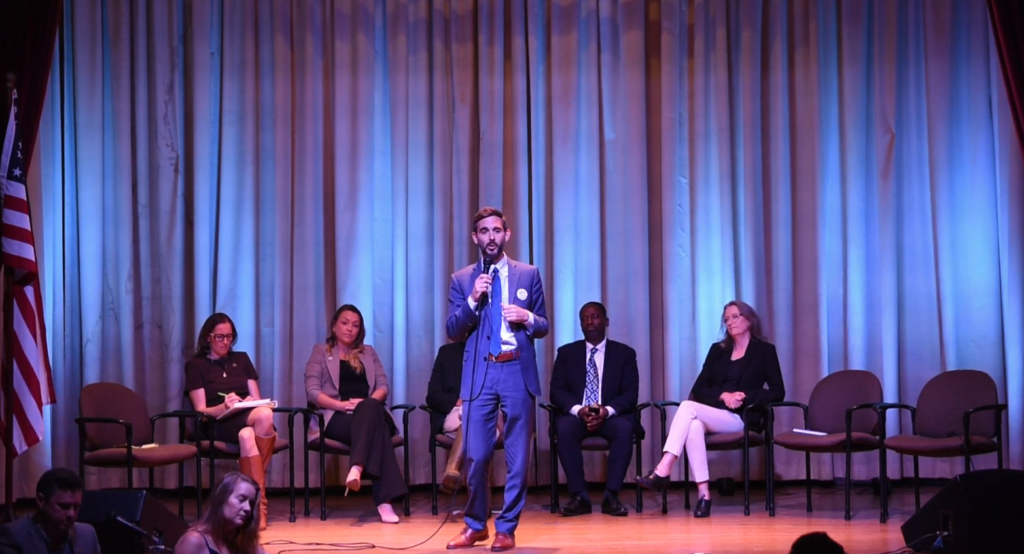
Asked for first-term priorities, Albares named reversing Medicaid cuts. Jewett and Garcia both emphasized impeachment and accountability for President Donald Trump. Fleenor said he would outlaw partisan gerrymandering. Crockett proposed a financial fairness act. Nyman said she would focus on overturning Citizens United.
By the end of the Hammond forum, the candidates had covered a sprawling set of issues. But the message was clear: the candidates were asking voters to treat May 16 not as a quiet off-cycle primary, but as a test of whether Louisiana voters will stay engaged while state and national Republicans push the limits of democratic accountability.