
Two donors supplied $750,000 to a political committee backing candidates in East Baton Rouge Parish’s school board elections, part of a larger political effort involving national education reform organizations and local business interests seeking to influence who governs the parish’s public schools.
And the organizations aren’t simply supporting preferred candidates. They’re spending money against others.
An investigation by The Bayou Progressive identified $91,610 in candidate-specific independent expenditures by two separate political organizations, including nearly $13,000 in opposition mailers targeting two school board candidates. The spending comes alongside direct campaign contributions and overlapping endorsements from organizations that advocate expanding charter schools and changing how public education is funded and governed.
Their political interests extend beyond Election Day.
The next school board will oversee a district directing substantial public funding to charter schools, with authority over new charter authorizations, school accountability and decisions about how struggling campuses are operated.
But the election also raises questions about what happens after candidates receiving substantial outside support take office.
District 3 incumbent Carla Powell, whose successful 2022 campaign benefited from financial support provided by education reform organizations, is now the target of opposition spending by one of those same groups.
In an interview with The Bayou Progressive, Powell described meetings with representatives of organizations that helped elect her, conversations about upcoming school board decisions and a deteriorating relationship after she publicly criticized outside political influence during the district’s contentious 2024 superintendent search.
Powell believes her public criticism played a significant role in the organizations’ decision to oppose her reelection.
But Democrats for Education Reform Louisiana executive director Terrence Lockett offered a different explanation, saying Powell’s positions no longer aligned with the organization’s education policy priorities.
The competing accounts offer a look at the political relationships behind a campaign finance operation that has attracted hundreds of thousands of dollars from national donors.
A $750,000 political operation
At the center of the largest disclosed fundraising effort is Red Stick Leaders for Students I.E. PAC (Red Stick Leaders), an independent-expenditure-only political action committee affiliated with the Baton Rouge Alliance for Students (the Alliance).
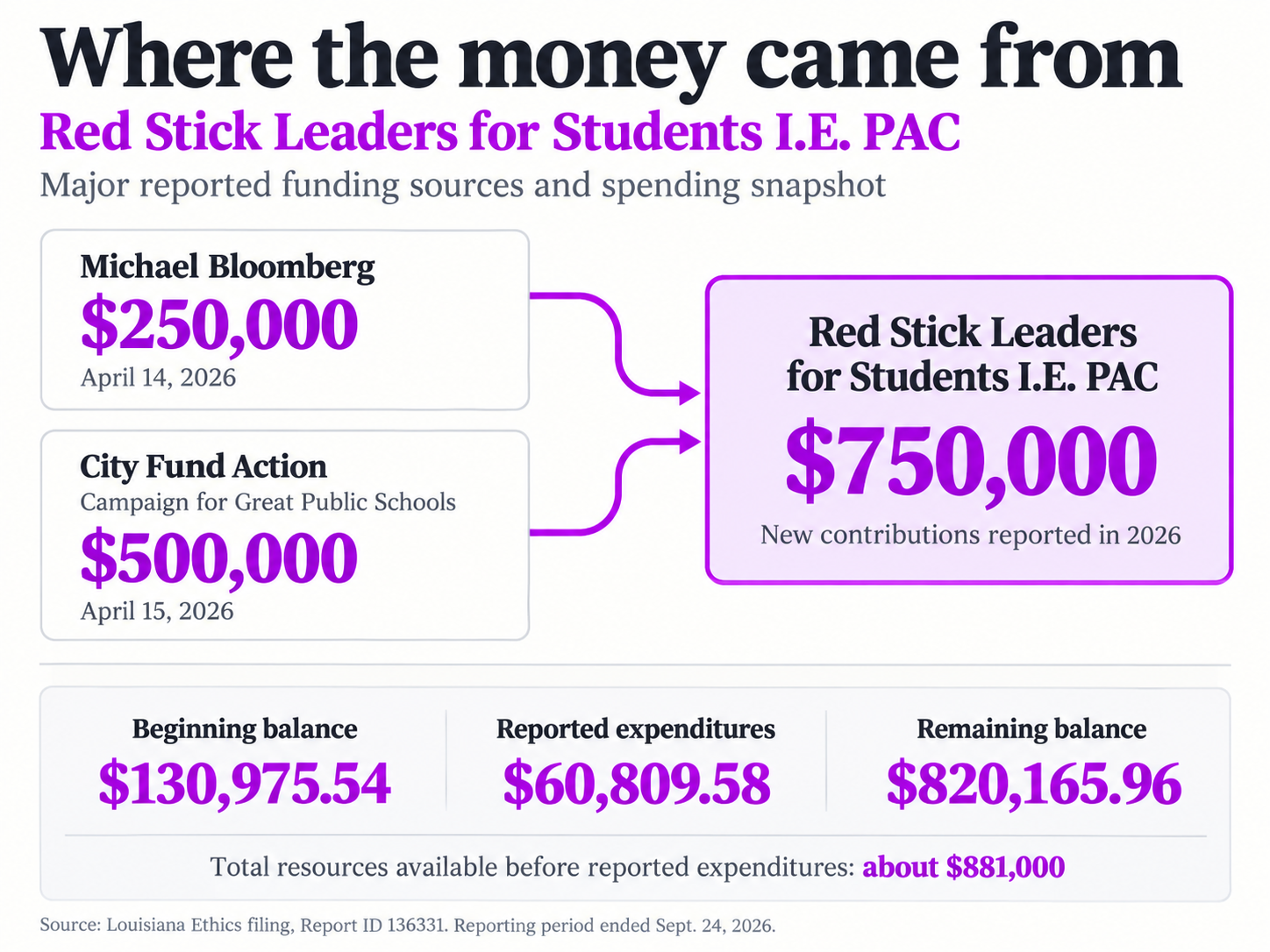
According to Red Stick Leaders’ campaign finance filing, former New York City Mayor Michael Bloomberg contributed $250,000 on April 14.
The following day, Campaign for Great Public Schools, operating as City Fund Action, contributed another $500,000.
Those two contributions account for all $750,000 in new money the committee reported receiving between January 1 and September 24.
With approximately $131,000 carried over from the beginning of the year, Red Stick Leaders had nearly $881,000 available before accounting for expenditures.
By September 24, the committee had reported spending $60,809.58, leaving a balance of $820,165.96.
That remaining balance is significant, although the September filing does not establish how much has been spent since then or will be spent before Election Day.
Both major donors have longstanding connections to the national education reform movement.
Bloomberg has spent years supporting charter-school expansion and other education initiatives. City Fund supports expanding access to high-quality public schools through different governance models, including independently operated charter schools.
Its financial relationship with the Alliance predates this year’s election.
Nonprofit financial records document a separate $662,738 grant from City Fund Action to Baton Rouge Alliance for Students Action (Alliance Action) during the fiscal year ending in June 2025. The reported purpose was to support school-improvement advocacy in Baton Rouge.
That earlier nonprofit advocacy grant is distinct from the $500,000 political contribution reported in April 2026. The records do not establish that the earlier grant financed any particular election expenditure.
The organizational distinctions matter.
The Alliance operates as an education advocacy organization. Alliance Action participates in policy advocacy and related political activity through a separate legal structure. Red Stick Leaders raises and spends money independently supporting or opposing candidates.
Those operations provide different avenues for advancing education policies and participating in elections, but they should not be treated as a single legal entity or a single pool of campaign funds.
The agenda — and the candidates backing it
The Alliance’s published policy priorities establish what the organization wants from East Baton Rouge’s elected school board.
Its agenda includes expanding high-quality school options, approving promising charter schools, replicating successful district and charter schools, establishing common academic accountability standards and intervening when schools consistently underperform.
The organization also advocates allocating funding based on student needs, strengthening educator recruitment and retention, developing a comprehensive facilities plan and simplifying enrollment.
In written responses to The Bayou Progressive, Alliance Action CEO Adonica Pelichet Duggan identified educator recruitment, school accountability and student-based budgeting as particularly important priorities.
She said the organization has not drafted specific policies for the incoming board to adopt.
“While we do have identified priority areas, we have drafted no specific policies for adoption by the board currently,” Duggan wrote.
The Alliance has nevertheless been active in debates over charter authorization and accountability. In September 2025, Duggan publicly criticized the school board for delays in revising its charter policy, arguing that the district needed to act more quickly to improve educational opportunities.
The board adopted revisions the following month.
The policy disagreements matter because charter schools are publicly funded but operated by organizations outside the traditional district administration. Supporters argue they provide additional opportunities for families and give successful operators greater flexibility. Critics question their effects on traditional neighborhood schools, district finances and direct public oversight.
The Alliance explicitly considers candidates’ alignment with its policy agenda when making endorsements.
Duggan said Red Stick Leaders’ endorsement committee consists of alumni of the Alliance’s CHANGEMAKERS program. Candidates seeking support complete questionnaires and have an opportunity to interview before the committee makes recommendations to the PAC board.
“All of the Alliance Action policy priorities, including the expansion of high quality school options, are considered in evaluating a candidate’s policy alignment, and each policy action is given the same weight,” she wrote.
Red Stick Leaders has endorsed nine candidates across seven contested school board districts.
FuturePAC, the political committee associated with the Greater Baton Rouge Economic Partnership, has endorsed eight candidates — all of whom also have Red Stick Leaders’ support.
Democrats for Education Reform Louisiana PAC (DFER Louisiana), affiliated with a national education reform network, has endorsed four candidates, all of whom are also backed by Red Stick Leaders.
The overlap is substantial.
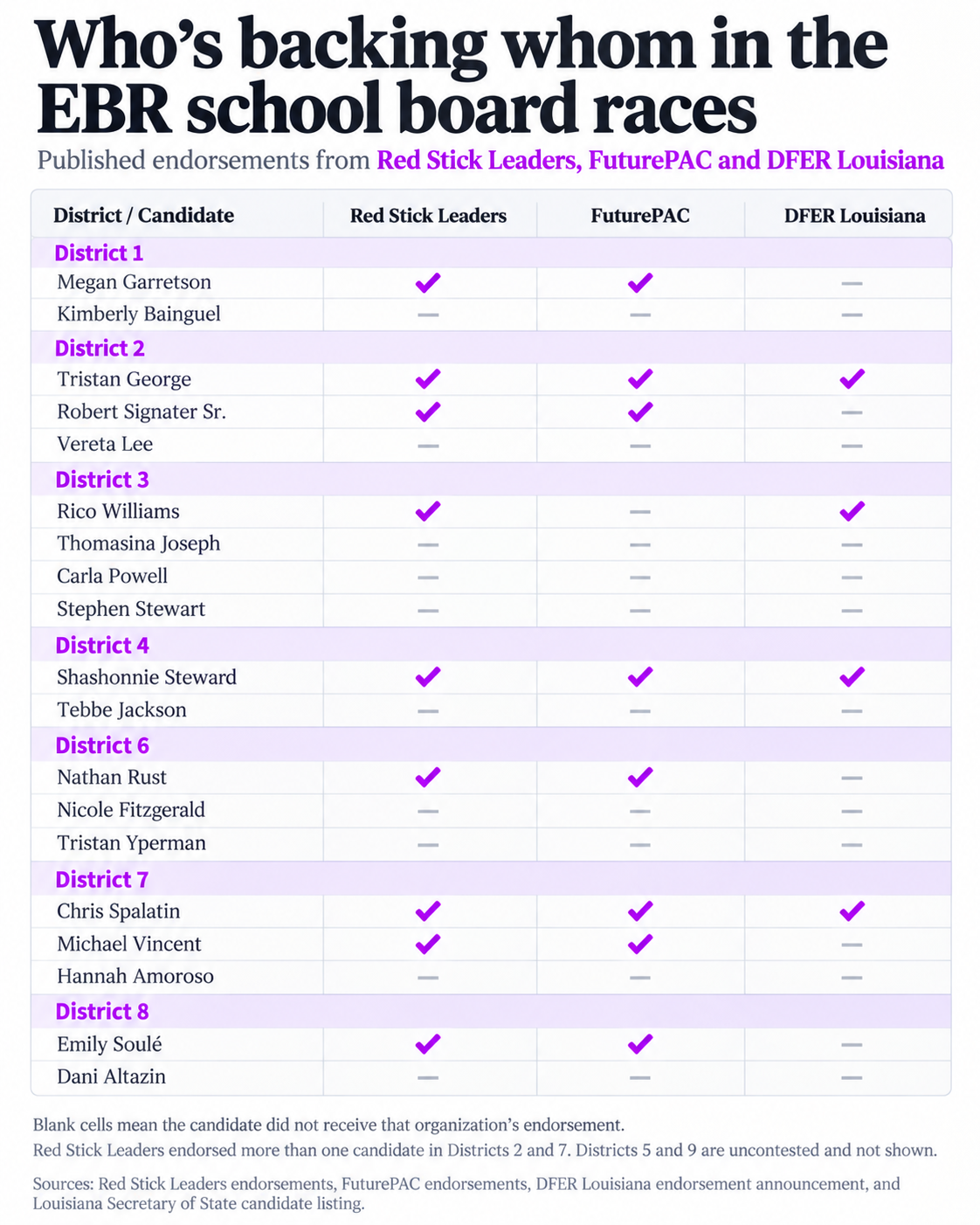
In District 2, all three organizations support Tristan George, while Red Stick Leaders and FuturePAC also endorse Robert Signater Sr.
In District 3, Red Stick Leaders and DFER support Rico Williams.
In District 4, all three organizations support incumbent Shashonnie Steward.
And in District 7, all three support Chris Spalatin, while Red Stick Leaders and FuturePAC also endorse Michael Vincent.
Red Stick Leaders also backs Megan Garretson in District 1, incumbent Nathan Rust in District 6 and Emily Soulé in District 8. All three have FuturePAC’s endorsement.
The organizations have different leadership and stated priorities, and the overlap does not itself demonstrate coordination.
“These three organizations have different leadership and priorities,” Duggan wrote. “Each organization has an independent candidate endorsement process.”
Still, their choices identify a largely overlapping group of candidates they believe will advance their respective goals.
Where the money is being spent
The financial disclosures show how that support translates into campaign resources.
Candidate filings reviewed by The Bayou Progressive identify $36,000 in direct contributions recorded under Alliance- or Red Stick-related donor names.
After a reported $1,500 refund by Rust, those identified contributions total $34,500 retained by the campaigns.
These are contributions identified through the candidates’ reported donor names, not a finding that Red Stick Leaders’ independent-expenditure-only PAC made direct contributions.
FuturePAC separately reported $15,000 in contributions to five school board candidates, with George, Signater, Rust, Spalatin and Soulé each receiving $3,000.
But some of the most consequential spending is happening outside candidates’ campaign accounts.
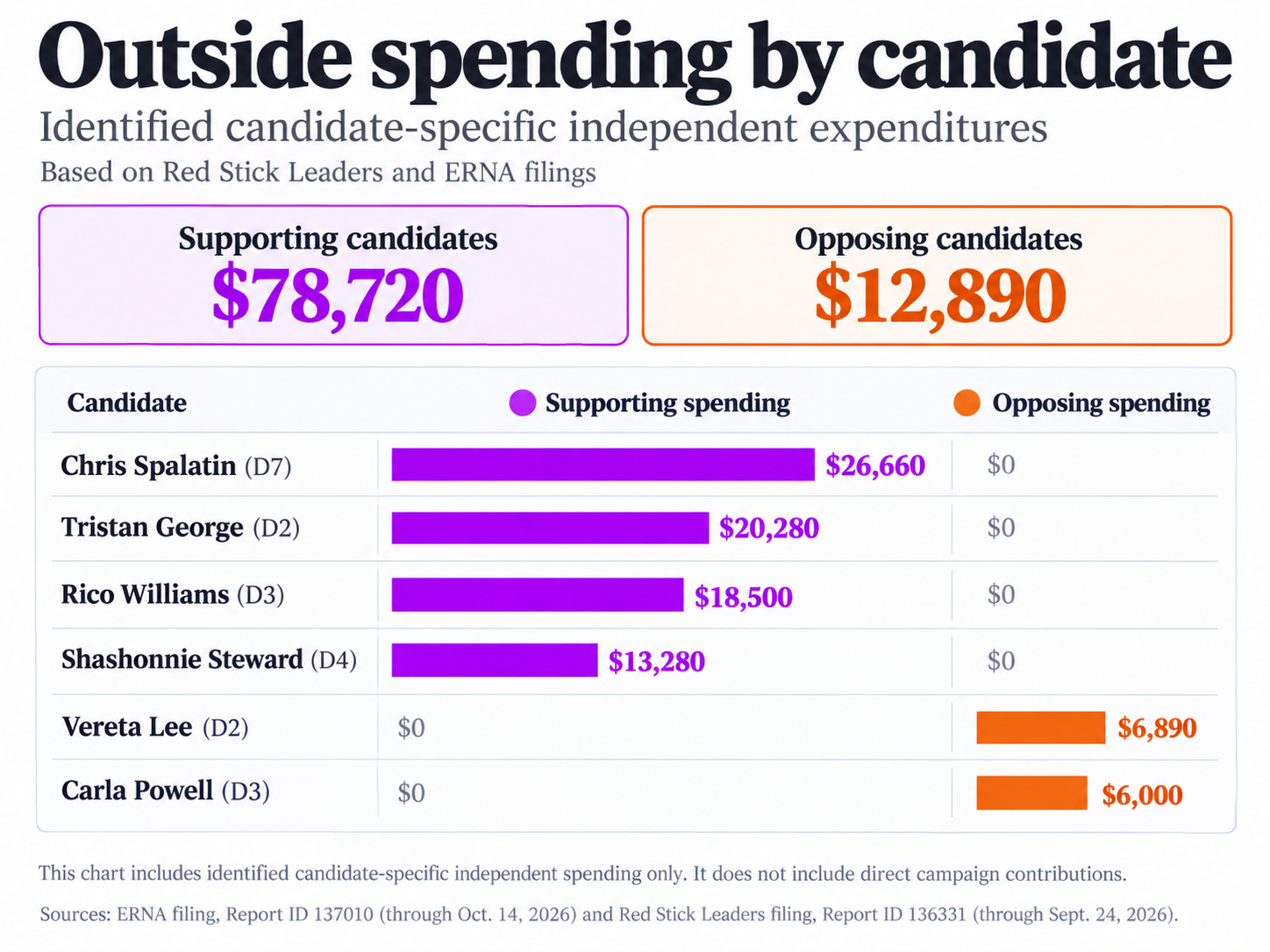
Education Reform Now Advocacy (ERNA), a separate organization in the DFER network, reported $84,890 in independent expenditures supporting or opposing school board candidates through October 14.
According to its October 20 disclosure, ERNA spent:
- $20,280 supporting George in District 2.
- $18,500 supporting Williams in District 3.
- $13,280 supporting Steward in District 4.
- $19,940 supporting Spalatin in District 7.
- $6,890 opposing Vereta Lee in District 2.
- $6,000 opposing Powell in District 3.
Red Stick Leaders separately reported a $6,720 mailer supporting Spalatin.
Together, the two organizations disclosed $91,610 in identifiable candidate-specific independent expenditures: $78,720 supporting candidates and $12,890 opposing them.
These expenditures are separate from campaign contributions. They pay for political communications outside the candidates’ campaigns rather than providing money the candidates control.
In District 7, for example, Spalatin reported $16,645 in campaign contributions and $5,000 in candidate loans through September 24, for total receipts of $21,645.
Outside organizations separately reported spending $26,660 supporting him.
That outside spending exceeded the receipts reported by Spalatin’s campaign for the period, illustrating why candidate fundraising totals alone provide an incomplete picture of the resources being deployed in these races.
The involvement also extends to Baton Rouge’s broader business community.
FuturePAC’s financial disclosures report $32,975 in contributions from businesses and other donors, including $10,000 from ExxonMobil Baton Rouge Chemical Plant, $3,750 in Turner Industries-related entries, and $2,500 each from Community Coffee and Neighbors Federal Credit Union.
Those contributions went to FuturePAC, not directly to its endorsed school board candidates through those transactions. The records do not establish that a particular business contribution financed a specific candidate contribution.
Other donors also appear across multiple campaigns. Garretson and Vincent each reported receiving $6,000 from businessman Eddie Rispone and $3,000 from ISC Constructors, a company Rispone co-founded.
Taken together, the disclosures reveal a network of political support involving national education reform donors, advocacy organizations and local business interests. The records establish overlapping financial and political preferences, but not that every donor or organization coordinated its activities.
The opposition spending also makes clear that some organizations are seeking to influence which candidates lose, not just which candidates win.
And nowhere is that reversal more striking than in District 3.
Carla Powell: From supported to opposed
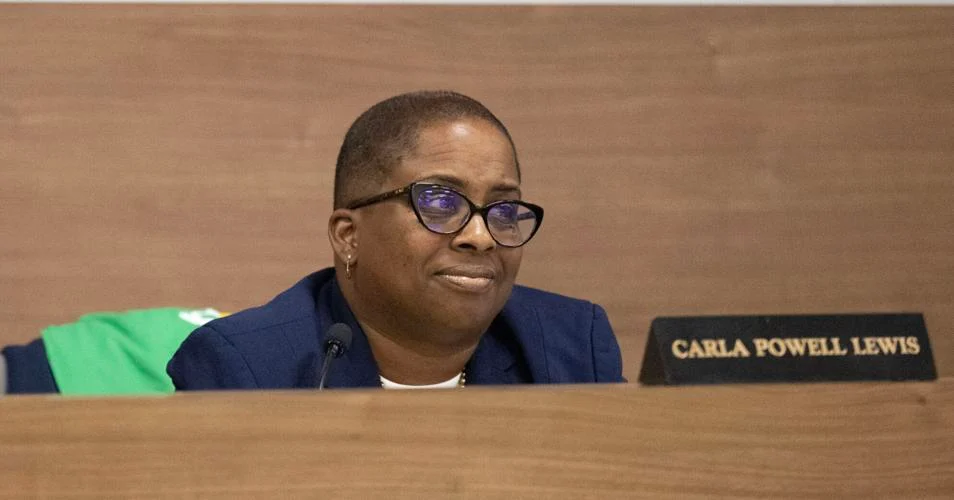
Four years ago, Powell was among the candidates supported by organizations now backing her opponent.
Following the 2022 election, Alliance Action publicly identified Powell among the candidates it endorsed and supported.
In January 2023, DFER Louisiana celebrated Powell’s selection as school board vice president and explicitly acknowledged that ERNA had conducted an independent expenditure campaign supporting her election.
FuturePAC also supported her in 2022.
Today, Powell has none of those organizations’ endorsements.
DFER instead backs Williams, while ERNA has spent $18,500 supporting him and $6,000 opposing Powell.
The shift has an explanation, according to Powell, that extends beyond disagreements over charter schools.
In an October 23 interview with The Bayou Progressive, Powell described regular interactions with representatives of the organizations that supported her election.
She said the groups initially approached her in 2022 to discuss her background as an educator, her familiarity with district schools and her education priorities.
There were no explicit commitments to support particular votes, she said, though she now wonders whether she fully understood the expectations accompanying the support.
After taking office in 2023, Powell said she participated in meetings with representatives of the Alliance and other supported board members, sometimes individually and sometimes in groups. The conversations included upcoming school board agenda items and members’ thinking about particular decisions.
Powell characterized those conversations as involving “subtle persuasiveness” toward certain outcomes.
Meetings between advocacy organizations and elected officials are a routine part of politics and do not inherently indicate improper conduct.
But Powell said she gradually felt that the organizations expected more political deference than she was comfortable providing.
Powell recounted a meeting at the Alliance’s office following her 2022 election. According to Powell, the conversation occurred after she attempted to establish a working relationship with Stand for Children, another education advocacy organization that had not supported her campaign.
Powell said Duggan discouraged that relationship while referencing approximately $60,000 spent supporting Powell’s election. She interpreted the conversation as a reminder of the organization’s financial support and an expectation that she maintain distance from competing political interests.
“These people think that they run us,” Powell recalled thinking.
Duggan, however, disputes Powell’s characterization of the meeting.
Duggan said the Alliance conducted post-election debriefings with every candidate it supported, reviewing the organization’s campaign expenditures and how that money had been spent.
“We did an election debrief with every candidate we supported reviewing spending by organization and tactic as a part of our post election wrap up,” Duggan wrote.
She rejected Powell’s broader account of their relationship, saying Powell’s “attempts to mischaracterize both this meeting and our subsequent relationship came much later in her term as a school board member.”
Duggan did not specifically address Powell’s assertion that she discouraged a relationship with Stand for Children. The Bayou Progressive has not independently corroborated that portion of Powell’s account or the approximately $60,000 figure she recalled.
The disagreement reflects a central tension in the relationship Powell described: what the Alliance characterizes as routine engagement with candidates it supported, Powell says she came to experience as pressure over her independence as an elected official.
The superintendent dispute becomes a turning point
Powell identified the district’s contentious 2024 superintendent search as the clearest turning point in her relationship with the organizations.
After the board decided not to renew the contract of former Superintendent Sito Narcisse, interim Superintendent Adam Smith attracted support from teachers, parents and other community members who wanted him considered for the permanent position.
Powell supported Smith, but the selection process fractured the board when he was excluded from the finalists.
During a contentious July 11, 2024, meeting, Powell publicly criticized outside political influence over the process.
WRKF reported at the time that Powell accused board members of being influenced by donor groups.
Asked Friday which organizations she had been referring to, Powell specifically identified the Alliance and DFER.
“I will say the Alliance and DFER together,” she said.
Powell believes that public confrontation substantially damaged her relationship with the organizations, particularly the Alliance.
She described communication with Duggan as largely disappearing after the meeting, apart from a personal exchange the following year.
Asked whether her public criticism played a greater role in the change of political support than her board votes, Powell answered:
“Absolutely.”
She also said representatives of the regional business community raised the 2024 confrontation during her interview for a FuturePAC endorsement this year.
According to Powell, she was told that some organizational leaders had been hurt by her criticism and its implications for their associates.
That account has not been independently corroborated with FuturePAC.
But it helps explain why Powell believes the reversal is about more than her education policy positions.
Her voting record complicates the disagreement
Powell’s record does not establish that she simply became an opponent of charter schools after taking office.
She has supported numerous charter renewals, authorizations and partnerships, including moving to renew BASIS Midcity’s charter in January 2025.
In January 2026, she also supported approving Harvest Commons, despite an earlier recommendation to deny the application.
Powell explained that she considered Harvest Commons’ model for serving neurodivergent students an example of the specialized opportunities charter schools can provide.
Her stated standard is that charter schools should offer meaningful educational value and face accountability comparable to traditional district-operated schools.
That approach has also led her to oppose particular charter proposals.
During the October 2025 charter-policy debate, Powell supported retaining shorter renewal periods for some charter schools and opposed certain provisions allowing broader expansion.
She ultimately voted for the final revised policy package.
Several of those earlier policy positions were shared by Steward, whom DFER and Red Stick Leaders continue to support.
Steward also supported Smith during the superintendent search.
The records therefore show areas of overlap between Powell and an incumbent who retained the organizations’ endorsements, although their voting records are not identical.
Powell believes the distinction lies partly in her willingness to challenge outside interests publicly.
DFER disputes the premise that the endorsement change was simply about her public criticism.
DFER offers a different explanation
In a written response to The Bayou Progressive, Lockett said DFER Louisiana PAC evaluates candidates through questionnaires covering five policy areas: public school choice, resource equity, educator recruitment and retention, access to higher education, and academic standards and accountability.
He said that evaluation determined Powell no longer aligned with the positions of candidates the organization supports.
“Based on this cycle’s questionnaires, we determined Ms. Powell’s positions were no longer consistent with other DFERs we’ve supported or currently support for the East Baton Rouge Parish School Board,” Lockett wrote.
He also cited Powell’s voting record on teacher compensation, referring to what he characterized as opposition to an 8% pay raise and abstentions on subsequent compensation proposals.
Those allegations require context.
The board considered multiple compensation proposals during contentious budget negotiations in 2023. Powell participated in those disputes, but also supported the final July 31 budget, which passed unanimously and included stipends for teachers and support staff.
That final vote was separate from the earlier proposals Lockett described. He did not identify the specific motions or dates, and The Bayou Progressive did not independently establish the individual votes referenced in his response.
Lockett did not identify a particular charter-school vote or Powell’s public criticism during the superintendent search as the reason for the endorsement change. Nor did he specify which questionnaire answers distinguished Powell from incumbents DFER continues to support.
Asked how DFER evaluates officials after helping elect them, Lockett said the organization monitors voting records and assesses officials’ engagement with schools and constituents.
“We support elected leaders who advance progressive public education policies across our five core policy areas, as well as leaders who lean on feedback and input from the community they represent,” he wrote.
Duggan offered a similar general explanation of the Alliance’s endorsement process.
“All incumbents were evaluated for endorsement based on questionnaire responses, candidate conversations and track record of leadership on the board,” she wrote.
Neither organization identified Powell’s July 2024 criticism of outside influence as a factor in its endorsement decisions.
The competing accounts leave the precise reasons for the reversal unresolved.
DFER points to policy alignment and Powell’s record on the board. Powell believes her willingness to challenge influential political organizations contributed to their decision to withdraw support.
The financial records establish what happened politically, even if they do not establish why.
An organization that financed independent spending supporting Powell’s election in 2022 is now paying for communications opposing her reelection.
What the next school board will decide
The stakes extend beyond any individual race.
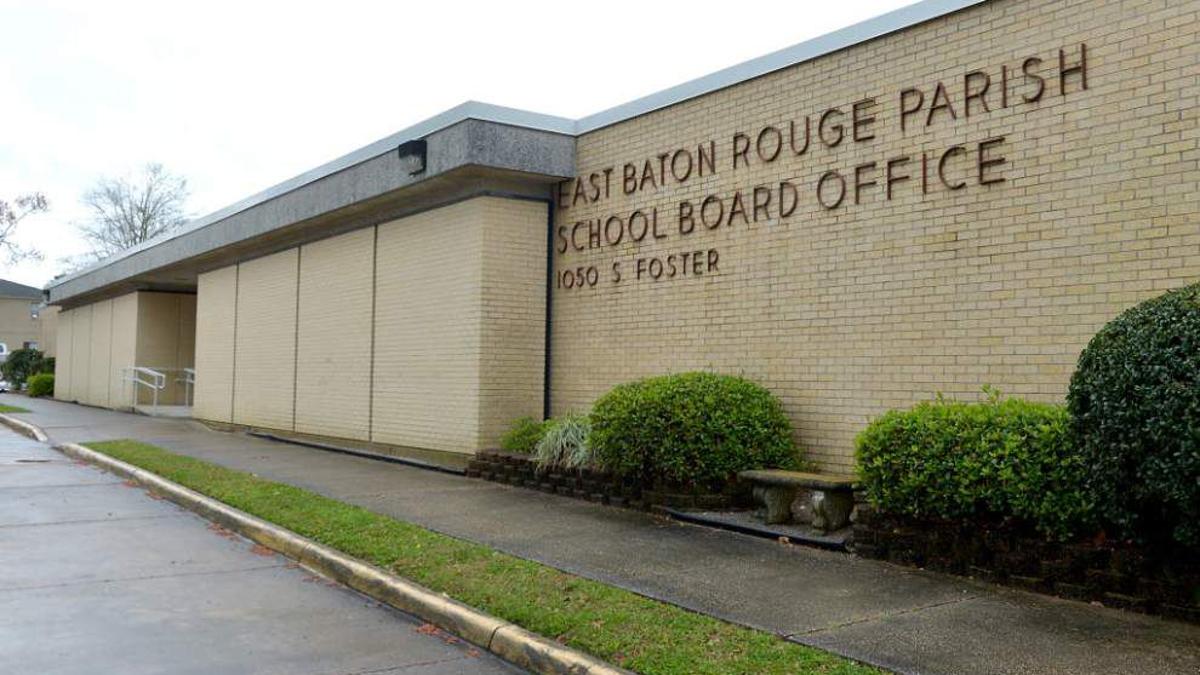
The East Baton Rouge Parish School Board oversees the traditional district-operated schools and authorizes and monitors locally approved charter schools.
According to the district’s fiscal year 2026 proposed budget, approximately $161.8 million was projected for allocations associated with charter schools and related programs, representing roughly one-fifth of the overall budget.
That was a prior-year budget projection, not a final accounting of expenditures. The district’s subsequent FY2027 draft projected approximately $164 million, although that figure was not independently reconciled against the final approved budget for this investigation.
The FY2026 summary also documented a significant enrollment shift over the preceding decade: traditional district-operated enrollment declined 15%, while enrollment in locally authorized Type 1 charter schools increased 142%.
Because public education funding is closely tied to enrollment, those changes affect how resources move through the school system, with implications for staffing, facilities and the financial sustainability of district-operated campuses.
The school board must also determine when struggling schools should receive additional support, face intervention or operate under different management.
Those questions go directly to the competing approaches advocated by the organizations active in this election.
And another set of decisions is approaching.
Under the district’s published charter application schedule, applications for new locally authorized charter schools were due October 19. The school board has until January 28, 2027, to approve or deny applications in the current cycle.
An endorsement does not establish how a candidate will vote on an individual application, and campaign contributions do not demonstrate that a candidate has promised to approve particular charter schools.
But the next board will have direct authority over decisions that could affect the balance between district-operated schools and independently operated public schools for years to come.
The organizations spending money in these elections have publicly advocated different approaches to those decisions, and their endorsement lists identify the candidates they prefer to see making them.
Two national donors contributed $750,000 to an Alliance-affiliated political committee. A separate organization in the DFER network is financing advertising supporting four candidates and opposing two others. The regional business community’s political committee has endorsed eight candidates who also have Red Stick Leaders’ support.
And in District 3, an incumbent who benefited from that network’s support four years ago now finds herself on the receiving end of its opposition spending.
The financial records do not establish that any elected official surrendered control of a vote to a donor or that candidates promised particular charter approvals.
But they do establish a substantial, organized investment in determining who governs East Baton Rouge’s public schools.
Reporting methodology: The Bayou Progressive reviewed original Louisiana Ethics campaign finance filings available through October 22, 2026, including candidate reports, political committee disclosures, independent-expenditure schedules and relevant nonprofit records. Reporting periods differ, with many candidate and PAC disclosures covering activity through September 24 and ERNA’s expenditures extending through October 14. The investigation also examined school board records, organizational policy statements and endorsement announcements, and incorporated October 23 written responses from Adonica Pelichet Duggan and Terrence Lockett and an on-the-record interview with Carla Powell. Statements about private conversations are attributed to the individuals providing those accounts. The findings reflect disclosed activity through the reviewed reporting periods, not necessarily all election spending through Election Day. Audio summary was generated with AI.