

The 2026 Democratic Roadshow stopped in Houma on Friday afternoon with two things hanging over the event: rain clouds and the unresolved political chaos surrounding Louisiana’s May 16 congressional elections.
Held at Downtown Jeaux’s and moderated by Bonnie Byland of Indivisible Acadiana, the forum featured U.S. Senate candidates Nick Albares and Gary Crockett, with Jamie Davis not in attendance. The 3rd Congressional District portion featured Tia LeBrun and Caleb “With a C” Walker, while John Day did not attend.
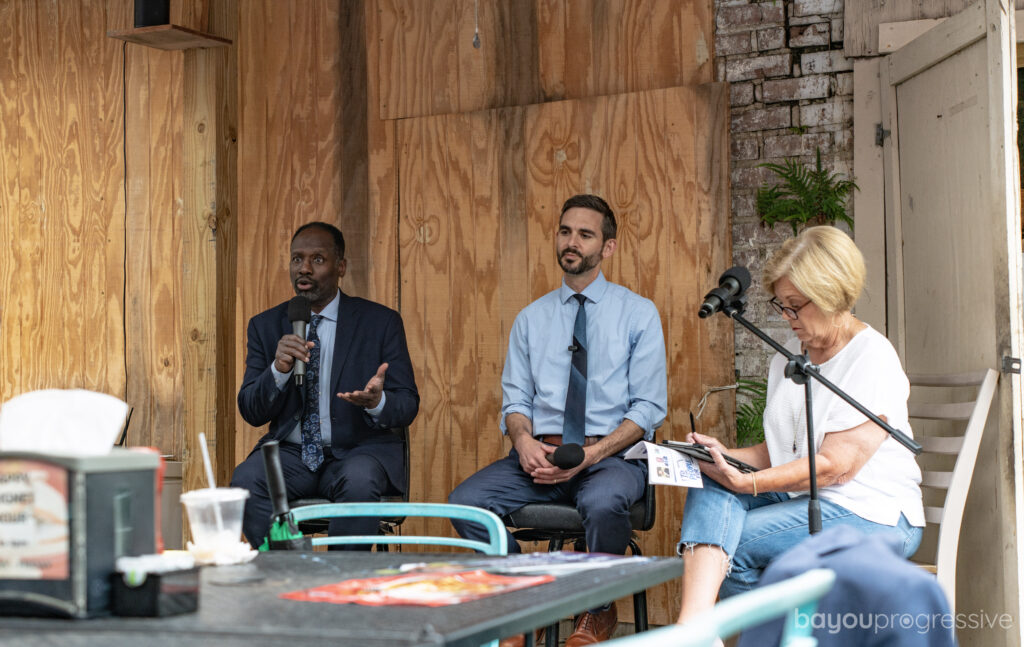
The Senate candidates went first in the outdoor courtyard. By the end of their portion, rain had grown heavy enough to overpower parts of Albares’ closing remarks, forcing organizers to move the congressional forum indoors.
But before the weather interrupted the event, the candidates were already speaking to a more serious disruption: voters being asked to participate in an election that state Republican leaders have thrown into uncertainty, even after mail ballots had gone out and early voting was set to begin.
Byland opened the Senate forum by asking what candidates would tell voters who feel politics is already rigged against them.
Crockett’s answer was blunt.
“Your vote is currency,” Crockett said. “And if you don’t use it, it’s no longer useful.”
Albares framed the moment as part of a broader attack on voting rights, accusing Gov. Jeff Landry of trying to “rip those votes from voters” after ballots had already been cast. He called the current political climate “the most anti-democratic chaos since the era of Jim Crow.”
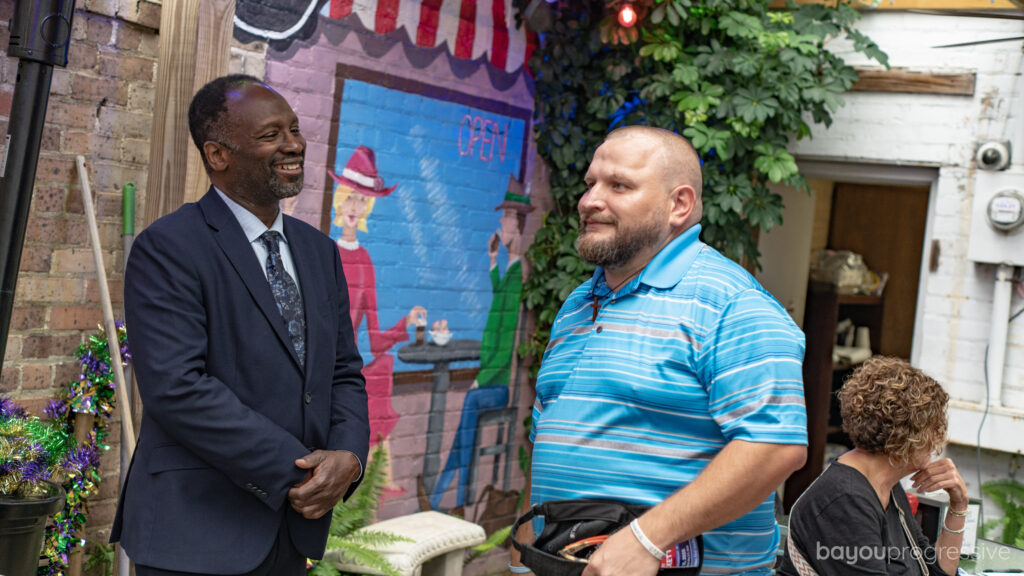
The candidates were also asked where the line falls between a legal fight over maps and outright voter disenfranchisement. Crockett criticized Louisiana’s “squiggly lines,” arguing that the state’s congressional districts are drawn to dilute representation. Albares said the real racial gerrymander was the previous map that denied Black voters fair representation.
“The true racial gerrymander was the districts that were drawn before that were designed to withhold Black power of the vote,” Albares said.
In Houma, though, the conversation quickly moved from democracy in theory to the more immediate question of whether coastal communities will have the federal support they need to survive.
Asked what federal fight he would prioritize for Terrebonne and Lafourche, Albares pointed to sediment diversions and coastal lawsuits. He said sediment is essential to rebuilding Louisiana’s coast and argued that industries damaging the coast should be held responsible for paying to clean it up.
Crockett argued that coastal parishes need more local control over permitting and business licenses for industries operating in their communities.
“That is what is going to save the coast,” Crockett said.
Both candidates said they would be willing to hold up unrelated federal priorities to force action on coastal protection, flood insurance or disaster recovery. Albares called the issue “existential” for southeast Louisiana and tied it directly to the rising cost of homeowners and flood insurance. Crockett simply answered yes.
On affordability, Crockett said his first priority would be eliminating taxes on food and raising wages. He said working people experience the economy through grocery bills, insurance premiums and basic survival, not stock market numbers.
“You spend everything that you make just to make it,” Crockett said.
Albares focused on Medicaid, insurance and wages, saying he would work to reverse federal Medicaid cuts and support raising the minimum wage while indexing it to inflation. He also argued for targeted tariffs to protect Louisiana shrimpers without embracing broad trade policies that raise prices for everyone.
The sharpest difference between the two Senate candidates came when they were asked what Democrats get wrong on affordability. Crockett said Democrats too often offer speeches and rhetoric without building real relationships with voters. Albares said the party has to ground policy in working people’s lives.
“Policy doesn’t just happen in think tanks,” Albares said. “It needs to happen on the streets of our cities, our towns, our villages.”
The Houma setting also forced the candidates to talk about climate and energy in a way that did not ignore the workers and families who depend on oil and gas jobs. Albares said the clean energy transition has to center workers, the environment and local communities. Crockett said health should come before industry.
“Our health is our wealth,” Crockett said.
After the rain moved the event indoors, LeBrun and Walker continued the 3rd District forum in a smaller, more conversational setting.
LeBrun, who was born and raised in Houma, opened by emphasizing her local roots, her six children and her commitment to protecting the coast while investing in cleaner energy alongside traditional energy. Walker introduced himself as a native of Wisner, a 10-year Army veteran and former Sam’s Club manager who is continuing his education in political science.
Asked how she campaigns when voters are uncertain whether their ballots will even count, LeBrun said candidates have to keep showing up.
“If we just stayed at home under these circumstances, we would be seen as fair weather candidates,” LeBrun said.
Walker said Democrats cannot get distracted by the chaos.
“We still have to campaign as if May 16 is going to be the day,” Walker said.
On kitchen-table issues, LeBrun called for repealing what she described as the “billionaire bailout bill,” raising the minimum wage and strengthening the child tax credit. She said families cannot survive on the current federal minimum wage, especially when child care costs force parents out of the workforce.
“We can’t live on less than a double-digit wage,” LeBrun said.
Walker said Congress should provide tax exemptions for teachers, arguing that educators are underpaid and need to feel valued if schools are going to retain talent.
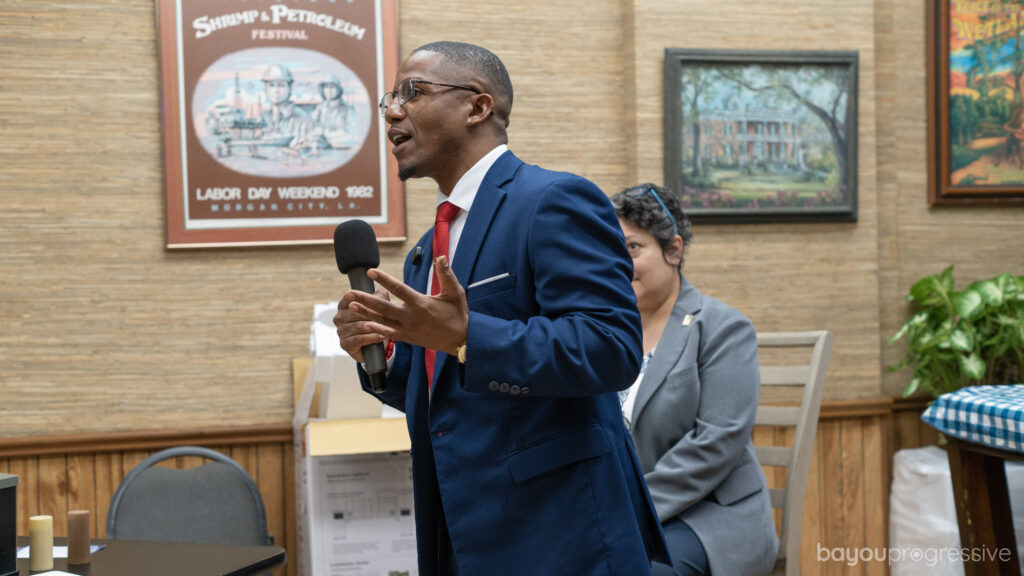
Public education became one of the clearest issue areas in the congressional portion. LeBrun said Washington cannot solve every classroom problem, but it can protect federal guidance and funding for students with special needs, English language learners and other vulnerable populations. Most importantly, she said, public dollars should remain in public schools.
Walker agreed, saying public money should not be diverted to private schools and that eliminating the Department of Education would be a mistake.
“I can’t see a good reason to do that,” Walker said.
The candidates also returned to the coastal and environmental issues central to the region. Walker said companies operating in coastal communities should contribute up front to funds that could respond to disasters like oil spills. LeBrun went further, warning against data centers, carbon capture projects and other developments that ask Louisiana communities to bear the risk without enough local control or benefit.
“I think Louisiana has given enough,” LeBrun said. “We don’t need to be the proving ground for any other industry.”
The larger message of the afternoon in Houma was clear: despite the rain and despite the uncertainty created by state Republican leaders, the candidates who came to Houma were still asking voters to treat the May 16 election as real.
In Louisiana politics right now, apparently even that has to be said out loud.