
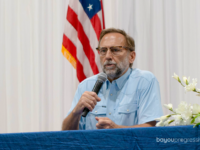







For many Louisiana voters, Nick Albares is still an introduction.
He is not a former statewide officeholder. He is not a longtime elected official with a built-in political base. And unlike some of the more familiar names in Louisiana Democratic politics, Albares comes out of the world of policy and nonprofit leadership more than the traditional candidate lane. A first-time Democratic candidate for the U.S. Senate, he is trying to build a campaign around healthcare, affordability and what he repeatedly calls “dignity, solutions and results.”
That message is not just branding. It is the clearest window into how Albares wants voters to understand both himself and the political moment.
In an interview with The Bayou Progressive, Albares framed his candidacy as a response to a country he sees sliding deeper into chaos, cruelty and personality-driven politics. He argued that Louisiana voters, regardless of party, want someone fighting for their interests rather than trying to prove proximity to Donald Trump.
“I think that Louisianans, no matter their political background, want someone who’s fighting for them and not just fighting to be closest to Donald Trump,” Albares said. “I think they want a leader that stands on their own two feet, who cares about advancing their interests.”
For Albares, that pitch is rooted in a personal story shaped by Katrina.
Born in New Orleans to parents from New Orleans, with family ties to St. Mary Parish, Albares said he stayed closely connected to Louisiana even after his family moved to Alabama when he was young. While studying at Notre Dame, he watched Hurricane Katrina devastate the Gulf Coast and said the catastrophe pushed him toward both service and public policy. He began leading groups to New Orleans to gut and rebuild homes, but quickly came to see the storm as more than a natural disaster.
“It wasn’t just houses that needed to be gutted and rebuilt,” he said. “It was about policies.”
That realization, he said, led him deeper into justice work and systems thinking. After studying theology with a focus on social ethics, he earned a master’s degree in public policy from Georgetown, worked at the Louisiana Budget Project, served in Governor John Bel Edwards’ administration and later joined Volunteers of America Southeast Louisiana.
That background gives Albares a coherent rationale for running. It also helps explain the style of his candidacy. He talks less like a natural bomb-thrower than a policy-minded, values-driven advocate trying to translate a governing philosophy into a statewide campaign.
The word he returns to more than any other is dignity.
Asked where he fits inside the Democratic Party, Albares declined the usual ideological shorthand and instead called himself a “dignity Democrat.”
“I believe in the dignity of every person, and that’s where our policy ought to start,” he said.
Even so, his positions were clear enough. Albares said he supports a constitutional amendment protecting abortion rights, arguing that politicians should not be making personal medical decisions for women. He said climate change is real, that Louisiana should trust science and invest in cleaner energy, but that any transition has to reckon with the state’s deep economic ties to oil and gas. And on healthcare, he described himself as supportive of a single-payer system while also emphasizing the immediate need to protect current coverage and reverse looming Medicaid cuts.
Healthcare, more than any other issue, seems to animate him.
When asked what policy he most enjoys discussing on the campaign trail, Albares pointed back to healthcare, but not in the narrow sense. He spoke about health as a broader measure of whether communities function, tying it to jobs, mental health, opportunity and the social conditions that shape whether people can live stable lives.
“Health, in my view, is a holistic perspective,” he said. “It really gets at the question of, what is the health of our cities, what’s the health of our communities and ultimately, our society, our nation.”
That broader framing is also central to how Albares talks about politics.
Rather than pitching himself as the loudest partisan in the room, he is trying to make the Democratic case sound less ideological than humane. He argues that Democrats can still compete in Louisiana if they stop surrendering to the idea that the state is unwinnable and start showing up, listening and connecting policy to the real pressures voters are under. He pointed to Louisiana’s relatively recent history of statewide Democratic victories and argued that too many Democrats have accepted a self-fulfilling prophecy about what is possible here.
On the trail, he said, even some Trump voters will stay in the conversation if Democrats are willing to actually have one.
“One of the things that we heard a lot was Democrats are just out of touch with people,” Albares said, arguing that the antidote is “authentically hearing people and seeing them and being in touch.”
His read on Trump’s appeal was less dismissive than many Democrats offer. Albares said some voters still associate Trump with business competence, while others respond to a strongman image that makes them feel seen. The answer, he argued, is not to water down Democratic values but to communicate them more plainly and more credibly.
That instinct may be one of the more politically useful things Albares brought to the conversation. But it also points to the challenge in front of him.
He is clearly trying to offer voters a more grounded, morally fluent Democratic message. At the same time, he is still a first-time candidate, and at times he sounds like one: careful, disciplined, and intent on returning to the safest and most durable architecture of his campaign language. The repeated invocations of dignity, unity, decency and shared values can sound persuasive, but they can also reveal a candidate still working to make his political voice feel fully lived-in rather than tightly managed.
There were, however, moments when Albares was more direct.
Asked whether he would support further war authorization in Iran, he answered bluntly: no. He called it a “reckless, impulsive war of choice” and argued Congress must be willing to check the executive branch.
And when the conversation turned to race — one of the unavoidable fault lines in any Louisiana Democratic primary — Albares gave an answer that tried to balance humility, history and responsibility. Asked how he would reassure Black voters that a white Democrat at the top of the ticket would still fight for their interests, he pointed to Louisiana’s long history of struggle over civil rights and voting rights and said that history demands more than rhetorical awareness.
“I take special care to remember the responsibility that I have,” he said, “to stand in solidarity with Black communities throughout the state of Louisiana, and I don’t take that lightly.”
For now, Albares is still in the phase of a campaign where much of the work is simply becoming legible to voters. He does not yet have the shorthand that comes with years in elected office or the instant recognition of a political brand built over time. What he does have is a coherent life story, a visible seriousness about policy, and a belief that Democrats should stop talking like managers of decline and start sounding like people who actually want to govern.
Whether that is enough is still an open question.
But Albares is plainly trying to answer a real one: what does it sound like when a Louisiana Democrat tries to make the case for government, for community and for basic human dignity in a state that has spent years being told to expect less from both politics and each other?