
















A special education teacher and union member is challenging Steve Scalise with a blunt promise: stop treating District 1 like an afterthought, and start “showing up.”
Lauren Jewett talks like someone who’s spent a career dealing with the consequences of systems that don’t work. Not in theory — in real time, with real people, and with no option to shrug and move on.
She traces that instinct back to her family. Growing up, she watched her aunt with Down Syndrome navigate a world that rarely builds itself around people who need support. Later, she spent more than 17 years in Louisiana classrooms as a National Board Certified special education teacher. Those experiences taught her a simple rule: when someone needs help, you don’t walk away. You show up.
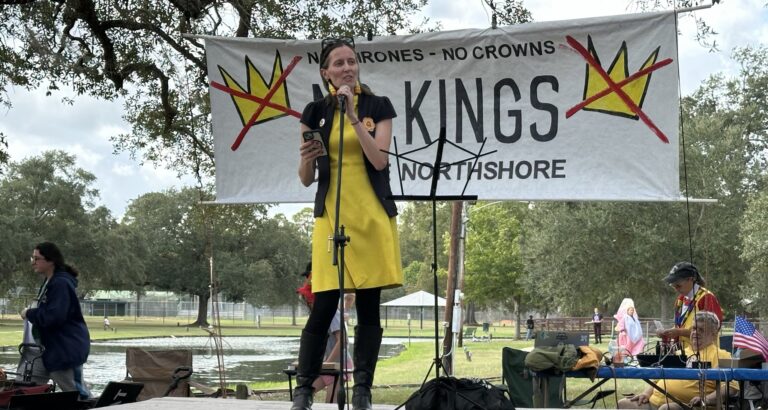
Jewett says she’s carried that same approach outside the classroom — through union work with United Teachers of New Orleans, community volunteering, delivering food, registering voters, and knocking doors for candidates she believed in. She also says her campaign has been built on physically being in the district — showing up at community events, meeting voters face-to-face, and spending time in the places politics usually flies over.

Now she’s applying that “show up” ethic to one of Louisiana’s most reliably Republican districts: Louisiana’s 1st Congressional District, represented by House Majority Leader Steve Scalise. Jewett’s critique isn’t primarily about personality. It’s about what she sees as a district getting the kind of representation that rewards Washington power accumulation more than it delivers tangible improvements back home. She argues the job should be measured in outcomes — whether families can stay insured, whether schools can serve the kids they have, whether disaster response works, whether coastal protection is treated like a priority instead of a regional inconvenience.
Her policy priorities follow naturally from that worldview: education, healthcare, and the environment — with an unusually Louisiana-specific emphasis on insurance, storms, and the costs that keep escalating for people who already feel squeezed.
Education is the clearest expression of her political identity. Jewett argues special education can’t survive on speeches and good intentions; it requires protected funding and federal follow-through. She points to the longstanding gap between what IDEA was supposed to deliver and what schools actually receive, and says the result is predictable: districts cut corners, and kids — especially kids with disabilities — pay the price. She also rejects the idea that schools exist to crank out test scores, framing teaching as “human work” that policymakers often misunderstand when they legislate from a distance.

On healthcare, Jewett calls it “a human right,” opposes cuts to Medicare, Social Security, and Medicaid, and argues Congress has repeatedly treated people’s survival as a bargaining chip — especially when safety net programs get held hostage in budget fights. She supports expanding what counts as basic care to include vision, dental, mental health, and sexual and reproductive healthcare, and backs the Women’s Health Protection Act to codify abortion rights nationally.
But it’s insurance where Jewett sounds most like a South Louisiana resident instead of a national candidate. She talks about the market like a kind of punishment for living here — and she grounds it in personal experience: after Ida, she had to switch carriers, and her premium is up more than 50% from pre-2020. She argues the federal government should invest heavily in mitigation so homes are more resilient and insurers have less justification to push costs onto consumers. She also calls for stricter scrutiny of premium hikes, and even raises the idea of a public insurance option that could cap premiums as an alternative to the private market. On auto insurance, she targets rating practices she calls discriminatory and predatory, pushing for rates based on driving record rather than proxies like zip code or credit score.
Jewett is similarly direct about disasters and flood policy. She warns against FEMA changes that could delay relief and shift costs onto states and families, recalling how after Ida, educators and neighbors built mutual aid networks while people waited on formal systems. On flood insurance, she argues the National Flood Insurance Program cannot be allowed to lapse, supports affordability tools like payment plans, and opposes privatization.
Her environmental argument is equally rooted in place: coastal restoration and storm protection aren’t optional in this district. She supports increased federal funding for Louisiana’s coastal work and backing litigation to hold oil and petrochemical companies accountable for environmental and health risks. She also takes a clear stance against carbon capture and storage projects near communities, citing a proposed carbon capture and storage (CCS) site in Sorrento near an elementary school as emblematic of a pattern Louisiana communities know too well: being asked to absorb long-term risk for someone else’s short-term solution.
When she contrasts herself with Scalise, Jewett frames it as a question of priorities, not just politics — and she argues his record on environmental regulation is part of the problem. One recent example: Scalise voted for H.J. Res. 35, a resolution to overturn an EPA rule implementing the “Waste Emissions Charge” — a methane-focused provision aimed at reducing leaks and flaring in oil and gas systems. Jewett’s broader point is that permitting rollbacks and regulatory retrenchment may play well in national party politics, but in coastal Louisiana they carry a real downstream cost.
And she doesn’t stop at kitchen-table issues. Jewett makes a constitutional argument, too. She says Congress should honor its oath consistently, not selectively, and she supports structural reforms like banning stock trading by members of Congress, overturning Citizens United, and term limits — alongside a more aggressive posture toward executive overreach than most challengers are willing to put on the record.
Jewett’s closing case is blunt: she’s asking voters whether they’re satisfied with a representative who builds national power while local problems compound — or whether they want someone who treats representation as a service job. She puts it in the simplest terms she knows:
“If elected, I will show up for the constituents of District 1 like I show up for my students.”