














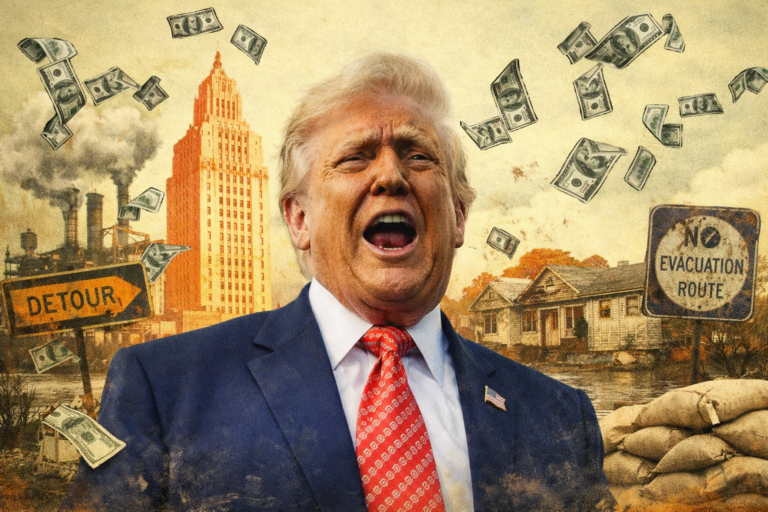
President Donald Trump’s proposed fiscal year 2027 budget is not law – yet.
Congress still has to pass actual spending bills. But presidential budgets still matter because they show what the White House is trying to protect, what it is willing to cut, and who it expects to absorb the damage. This one is pretty clear: Trump wants to shrink a wide range of domestic programs while boosting defense and immigration enforcement. The White House says non-defense discretionary spending would be cut by about 10 percent, while defense spending would rise sharply.
That formula is especially dangerous for Louisiana.
This is a state with high poverty, high energy burdens, repeated hurricane and flood threats, aging water systems, and deep shortages in affordable housing. So when Washington targets the very programs that help people pay utility bills, keep housing stable, prepare for disasters, upgrade infrastructure, and support underfunded schools, Louisiana is one of the places most likely to feel it first and hardest.
Because federal and state budget documents are released on different timetables, the Louisiana figures in this story come from the most recent program-specific state allocations, grant profiles, and planning documents available for each targeted federal program, generally from fiscal years 2024 through 2026. They are meant to show how exposed Louisiana is to the cuts Trump is proposing. And when you put those federal risks next to Jeff Landry’s budget and the Landry administration’s current budget posture, there is not much evidence the state is in a position to casually replace major federal losses on its own. The state’s FY 2026-2027 executive budget materials show a tighter overall posture, including a lower Department of Education total than the existing operating budget baseline.
Not every cut in Trump’s budget would hit on the same timeline. Some would show up almost immediately in household finances. Others would do slower but deeper damage by weakening the systems Louisiana depends on behind the scenes. Make no mistake: all of these cuts are bad. But ranked by urgency and scope, these are the five biggest Louisiana impacts:
1. Utility-bill help and anti-poverty services
If you’re asking which part of this budget would hurt fastest, this is probably it.
The Low Income Home Energy Assistance Program, or LIHEAP, helps low-income households pay heating and cooling bills. In Louisiana, that matters a lot because the summer heat is not just uncomfortable. It is dangerous. Louisiana’s LIHEAP profile shows more than 80,000 households received cooling assistance in FY 2024, and the state’s FY 2026 LIHEAP funding was listed at just over $51.2 million. The program exists because a lot of households do not have enough margin to absorb a big utility spike on their own.
Trump’s budget also targets the Community Services Block Grant, or CSBG. That is a federal anti-poverty block grant that flows to local community action agencies, which are often the groups helping families with rent, utilities, food, transportation, and emergency stabilization. Louisiana’s current CSBG state plan projects about $15.98 million distributed through local agencies.
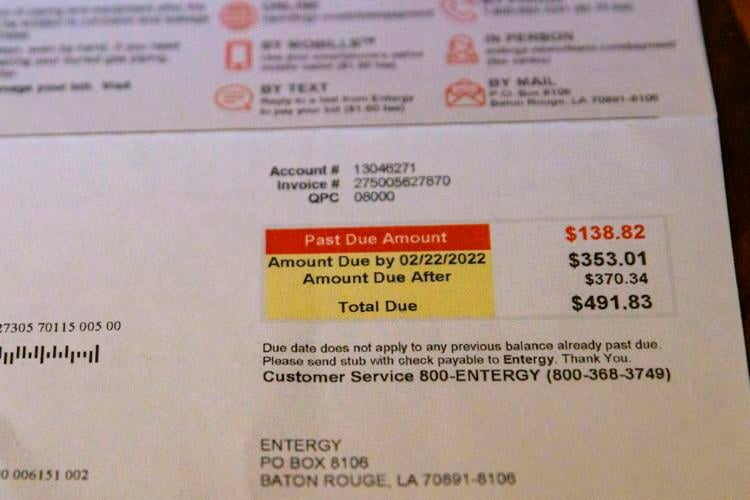
So this is not some obscure policy fight. If LIHEAP and CSBG get cut or eliminated, the impact looks like more unpaid Entergy bills, more families in line at nonprofits, and more people falling from financial stress into full-blown crisis.
That is why this ranks first. It would hit quickly, and it would hit people directly.
2. Housing and homelessness

The second-biggest blow would likely be housing.
Trump’s budget goes after several of the federal programs that help Louisiana cities, parishes, and nonprofits deal with blight, build or rehabilitate affordable housing, and respond to homelessness.
One of them is the Community Development Block Grant, or CDBG. CDBG is a flexible federal program that communities use for things like neighborhood redevelopment, housing rehabilitation, basic infrastructure, and economic-development projects. Louisiana’s own documents projected roughly $22 million in FY 2025 Community Development Block Grant funding for the state program, and Louisiana Housing Corporation describes CDBG as a key flexible tool for local governments tackling serious community-development problems.
Another is the HOME Investment Partnerships Program, usually just called HOME. HOME helps states and local governments finance affordable housing construction, rehabilitation, rental assistance, and homeownership support. Louisiana’s HOME allocation was listed at about $16.7 million for FY 2025 in HUD budget materials.
The same broader housing ecosystem includes the Emergency Solutions Grant, or ESG, which helps fund shelter operations, rapid rehousing, and homelessness prevention, and Housing Opportunities for Persons With AIDS, or HOPWA, which supports housing for people living with HIV/AIDS. These are not side programs. They are part of the patchwork keeping Louisiana’s housing crisis from getting worse even faster.
And Louisiana’s housing problems are not theoretical. In a state where storms damage homes regularly, rents have risen, and affordable units are already too scarce, taking away major federal housing tools would ripple through the entire system — local governments, service providers, renters, and families already on the edge.
3. Disaster preparedness and resilience

This one should be obvious in Louisiana, but it still needs to be said plainly: cutting disaster-preparedness funding in this state is reckless.
Trump’s budget would cut FEMA’s non-disaster grant programs. Those are the grants that help governments prepare before disaster hits. That includes emergency planning, communications upgrades, flood-mitigation work, emergency operations centers, cybersecurity, and related readiness projects.
A 2024 presentation to the Louisiana Emergency Management Conference showed the Governor’s Office of Homeland Security and Emergency Preparedness, or GOHSEP, carrying years of these kinds of open grants, including emergency management performance grants, homeland security grants, flood-mitigation awards, and cybersecurity funding.
For a reader outside the policy weeds, the simplest way to understand this is: these are the dollars that help Louisiana be less screwed when the next hurricane, flood, or infrastructure emergency arrives.
They are not the cleanup money after the fact. They are the preparation money that can reduce the scale of the disaster in the first place.
In Louisiana, that is not overhead. That is survival.
4. Water infrastructure and environmental protection

This category is easy to underestimate because the pain often arrives through systems, not headlines. But the stakes are huge.
Louisiana depends heavily on federal State Revolving Funds, which are long-running financing programs that help communities pay for drinking water and wastewater upgrades. These are the funds that help towns replace failing pipes, upgrade treatment plants, and fix sewer and stormwater systems that local tax bases often cannot support on their own.
Louisiana’s Drinking Water State Revolving Fund plan said the state was eligible for about $108.4 million in federal fiscal year 2024 Infrastructure Investment and Jobs Act funding through drinking-water grant categories. Louisiana’s Clean Water State Revolving Fund materials say the program has awarded more than $1.3 billion over time and expected to fund at least $180.3 million in high-priority projects in state fiscal year 2024.
That matters because Louisiana has real infrastructure problems: aging systems, recurring boil advisories, drainage failures, sewer weaknesses, and small communities that cannot just float massive local fixes by themselves.
Trump’s budget also points toward a weaker Environmental Protection Agency overall. In Louisiana, that has real consequences beyond pipes. It means weaker oversight in a state where entire communities already believe they are under-protected from pollution and industrial exposure.
So this is not just a story about grants. It is a story about whether people can trust the water, whether towns can modernize failing systems, and whether the federal government is still willing to help.
5. Education and the federal support system around public schools

Education ranks fifth not because it matters less, but because this section of the budget is more complicated than some of the cleaner cuts above.
Trump is not proposing to erase every major education funding stream in one shot. For example, Title I, Part A — the big federal program that sends extra money to school districts serving large numbers of low-income students — still remains a major program. Title I is part of the Elementary and Secondary Education Act, the main federal K-12 law, and it helps districts pay for academic support, tutoring, reading and math intervention, and other services in high-poverty schools. Federal Education Department data show Louisiana has received hundreds of millions of dollars annually through Title I in recent years.
The same is true for Individuals with Disabilities Education Act funding, or IDEA. That is the main federal law supporting special education. Louisiana’s exposure there is also substantial.
But the bigger issue is the direction of travel. Trump’s budget still points toward a smaller federal role in public education overall, including cuts, consolidations, or eliminations affecting the programs around the edges — the ones supporting staffing, school improvement, specialized services, workforce training, and higher education.
That matters because schools do not run on one giant formula alone. They depend on layers of support. Strip away enough of the surrounding layers, and districts start feeling it even if the best-known acronym survives.
And this is where Jeff Landry’s budget needs to be handled honestly. The Landry administration’s budget does not prove Louisiana is already making the exact same cuts Trump wants. That would be too sloppy. But it does show a state budget that is not obviously flush with spare capacity. So if Washington pulls back further, Louisiana is not in some especially strong position to absorb the shock without painful tradeoffs.
The larger point
There are other damaging pieces of this budget too. Rural-development cuts would hurt parishes that rely on outside help for basic facilities and local growth. Environmental-justice cuts would hit a state where many communities already feel treated as sacrifice zones. And the overall moral logic of the budget is pretty hard to miss: less help for poor and working families, less investment in public systems, and more money for punishment, militarization, and control.
That is the real Louisiana story in Trump’s 2027 budget.
It targets the places where the state is already weakest: high utility burdens, housing instability, disaster exposure, aging infrastructure, and under-resourced public institutions. And when you place that next to the reality of Jeff Landry’s budget, there is not much reason to think Louisiana could simply step in and replace what Washington takes away.
This is not just a conservative budget. For Louisiana, it is a budget aimed directly at the stress fractures.
Read the Trump budget for yourself:
budget_fy2027