
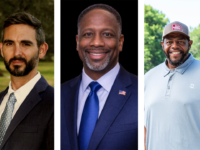
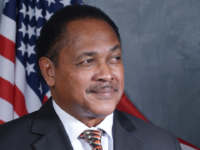






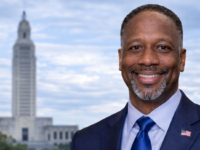


Rev. Larry Foy is running for Congress with an argument Louisiana voters do not hear very often from a candidate shaped by the church: faith is not a detour from progressive politics. It is what brought him there.
For Foy, a Democrat running in Louisiana’s 5th Congressional District, the through line from ministry to public office is not complicated. “In our tradition, especially Black tradition, there’s a saying that prayer changes things. I believe that,” he said. “But I have come to recognize and to realize that it’s public policy that brings about the change we desire.” That, more than anything else, is the rationale for his candidacy. Congress, he said, is where he believes he can now do the most good for “everyday, ordinary working people.”
That is the frame Foy returns to again and again. He is not running as a preacher dabbling in politics. He is running as a minister, educator, and organizer making the case that moral conviction means little if it never hardens into law, budgets, or representation.
Born in Monroe and raised in Winnsboro, Foy left Louisiana after high school and spent years in Illinois and California, earning degrees in religion, philosophy, theology, ethics, and public policy before teaching theology and ethics at the college level. In Los Angeles, he said, his work eventually pulled him beyond the classroom and deeper into direct service and justice work, including time leading Union Rescue Mission and later working with organizations focused on racial justice and decarceration. His story is not the usual candidate résumé, and that helps explain why he talks less like a conventional office-seeker than someone who arrived at politics after years of trying to solve the same problems through other institutions first.
He also speaks about Louisiana less like a place he came back to than a place he never really left. Foy said he returned regularly over the years because his family remained here. And when he talks about the criminal legal system, he is not speaking in abstractions. His brother died last year after spending more than 40 years in Angola, an experience that now clearly informs both his politics and his sense of what public policy can do to a life, a family, and a community. That personal history sits behind his interest in serving on the House Judiciary Committee if elected. “I’d love to serve on the Judicial Committee,” he said, citing his brother’s incarceration and his belief that both the death penalty and life without parole are inhumane. “You have death by execution, but then you also have death by way of life without the possibility of parole. Both are inhumane.”
Foy also named Appropriations as a desired committee assignment, for a more straightforward reason: money. “That’s where a lot of the funding lies,” he said. “And I want to make sure that the people of the 5th District get every dollar, every dollar.” It is an ambitious answer for a first-time congressional candidate, but it is also a useful one. It suggests Foy has at least thought beyond slogans and into where power actually sits in Washington.
His political consciousness, he said, began long before any of that. Foy recalled seeing his father vote after the Voting Rights Act and watching the dignity that act of citizenship gave him. That memory helped shape how he understood politics from an early age. He says he has followed politics since childhood and has not missed an election since turning 18. What he is offering voters now is not a late-life whim or a purely symbolic run, but the next step in a political identity he says has been with him for decades.
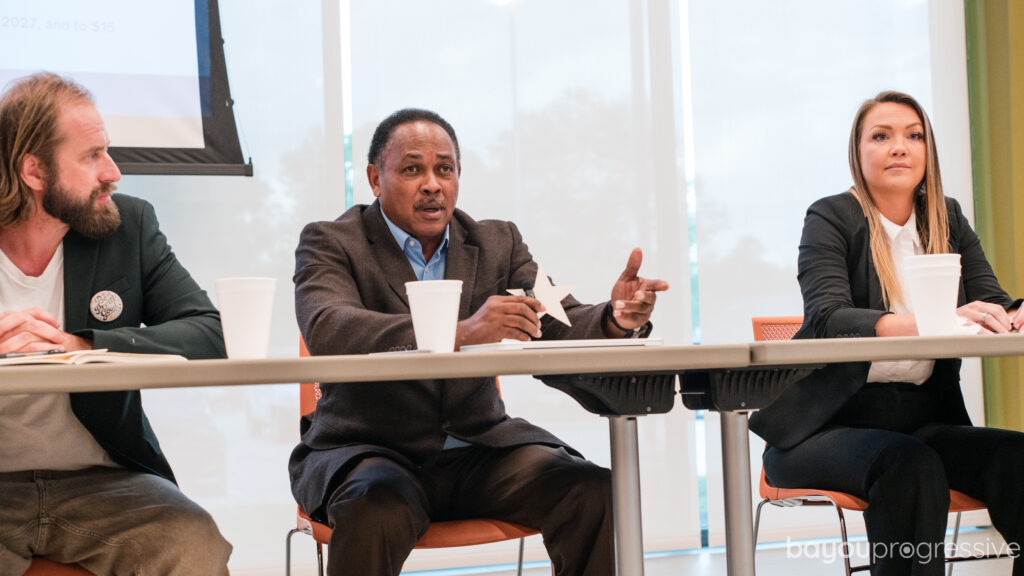
Asked how he balances his role as a minister with the practical demands of modern politics, Foy rejected the premise that the two are naturally at odds. “Religion helps shape politics, has always,” he said. For him, the real test is not whether a candidate quotes Scripture or invokes God, but whether the policies they support respect human dignity and serve the common good. “If legislation does not respect and honor the human dignity of people, especially people who are marginalized, then I cannot be a part of that legislation,” he said. “I will not support any legislation that undermines the human dignity of people.”
That is also how he explains the relationship between his Christianity and his politics. “I’m a firm believer in Jesus Christ,” Foy said, “and by that I mean I’m a firm believer in his mission. His mission was always to liberate the oppressed, to serve the poor and to ensure that everybody was welcome.” In a political culture where public Christianity is often used to signal conservatism, that is a notably different kind of religious language. Foy is not using faith to sanctify exclusion. He is using it to argue for a politics centered on the poor, the marginalized, and the dignity of people too often treated as disposable.
That view shapes how he talks about everything from LGBTQ rights to abortion. On both, Foy argued that conservative Christians have too often “boxed God in,” using theology to rationalize dehumanization rather than resist it. His answer on abortion was framed in terms of both women’s autonomy and “quality of life,” with Foy arguing that pregnancy decisions should belong to women in consultation with doctors and family, not the state. Whether one agrees with him or not, the answer fit the broader logic of his candidacy: public policy should be measured not by ideological purity, but by whether it reflects human dignity and the realities people actually live in.
On the campaign trail, Foy says the needs he hears from voters are more concrete than ideological. “For the most part, people want jobs with living wages,” he said. “People really want to work.” He said voters want meaningful jobs, stable bills, food on the table, and a representative who will not “sell out” once they get to Washington. He also said younger people often want to stay in Louisiana but feel like there are too few real options to build a future here.
That concern over wages, poverty, and mobility is central to his campaign, but healthcare is where Foy sounds especially urgent. “The health care issue here in the state of Louisiana is just horrific,” he said, pointing to the danger that proposed Medicaid cuts could trigger more closures or service reductions in already fragile rural healthcare systems. For parts of northeast Louisiana, he argued, that could mean people traveling extraordinary distances simply to receive basic care. “It’s absolutely horrible,” he said. “It’s morally reprehensible that people have to travel so far, will have to travel so far, just to get medical assistance and to have their medical needs addressed.”
He speaks about poverty in similar terms. Louisiana, he argues, is not poor because it lacks resources. It is poor because of “bad public policy” and “failed leadership.” He pointed to stubborn poverty rates in northeast Louisiana as evidence that the state’s suffering is not inevitable, but chosen through policy. “No one should be living in poverty in America,” he said, “and no one should be living in poverty in Louisiana.”
That same approach came through in his answer about the massive AI data center project in the Rayville area. Foy did not reject the project out of hand. He called it a “mixed bag.” Louisiana needs good-paying jobs, he said, but it does not need another version of the same old bargain, where corporations get tax breaks, politicians celebrate ribbon cuttings, and local communities are left with less than promised. “The community must be at the decision-making process,” Foy said, arguing for community benefit agreements and local hiring requirements early in negotiations, not as an afterthought. He pointed to the danger that the best jobs will once again go to workers brought in from outside the district while local residents are left with the talking points.
One of the more revealing moments in the interview came when the conversation turned to the Black church. Foy did not make that critique the centerpiece of his campaign, but when asked, he did not duck it. He said the Black church has historically been “in the forefront of the movement for justice, equality and freedom,” but argued that over time, too much of that prophetic tradition gave way to something thinner. “The black church kind of lost its prophetic tradition,” he said. By the 1990s and 2000s, he argued, too many churches had moved “away from the prophetic tradition to the prophets” — from justice-centered witness to “profiteering” and prosperity preaching. “We need to do more,” he said. “We need to become more actively involved.”
That exchange was revealing not because it proves the Black church is a defining campaign issue for Foy, but because it clarifies what kind of leadership he values. When asked about whether standards for leadership in the pulpit have slipped, especially intellectually, Foy agreed that some leaders have settled for charisma without enough rigor or growth. “There are persons who do not aspire to improve themselves theologically or biblically,” he said. That may once have been understandable, he added, when access to formal training was far more limited. “That’s inexcusable today.” He said younger people are more informed, more aware, and have harder questions than many churches are prepared to answer.
The same instinct shows up in how he talks about the Democratic Party. Asked to define the difference between Democrats and Republicans in 2026, Foy said Democrats are, at least in theory, more inclusive. But he also argued that Democrats too often fail to act with conviction once they hold power. “We fail to stand on that which we claim to be for,” he said. Republicans, by contrast, “tell you what they are going to do, and then when they get elected, they do it.” His conclusion was blunt: “Democrats need to grow some courage and grow some thick skin and act on what they say they’re going to do.”
That may be the best way to understand Foy’s candidacy. He is not just running as a preacher, and not just as another Democrat with a list of issue positions. He is running as someone who believes moral language should cost something — that if you say you care about dignity, justice, and ordinary people, that belief should show up in committee priorities, wage policy, healthcare fights, criminal justice reform, and how you govern once you get power.
He put it more simply when asked what he wants voters to know about him. “I am a person of profound faith,” Foy said, and that faith, he said, means he will “honor and treat everyone with human dignity.” In a race where candidates can easily blur together, that is the core argument he is making: not that faith should excuse politics, but that it should demand more from it.