







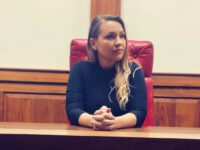


Democratic congressional candidate Tania Nyman is not running as a generic issue-sheet progressive.
In an interview with The Bayou Progressive, Nyman framed her candidacy in Louisiana’s 5th Congressional District as an extension of years of advocacy around public schools, fair maps, democratic accountability and the preservation of public institutions she argues are steadily being hollowed out by privatization, concentrated wealth and political systems designed to dilute public control.
For Baton Rouge voters who know her from fights over East Baton Rouge schools and the St. George incorporation effort, that is familiar terrain. But Nyman said her move into congressional politics follows the same logic that drove her earlier campaigns for school board and Metro Council: stepping into races where Republicans were poised to win without opposition and using the campaign itself to elevate information and arguments she believed the public was not hearing.
“I’m always asking, what can I do within my power to affect some good in the community and in the world at large?” Nyman said, recalling her first run for school board after seeing then-incumbent Mike Gaudet positioned to coast to reelection without a challenge. With little money but years of accumulated research from her advocacy work, she said she put her name on the ballot, built a website and tried to force issues into the public conversation.
That same instinct, she said, pushed her into a Metro Council race during the St. George fight. Nyman said she believed too many local leaders either lacked the historical context or were unwilling to push back against what she viewed as a deeply harmful breakaway effort. Even if she did not win, she wanted voters and public officials to have access to the research and arguments she believed local media and mainstream political discourse were not adequately surfacing.
That St. George fight remains central to how Nyman understands politics.
She argued the movement was not just about a city incorporation or a school district in the narrow procedural sense, but part of a broader pattern in Louisiana in which governance structures are manipulated to protect wealth, preserve exclusion and weaken democratic control. She described the fight as inseparable from race, class and public education, and said the push to carve out St. George was driven in part by a refusal to remain tied to a majority-Black parish school system and by a broader effort to escape shared public institutions rather than improve them.
Nyman went further, arguing that Louisiana’s school accountability system and charter laws have helped create a pipeline from under-resourced public schools to privatization, especially in higher-poverty and disproportionately Black communities. In her telling, those systems do not merely weaken public education. They also weaken voting rights by transferring decision-making power from elected school boards to unelected charter operators and private interests.
“The fight for public education is because it’s the cornerstone of a healthy democracy,” she said. “It was always important to me that my children go to public schools.” She argued that public schools remain one of the few institutions where people from different racial, religious and economic backgrounds are meant to encounter one another as equals, and said that class segregation is too often ignored in conversations about education policy.
That belief in public institutions as democratic infrastructure is the clearest throughline in Nyman’s campaign.
Asked what her local fights reveal about the national moment, Nyman was blunt: “I think our democracy is under threat.” She pointed to voting rights, fair maps, dark money and the influence of Citizens United as evidence that the country is moving further away from meaningful democratic control rather than closer to it. Even at the federal level, she said, her focus would remain the same: defending democratic rights and scrutinizing how federal policy is implemented on the ground, especially when seemingly well-intentioned programs can be twisted by state and local actors.
That skepticism toward both privatization and technocratic policymaking shapes much of Nyman’s worldview.
She criticized both parties’ roles in education policy, arguing that Republicans openly pushed accountability regimes that punished high-poverty districts while Democrats too often embraced “market” language that functioned as a softer route to privatization. She cited Louisiana’s experience with charter expansion and the fallout of federal-era education reforms as examples of how big national policy ambitions can be undermined or repurposed locally.
On economics, Nyman’s politics are even more explicitly old-school liberal.
She argued Social Security’s long-term funding issues could be substantially addressed by raising the payroll tax cap rather than cutting benefits, and she called for new tax brackets beginning at $1 million in income to claw back revenue lost through Trump-era tax cuts. She also argued that a more aggressively progressive tax code should work in tandem with a living wage, both to reduce inequality and to prevent extreme executive compensation from continuing to outrun worker pay.
For Nyman, those are not separate issues from the fight over public services. They are part of the same larger question: what government is for, and what happens when profit becomes the organizing principle of every sector of public life.
Asked how she distinguishes between areas where government should act directly and areas where private markets should take the lead, Nyman said she starts with a basic test: whether the introduction of a profit motive creates a corrupting social incentive. Privatized prisons and for-profit healthcare, she said, are clear examples of sectors where private profit can distort public purpose, whether by encouraging incarceration or by denying care to protect margins.
At the same time, Nyman said she is not arguing that government should do everything. She said private competition can serve as a useful check on public institutions, but only if voters understand that private interests also have a constant incentive to undermine public systems in order to justify taking them over. In her view, that dynamic has been at work for decades in public education and public healthcare, and too often goes unrecognized until the damage is already done.
One of her most vivid examples came from closer to home.
Nyman argued that the privatization of local trash collection in East Baton Rouge Parish illustrates how “smaller government” can actually mean weaker communities: fewer stable jobs, worse benefits, more economic insecurity and ultimately more strain on public resources. What gets sold to voters as efficiency, she argued, often amounts to transferring public functions into private hands so shareholders and executives can profit while workers and communities lose stability.
That line of argument is a natural fit for how Nyman describes herself politically: a “Newer Deal Democrat,” borrowing from the New Deal tradition of using government not simply as a referee but as an instrument for collective stability, economic dignity and public investment.
It also makes her a somewhat unusual candidate in a modern campaign environment that often rewards brevity over exposition. Nyman is plainly more comfortable unpacking the history and structure behind an issue than reducing it to a bumper sticker. She acknowledged as much in the interview, joking more than once about her tendency to go long and her need to spend more time listening in communities across the sprawling district. But she also suggested that what some see as over-explaining is part of what qualifies her for office: a habit of digging for information, interrogating narratives and trying to make decisions based on more than just branding or instinct.
That could prove either an asset or a challenge in a district as large and politically difficult as the 5th, where Democrats cannot afford to assume voters will simply share their premises. Nyman acknowledged that reality directly, saying she still has much to learn about rural parts of the district and that she plans to do that by attending forums, meeting voters and listening as much as she talks. But she rejected the idea that her campaign is merely symbolic.
“Oh, absolutely,” she said when asked whether she is running to win. “I honestly, I really think it’s flippable. But win or lose, we win by raising the issues.”
That may be the clearest distillation of her candidacy.
Nyman is running to win the seat. But she is also plainly running to force a deeper argument into the race – about democracy, public goods, privatization, class and whether government still has any obligation to preserve institutions that do not exist to turn a profit.
In a political culture dominated by slogans, consultants and the constant temptation to say less, Nyman is betting there is still room for a candidate who wants to explain not just what she believes, but why.