



















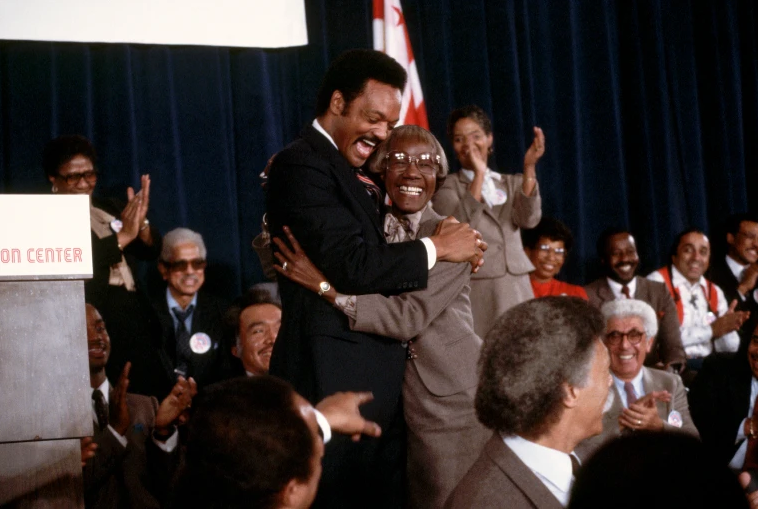
Rev. Jesse Jackson died today in Chicago at the age of 84.
If you’re looking for the neat version of American political history, Jackson is an easy footnote: two presidential runs, no nomination, no presidency. The kind of “historic” candidacy people praise after the fact precisely because it never has to win.
That version is lazy. And it’s wrong.
Jackson’s 1984 and 1988 campaigns didn’t come close to putting him in the Oval Office. But they did something arguably more important for Black political power inside the Democratic Party: they proved, in the bright lights of national politics, that Black voters were not a constituency to be politely consulted. They were a force that could shape the outcome, shift the platform, and demand a different coalition – one that wasn’t built around begging for scraps.
That is the connective tissue to Barack Obama in 2008. As the saying goes, Jesse walked so Barack could run.
Not because Obama was “Jackson’s successor” in any simplistic sense, and not because Jackson “made Obama possible” in some mystical, linear destiny narrative. But because Jackson expanded the imaginable, then built machinery around that imagination: turnout, coalition-building, delegate math, and the stubborn refusal to accept that the party’s future could be decided without the people who kept showing up for it.
Jackson’s campaigns were a warning shot to the Democratic establishment: you can’t keep treating Black voters like the engine of your coalition while acting like we’re optional when it’s time to pick the driver.
In 1984, Jackson won about 18% of the Democratic primary vote nationwide and carried five contests – including Louisiana. That last part matters more than most people realize. Louisiana wasn’t “supposed” to be part of a national breakthrough story. Yet Jackson went into the Deep South and demonstrated that when Black voters are activated, they can tilt the terrain – even in states the party often writes off as either conservative by default or permanently “complicated.”
Then came 1988 – the campaign people still underestimate because they only remember the ending. Jackson didn’t win the nomination, but he won 13 contests and captured roughly 29% of the primary vote, emerging as a serious national contender in a crowded field.
Zoom in on Louisiana again, because the South is the whole point of this argument.
In the 1988 Louisiana Democratic presidential primary, Jackson finished first with about 35% of the vote. That wasn’t a symbolic win. It was a practical demonstration that in a state where Black voters are central to any Democratic coalition, the ceiling is not “being heard.” The ceiling is how much power we’re willing to exercise.
And Jackson understood that exercising power requires more than inspiration. It requires organization. It requires a coalition that isn’t confined to respectability politics or the narrow permission structure of “electability” as defined by nervous donors and editorial boards. Jackson’s Rainbow Coalition politics — multiracial, working-class, unapologetically focused on economic justice — wasn’t a branding exercise. It was a blueprint.
That blueprint shows up in Obama’s rise, even where the styles differ.
Obama’s 2008 coalition was famously broader: young voters, independents, white liberals but perhaps most importantly – and certainly hard earned – were Black voters turning out in massive numbers in key contests. His win in South Carolina’s Democratic primary, powered heavily by Black voters, was one of the early moments that forced the party to stop treating him as a novelty and start treating him as plausible. The point isn’t that Jackson and Obama ran the same race. The point is that Jackson helped build a party reality where a Black candidate could run a national race that wasn’t confined to the “Black lane,” and where the political world had already been forced — twice — to watch Black voters reorganize the scoreboard.
There’s also a more uncomfortable connection between Jackson and Obama that we don’t talk about enough: Jackson’s campaigns were a direct confrontation with Democratic complacency, while Obama’s success sometimes became an excuse for complacency. After 2008, too many people treated the election of the first Black president as proof that the job was basically done, and that the rest was just managing the brand. History has been punishing that delusion ever since.
Which brings this back home — to Baton Rouge, to South Louisiana, to the parts of the South where Black people are not a small slice of the electorate but the backbone of it.
Jackson’s legacy here isn’t about nostalgia. It’s about discipline and audacity. He reminded Black voters, loudly and repeatedly, that dignity is not something you ask permission for. “I am somebody” wasn’t a cute slogan. It was a political demand: act like you matter, and make the system respond accordingly.
And if we’re being honest, that’s exactly where modern Black politics in many Southern cities has gotten lazy – not at the voter level, but at the leadership level. Too many so-called leaders have grown comfortable managing a dependable Black electorate rather than mobilizing it. Too many have convinced themselves that survival inside local machines is the same thing as progress. Too many have traded Jackson’s audacity for ribbon-cuttings and backroom arrangements, then call it “pragmatism.”
But Jackson proved that “pragmatism” without vision is just fear wearing a suit.
He proved you can start with less – fewer endorsements, fewer donors, less institutional permission – and still force the country to reckon with you if you organize people who’ve been taught to expect nothing.
So if we’re going to write about Jesse Jackson today, we should tell the truth about what he actually did.
He didn’t become president. He changed the terms of the argument. He made Black political power visible in a way the Democratic Party could not ignore, and he did it while insisting that the point of power is not proximity to decision-makers—it’s accountability over them.
Barack Obama’s historic 2008 victory didn’t arrive from nowhere. It landed on ground that had already been fought over.
Jackson helped fight for that ground. The question now is whether we’re going to keep it — or let it be washed away by small politics dressed up as inevitability.